Visual Proof of the Pythagorean Theorem
The Pythagorean theorem is one of the most fundamental principles in geometry, stating that in a right-angled triangle, the square of the length of the hypotenuse (c) is equal to the sum of the squares of the lengths of the other two sides (a and b). This relationship is expressed as ( a^2 + b^2 = c^2 ). While this theorem is often memorized, a visual proof can provide a deeper understanding of why this relationship holds true.
Why this matters
Understanding the Pythagorean theorem through a visual proof can make the concept more intuitive. By seeing how the areas of the squares on the sides of a right triangle relate to each other, one can grasp the theorem's essence without relying solely on memorization. This approach is particularly useful for visual learners and those who prefer to see mathematical principles in action.
Main discussion
The Basics of the Pythagorean Theorem
The theorem is named after the ancient Greek mathematician Pythagoras, although knowledge of the relationship was present in earlier civilizations. The theorem applies to any right-angled triangle, and it has numerous applications in fields such as architecture, navigation, and physics.
Visual Proof with Affine Transformations
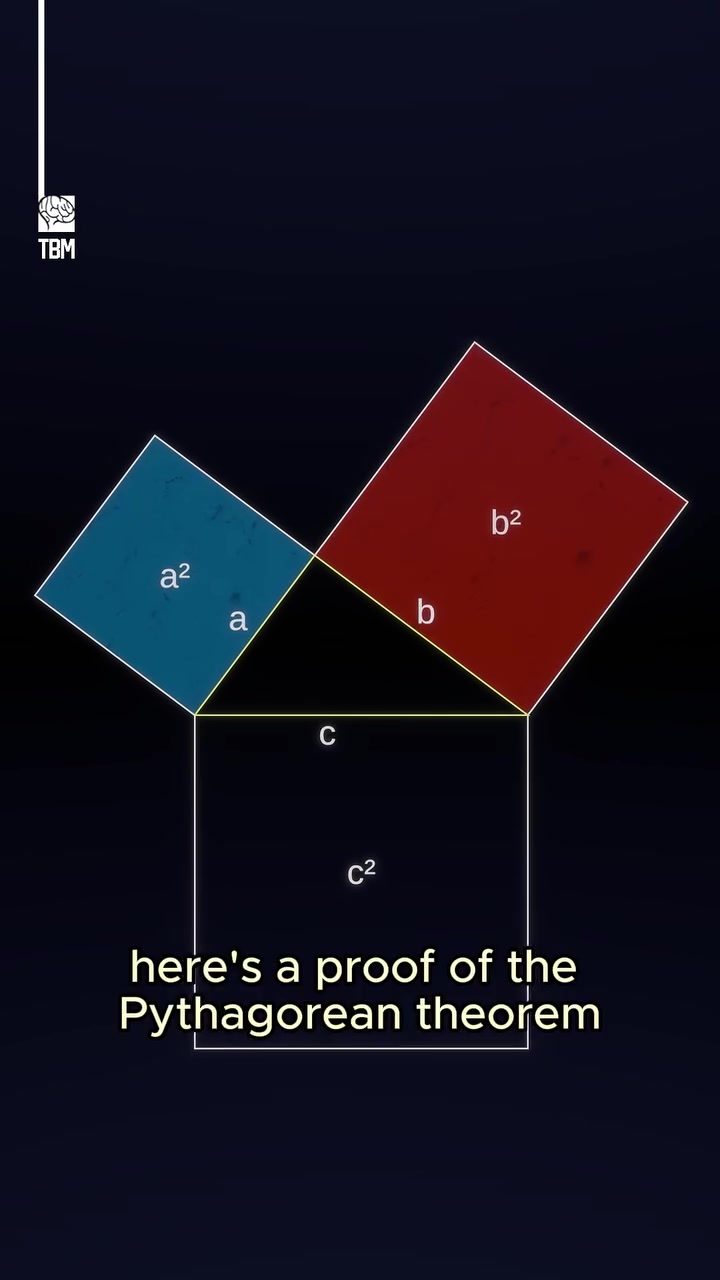
To visualize the proof, start with a right triangle with sides labeled a and b, and the hypotenuse labeled c. Draw a square on each of the three sides of the triangle. The areas of these squares are ( a^2 ), ( b^2 ), and ( c^2 ) respectively. The goal is to show that the combined area of the squares on sides a and b is equal to the area of the square on the hypotenuse c.
Step-by-Step Transformation
-
Initial Setup: Begin with a right triangle and draw squares on each of its sides. Highlight the squares on sides a and b, which have areas ( a^2 ) and ( b^2 ) respectively.
-
Affine Transformations: Perform a series of area-preserving affine transformations on the highlighted squares. These transformations include shearing and rotating the squares without changing their areas.
-
Shearing and Rotation: First, shear the squares to the side. This changes their shape but keeps their area intact. Next, rotate the regions to align them with the square on the hypotenuse. Finally, shear them again to fit perfectly into the square on side c.
-
Final Configuration: Observe that after these transformations, the shapes have changed, but their total area remains the same. The combined area of the squares on sides a and b now fits perfectly into the square on the hypotenuse.
Key Insights
Through this visual proof, it becomes clear that the area of the square on the hypotenuse (c²) is exactly equal to the sum of the areas of the squares on the other two sides (a² + b²). This visual representation makes the theorem more accessible and easier to understand.
Practical tips
Applying the Visual Proof
To apply this visual proof in practice, consider the following tips:
- Draw the Triangle and Squares: Use graph paper or a digital drawing tool to sketch a right triangle and draw squares on each side.
- Highlight the Relevant Areas: Clearly mark the areas of the squares on sides a and b.
- Perform the Transformations: Carefully execute the shearing and rotating steps to see how the areas transform but remain constant.
- Verify the Result: Ensure that the combined area of the transformed squares fits perfectly into the square on the hypotenuse.
Teaching the Theorem
For educators, this visual proof can be a valuable teaching tool. By demonstrating the theorem visually, students can better grasp the concept and see the relationships between the areas of the squares. This hands-on approach can make the learning process more engaging and effective.
Important takeaways
- The Pythagorean theorem states that in a right-angled triangle, ( a^2 + b^2 = c^2 ).
- A visual proof using affine transformations can make the theorem more understandable.
- Affine transformations, such as shearing and rotating, preserve the area of the shapes involved.
- The combined area of the squares on sides a and b equals the area of the square on the hypotenuse.
Conclusion
The visual proof of the Pythagorean theorem provides a clear and satisfying explanation of why ( a^2 + b^2 = c^2 ) holds true. By using affine transformations, the proof demonstrates that the areas of the squares on the sides of a right triangle can be rearranged to fit perfectly into the square on the hypotenuse. This method not only makes the theorem more intuitive but also highlights the beauty and elegance of geometric principles.
Watch the Reel
Related deep dives
Similar reads based on topic and creator.

Recent articles
Fresh deep dives from the latest Reels we unpacked.




Comments
Be the first to comment.