The U.S. Dollar's Role in Portfolio Diversification
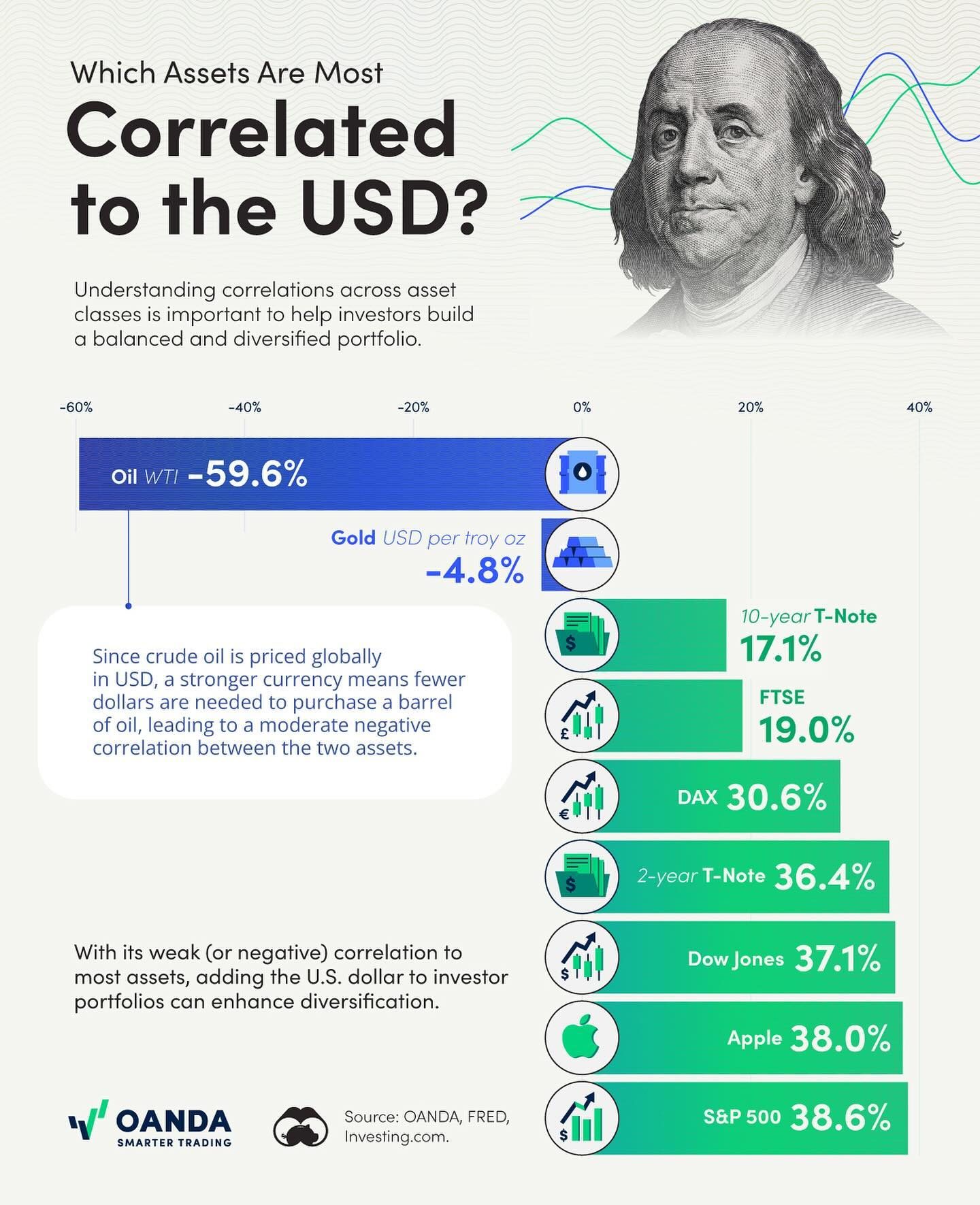
Understanding how the U.S. dollar (USD) correlates with various assets is crucial for investors looking to diversify their portfolios. The USD shows weak correlations with major U.S. equities, including the S&P 500, Apple’s stock, and the Dow Jones. This insight suggests that including the USD in a portfolio can enhance diversification, even when exposure to these assets is already present. The financial analysis platform OANDA illustrates the USD’s relationships with other assets and indices, providing valuable context for investors.
Why This Matters
Diversification is a cornerstone of effective investment strategies. It helps mitigate risk by spreading investments across various asset classes. Knowing how the USD correlates with other assets allows investors to make more informed decisions about where to allocate their funds. This is particularly important in today's interconnected financial markets, where changes in one asset can have ripple effects across others.
Correlation with Major Assets
Oil and the USD
One of the most notable correlations is between the USD and crude oil, specifically the Oil WTI. The correlation stands at -59.6%, indicating a strong negative relationship. This means that when the USD strengthens, the price of oil tends to decrease. Conversely, a weaker USD often leads to higher oil prices. This dynamic is driven by the fact that crude oil is priced globally in USD. A stronger USD means fewer dollars are needed to purchase a barrel of oil, leading to a moderate negative correlation.
Gold and USD Correlation
Gold, a traditional safe-haven asset, also shows a negative correlation with the USD. Although the exact percentage is not specified, the relationship is clear: when the USD strengthens, gold prices typically fall, and vice versa. This is because gold is often seen as a hedge against inflation and currency devaluation. When the USD is strong, investors may see less need for this hedge, leading to a decrease in gold prices. Conversely, a weak USD can drive up gold prices as investors seek to protect their wealth.
Equities and the USD
Equities, including major indices like the S&P 500, Dow Jones, and DAX, show varying degrees of correlation with the USD. The S&P 500 has a 38.6% correlation, the Dow Jones 37.1%, and the DAX 30.6%. These positive correlations suggest that when the USD strengthens, these equity indices tend to rise as well. This is likely due to the broader economic conditions that influence both the USD and equities. For example, a strong USD often reflects a robust U.S. economy, which can boost the performance of U.S. equities.
Bonds and the USD
Bonds, such as the 10-year T-Note and 2-year T-Note, also show positive correlations with the USD. The 10-year T-Note has a slightly lower correlation compared to the 2-year T-Note, while both correlations are modest, indicating that these bonds are less sensitive to changes in the USD. This lower sensitivity can be attributed to the fact that bond prices are influenced by a variety of factors, including interest rates and inflation expectations, which may not always move in tandem with the USD.
Individual Stocks and the USD
Individual stocks, such as Apple, also show a positive correlation with the USD, at 38.0%. This suggests that a stronger USD can lead to better performance for Apple's stock. This correlation can be influenced by various factors, including the company's global revenue, which is often denominated in USD, and the overall economic conditions that affect both the USD and the stock market.
Practical Tips for Investors
-
Understand the Correlation: Before making investment decisions, understand the correlation between the USD and the assets in your portfolio. This knowledge can help you anticipate how changes in the USD might affect your investments.
-
Diversify Across Asset Classes: Diversification is key to managing risk. By including a mix of assets with varying correlations to the USD, you can build a more resilient portfolio.
-
Monitor Economic Indicators: Keep an eye on economic indicators that influence both the USD and other assets. This includes interest rates, inflation, and global economic conditions.
-
Use Tools and Platforms: Utilize financial analysis tools and platforms, like OANDA, to gain insights into asset correlations and make more informed investment decisions.
-
Consider Hedge Strategies: For assets with strong negative correlations, consider implementing hedge strategies to protect your portfolio from potential losses.
Important Takeaways
-
Diversification Benefits: Adding the USD to a portfolio with exposure to major U.S. equities can still enhance diversification, despite the weak correlations.
-
Asset-Specific Correlations: Different assets have varying correlations with the USD. Understanding these correlations can help investors make more informed decisions.
-
Role of Economic Indicators: Economic factors play a significant role in the correlations between the USD and other assets. Staying informed about these factors is crucial for effective investment strategies.
-
Importance of Hedging: For assets with strong negative correlations, implementing hedge strategies can provide an additional layer of protection.
Conclusion
The U.S. dollar's weak correlations with major U.S. equities highlight its potential as a diversification tool. By understanding the relationships between the USD and other assets, investors can build more balanced and diversified portfolios. Tools and platforms, like OANDA, offer valuable insights into these correlations, helping investors make more informed decisions. Whether you're investing in equities, commodities, or bonds, keeping an eye on the USD and its correlations can be a crucial part of your investment strategy.
Watch the Reel
Questions readers ask
How can the USD help in managing portfolio risk?
The USD can help manage portfolio risk by providing a hedge against market volatility. Its weak correlations with major U.S. equities mean that it can act as a stabilizer in a portfolio, potentially reducing overall risk during market downturns. Investors can use the USD to balance their portfolios and mitigate losses from equity market volatility.
What does a weak correlation between the USD and major U.S. equities mean for investors?
A weak correlation indicates that the USD and major U.S. equities do not tend to move in tandem. This means that when equity markets are performing poorly, the USD may not follow suit. Consequently, investors can use the USD to diversify their portfolios and potentially protect against losses in equity markets.
How is the USD related to crude oil in a diversified portfolio?
The USD and crude oil typically have an inverse relationship. When the USD strengthens, crude oil prices often decrease, and vice versa. This inverse correlation can be beneficial for portfolio diversification, as it allows investors to balance their portfolios and mitigate risk by including both assets. Understanding this relationship can help investors make more informed decisions about their portfolio allocations.
Why is it important to consider the USD's relationship with gold in a diversified portfolio?
Gold is often seen as a safe-haven asset, and its relationship with the USD can be complex. Historically, the USD and gold have shown a negative correlation, meaning that when the USD strengthens, gold prices tend to decrease, and vice versa. This relationship can be beneficial for portfolio diversification, as it allows for balancing and risk mitigation. Investors should consider this dynamic when making decisions about their portfolio allocations.
How can understanding the USD's correlations with other assets improve portfolio management?
Understanding the USD's correlations with other assets, such as equities, crude oil, and gold, can help investors optimize their portfolio allocations. By recognizing how these assets interact, investors can make strategic decisions to better manage risk and potentially enhance returns. This knowledge can lead to more effective portfolio management strategies that take advantage of weak correlations and diversify effectively.
What are some key benefits of including the USD in a diversified portfolio?
Including the USD in a diversified portfolio can provide several benefits, such as enhancing diversification, reducing overall portfolio risk, and offering a hedge against market volatility. The USD’s weak correlations with major U.S. equities, crude oil, and gold make it a valuable asset for balancing portfolios and mitigating risk. Additionally, understanding the USD’s relationships with other assets can help investors make more informed decisions about their portfolio allocations.
Recent articles
Fresh deep dives from the latest Reels we unpacked.




Comments
Be the first to comment.