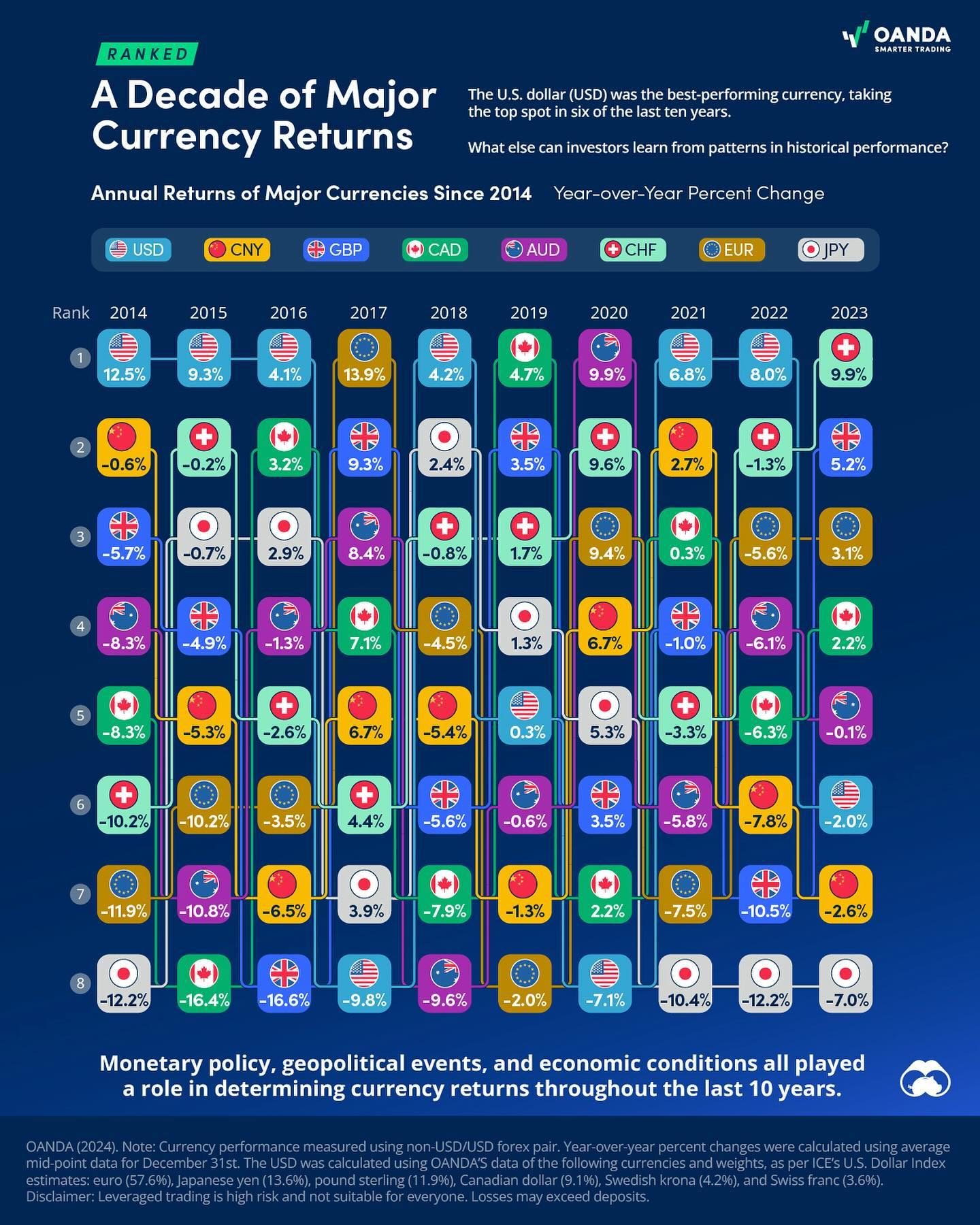
The U.S. dollar's (USD) dominance in the global financial landscape is well-documented, but its performance over the last decade is particularly noteworthy. The USD emerged as the best-performing currency among the top eight most-traded currencies by volume, according to data visualizations provided by OANDA.
Why this matters
Understanding the historical performance of major currencies and the factors that drive their fluctuations is crucial for investors. By analyzing the trends of the last decade, investors can gain insights into potential future movements and make more informed decisions. The USD's performance, in particular, highlights the currency's resilience and its role as a safe haven asset.
Major currency performance from 2014 to 2023
The graphic presented by OANDA visualizes the annual returns of major currencies, including the USD, CNY (Chinese yuan), GBP (British pound), CAD (Canadian dollar), AUD (Australian dollar), CHF (Swiss franc), EUR (euro), and JPY (Japanese yen). These currencies are among the most-traded globally, making their performance indicative of broader economic trends.
U.S. dollar (USD)
The USD's performance over the decade can be attributed to several factors, including its status as a reserve currency, the stability of the U.S. economy, and the monetary policies of the Federal Reserve. Throughout the years, the USD has shown consistent strength, making it a reliable choice for investors seeking stability and returns.
Chinese yuan (CNY)
The CNY has shown significant volatility over the last decade. The currency's performance is closely tied to China's economic growth and its policies regarding capital controls. The CNY's movements reflect China's evolving role in the global economy and its efforts to internationalize the currency.
British pound (GBP)
The GBP has faced challenges, including Brexit and economic uncertainties. The currency's performance reflects these events, with periods of significant fluctuations. Despite these challenges, the GBP remains a major player in the global forex market, influenced by economic policies and geopolitical events.
Canadian dollar (CAD)
The CAD's performance is closely linked to commodity prices, particularly oil. The correlation between oil prices and the CAD's value makes it a unique currency in the forex market. The CAD's volatility reflects the fluctuations in global commodity markets and Canada's economic health.
Australian dollar (AUD)
Similar to the CAD, the AUD's performance is influenced by commodity prices, particularly metals and minerals. The AUD's movements reflect the dynamics of the global commodity market and Australia's economic conditions. Investors often use the AUD as a proxy for commodity market trends.
Swiss franc (CHF)
The CHF is known for its stability and is often seen as a safe-haven currency. Its performance is influenced by global economic conditions and monetary policies. The CHF's movements reflect investor sentiment and risk aversion, making it a critical currency to watch during times of market turbulence.
Euro (EUR)
The EUR's performance is influenced by the economic policies of the European Central Bank (ECB) and the economic health of the Eurozone. The EUR's movements reflect the dynamics of the Eurozone economy, including GDP growth, inflation, and trade balances. Despite challenges, the EUR remains a major currency in the forex market.
Japanese yen (JPY)
The JPY is another safe-haven currency, often sought during times of global economic uncertainty. Its performance is influenced by Japan's monetary policies and economic conditions. The JPY's movements reflect investor sentiment and risk aversion, making it a key currency for risk management strategies.
Factors influencing currency performance
Currency performance is influenced by a variety of factors, including:
Monetary policy
Central banks play a crucial role in shaping currency values. Monetary policies such as interest rate adjustments, quantitative easing, and forward guidance impact currency performance. For instance, higher interest rates can make a currency more attractive to investors, leading to appreciation.
Geopolitical events
Geopolitical events, such as elections, trade agreements, and conflicts, can significantly impact currency values. These events often introduce uncertainty and volatility, affecting investor sentiment and currency performance. For example, Brexit had a notable impact on the GBP, while trade tensions between the U.S. and China influenced the USD and CNY.
Economic conditions
Economic indicators, such as GDP growth, inflation, and unemployment rates, are critical factors influencing currency performance. Strong economic conditions generally lead to currency appreciation, while weak economic performance can result in depreciation. For example, the AUD's performance is closely linked to Australia's economic health and commodity prices.
Practical tips
Investors seeking to capitalize on currency trends and mitigate risks can follow these practical tips:
Monitor economic indicators
Keeping a close eye on key economic indicators can provide insights into potential currency movements. Indicators such as GDP growth, inflation, and unemployment rates are essential for understanding a currency's performance and making informed investment decisions.
Stay informed about monetary policies
Central banks' decisions on monetary policies can have a significant impact on currency values. Staying updated on interest rate changes, quantitative easing, and forward guidance can help investors anticipate currency movements and adjust their strategies accordingly.
Assess geopolitical risks
Geopolitical events can introduce volatility and uncertainty in the forex market. Assessing geopolitical risks and their potential impact on currencies can help investors manage risks and capitalize on opportunities. For example, understanding the implications of trade agreements, elections, and conflicts can provide valuable insights into currency performance.
Diversify your portfolio
Diversifying a forex portfolio can help mitigate risks and optimize returns. Investors can allocate funds across various currencies to reduce exposure to individual currency risks and benefit from the performance of multiple currencies.
Utilize risk management strategies
Implementing risk management strategies, such as stop-loss orders, can help protect investments from significant losses. Risk management techniques can help investors navigate volatile markets and make informed decisions.
Important takeaways
The performance of major currencies over the last decade highlights the importance of understanding historical trends and the factors influencing currency values. Key takeaways from the analysis include:
- The USD's resilience: The USD's strong performance underscores its role as a safe-haven currency and its resilience in the face of global economic uncertainties.
- Volatility and risk: Currencies such as the CNY and GBP have experienced significant volatility due to economic and geopolitical events, highlighting the importance of risk management.
- Commodity correlation: Currencies like the CAD and AUD are closely linked to commodity prices, making them sensitive to global market dynamics.
- Safe-haven currencies: The CHF and JPY's performance reflects their role as safe-haven currencies, sought during times of global uncertainty.
- Economic indicators: Monitoring economic indicators and geopolitical risks is crucial for understanding currency performance and making informed investment decisions.
- Diversification and risk management: Diversifying a forex portfolio and implementing risk management strategies can help optimize returns and mitigate risks.
Conclusion
The U.S. dollar's dominance as the best-performing currency over the last decade underscores its significance in the global financial landscape. By understanding the historical performance of major currencies and the factors influencing their values, investors can gain valuable insights and make informed decisions. Monitoring economic indicators, staying informed about monetary policies, assessing geopolitical risks, diversifying portfolios, and utilizing risk management strategies are essential for navigating the forex market and capitalizing on opportunities.
Watch the Reel
Questions readers ask
What does the term 'safe haven asset' mean in the context of the USD's performance?
A 'safe haven asset' is an investment that is expected to retain or increase its value during times of market uncertainty. The USD is considered a safe haven because it tends to appreciate during global economic instability, as investors seek the security of the U.S. economy.
How did the USD compare to the euro, yen, and pound over the past decade?
From 2014 to 2023, the USD outperformed the euro, yen, and pound. This was driven by the USD's role as a safe haven asset and the relatively stable U.S. economy compared to the economic conditions in the Eurozone, Japan, and the United Kingdom.
Which other currencies were compared to the USD in this analysis?
In addition to the euro, yen, and pound, the USD was compared to the Chinese yuan (CNY), Canadian dollar (CAD), Australian dollar (AUD), and Swiss franc (CHF) in the analysis of the top eight most-traded currencies by volume.
What factors contributed to the USD's decade of strength?
The USD's decade of strength can be attributed to several factors, including its status as a safe haven asset, the stability of the U.S. economy, and the relative economic performance of other major economies.
Why is it important for investors to understand the historical performance of major currencies?
By examining the historical performance of major currencies, investors can identify trends and patterns that may inform their investment strategies. This analysis can help investors anticipate potential future movements and make well-informed decisions.
What was the performance of the USD against the Japanese yen (JPY) from 2014 to 2023?
The USD outperformed the Japanese yen (JPY) over the period 2014-2023. This performance was driven by the USD's status as a safe haven asset and the relatively stable U.S. economy, which appreciated against the yen.
How can investors use the insights from the USD's performance to inform their decisions?
Investors can use insights from the USD's performance to anticipate potential future movements in currency markets. By understanding the factors that drove the USD's strength, investors can make more informed decisions about when and how to invest in different currencies.
Recent articles
Fresh deep dives from the latest Reels we unpacked.




Comments
Be the first to comment.