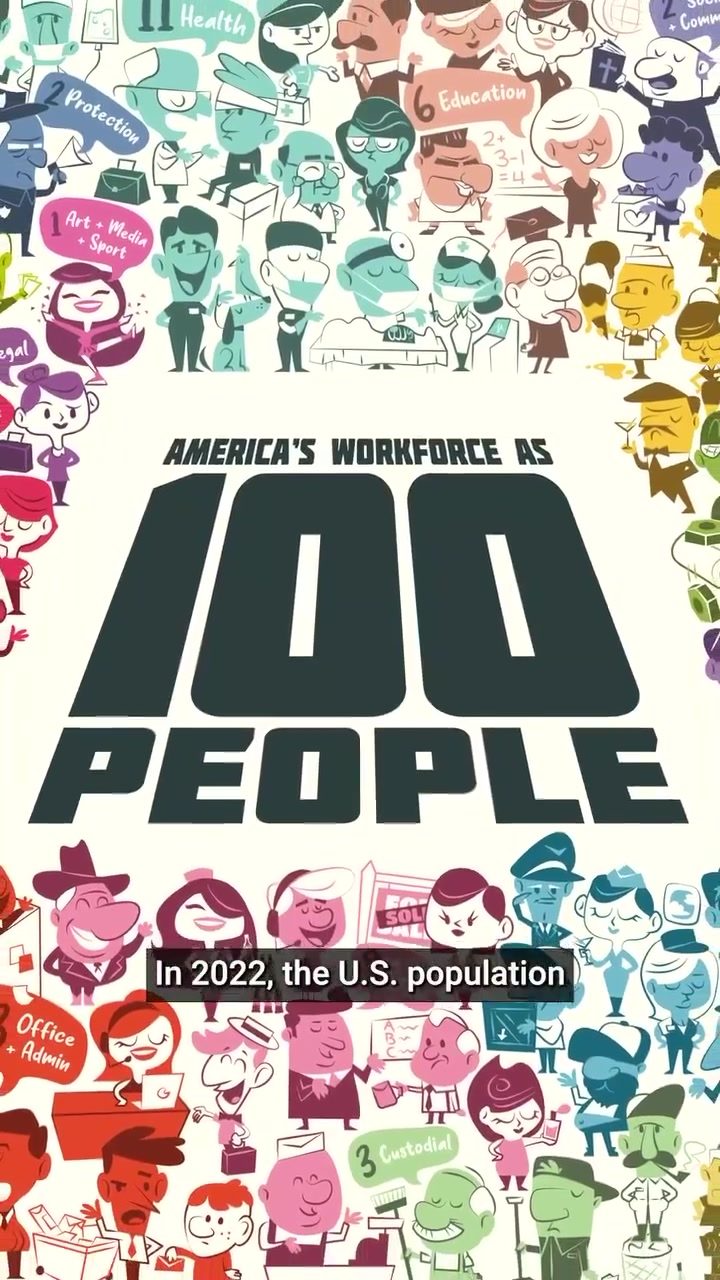
The American Workforce as 100 People
The U.S. workforce is as diverse as its population, with a wide range of roles and industries contributing to the economy. According to data from 2022, when the U.S. population stood at 333 million, the workforce can be visualized as 100 people, each representing a segment of the total population. This visualization helps break down the complexity of the workforce into a more understandable format.
Why This Matters
Understanding the distribution of jobs in the U.S. is crucial for various stakeholders, including policymakers, employers, and job seekers. It provides insights into which sectors are thriving, which are struggling, and where opportunities for growth and innovation might lie. This breakdown also helps in identifying trends and making informed decisions about education, training, and workforce development.
Main Discussion
Office and Administration
Office and administrative roles form a significant part of the workforce, with 13 out of 100 people holding such positions. These roles include receptionists, assistants, and customer service representatives. These positions are essential for the smooth operation of businesses and organizations, ensuring that day-to-day tasks are managed efficiently. The prevalence of these roles highlights the importance of administrative support in various industries.
Sales and Transportation
Nine out of 100 people work in sales, and another nine are involved in transportation. Sales roles are vital for driving revenue and growth in companies, while transportation jobs are crucial for the logistics and supply chain sectors. These roles often involve direct interaction with customers and the public, making them key components of the economy.
Food Services
The food service industry employs 8 out of every 100 people, showcasing its significance in the U.S. economy. This sector includes a wide range of positions, from chefs and cooks to servers and managers. The demand for food services is relatively stable, making it a reliable source of employment.
Manufacturing, Finance, and Management
Manufacturing, business and finance, and management each account for 6 out of 100 people in the workforce. These sectors are integral to the economy, driving production, financial stability, and strategic decision-making. Manufacturing involves the creation of goods, while business and finance roles are involved in managing money and investments. Management roles oversee the operations and strategy of organizations, ensuring they achieve their goals.
Science, Data, and Technology
Science, data, and tech roles are represented by 5 out of 100 people, underscoring their growing importance in the modern economy. These fields are at the forefront of innovation and technological advancement, driving progress in various industries. The demand for skilled professionals in these areas continues to rise, making them attractive career paths.
Legal, Artistic, and Athletic Fields
Legal roles are represented by 2 out of 100 people. Legal professionals are essential for maintaining justice, enforcing laws, and providing legal advice. Art and media roles also account for 2 out of 100 people, reflecting the creativity and entertainment industries' contributions to the economy. Athletes, along with farming, fishing, and forestry, make up the remaining segments, each represented by 1 person out of 100. These roles, though fewer in number, contribute to the cultural and agricultural fabric of the country.
Other Roles
The workforce also includes other vital roles such as healthcare, protection, and custodial services. These roles are essential for maintaining public health, safety, and cleanliness. The diversity in these roles highlights the interconnectedness of various sectors and their collective contribution to the economy.
Practical Tips
For Job Seekers
If you're considering a career transition or just starting your job search, understanding which sectors are in demand can be invaluable. Office administration, sales, and transportation are great starting points due to their prevalence. Additionally, roles in science, data, and tech offer promising career paths with growing demand. Researching these sectors and gaining relevant skills can enhance your employability.
For Employers
For those looking to hire, knowing the distribution of the workforce can help you identify talent pools and understand where to invest in recruitment efforts. Sectors like office administration, sales, and transportation offer a broad base of skilled workers. Conversely, fields like science, data, and tech, though smaller in representation, are experiencing high demand and may require more targeted recruitment strategies.
For Policymakers
Policymakers can use this information to guide workforce development initiatives. Focusing on sectors with high demand, such as science, data, and tech, can help ensure a skilled workforce ready to meet future challenges. Investing in education and training programs tailored to these sectors can enhance competitiveness and support economic growth.
Important Takeaways
The American workforce is a complex tapestry woven from various roles and industries, each contributing uniquely to the economy. Office and administrative roles form a significant portion, followed by sales, transportation, and food services. Manufacturing, business, finance, and management roles are also crucial, along with emerging fields like science, data, and technology. Legal, artistic, and athletic roles, along with farming, fishing, and forestry, add to the diversity and richness of the workforce. Understanding this breakdown can help job seekers, employers, and policymakers make informed decisions and navigate the ever-evolving landscape of the U.S. economy.
Conclusion
The U.S. workforce is a dynamic and multifaceted entity, with a wide array of roles contributing to its vibrancy. From the prevalence of office and administrative positions to the growing significance of science, data, and tech, each sector plays a pivotal role in the economy. By visualizing the workforce as 100 people, we gain a clearer understanding of its composition and can make more informed decisions about career paths, hiring, and policy development. This breakdown serves as a valuable tool for navigating the complexities of the job market and ensuring a robust and resilient economy.
Watch the Reel
Questions readers ask
How does the 100 people visualization help understand the U.S. workforce?
The 100 people visualization simplifies the vast U.S. workforce by representing each person as a fraction of the total workforce, making it easier to grasp the relative sizes of different job sectors. This approach helps identify which sectors employ the most people and which are smaller but still significant.
What are the most prominent job sectors in the U.S. according to the 2022 data?
According to the 2022 data, prominent job sectors include office administration, transportation, and food services. These sectors represent a significant portion of the workforce, indicating their importance to the U.S. economy.
Why is it important to understand the distribution of jobs in the U.S.?
Understanding job distribution helps stakeholders, such as policymakers and employers, identify trends, make informed decisions, and allocate resources effectively. It also aids job seekers in finding opportunities and understanding where the demand lies.
How can visualizing workforce data benefit policymakers?
Visualizing workforce data provides policymakers with a clear picture of which sectors are thriving and which need support. This information is vital for creating policies that foster economic growth, address unemployment, and promote innovation.
What insights can be gained from looking at the U.S. workforce as 100 people?
By visualizing the U.S. workforce as 100 people, one can gain insights into the diversity of job roles and the relative sizes of different industries. This perspective highlights the interconnected nature of the workforce and the contributions of various sectors to the economy.
How can job seekers benefit from understanding the U.S. workforce breakdown?
Job seekers can benefit by identifying sectors with high employment rates and potential growth. This understanding can guide career choices, training programs, and help navigate the job market more effectively.
What is the significance of roles like office administration and transportation in the U.S. workforce?
Roles in office administration and transportation are vital as they support the operations of many other sectors. Understanding their significance can help in workforce management, ensuring that these crucial roles are adequately staffed and supported, thus maintaining the overall efficiency of the economy.
Recent articles
Fresh deep dives from the latest Reels we unpacked.




Comments
Be the first to comment.