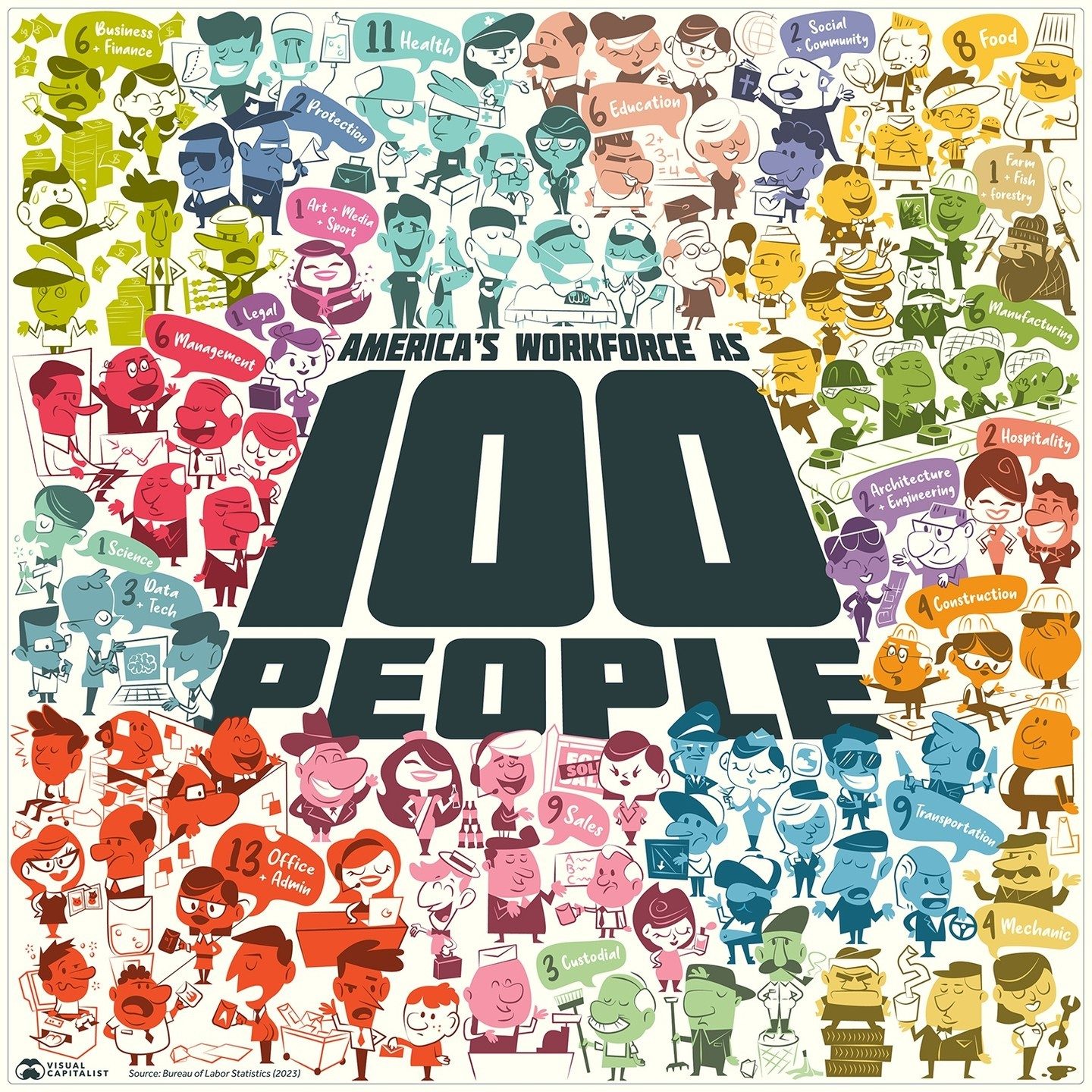
America's Workforce as 100 People
Understanding the employment landscape of the United States can be complex, given the vast number of industries and professions. To simplify this, data from the National Occupational Employment and Wage Estimates (2022) put out by the U.S. Bureau of Labor Statistics has been reinterpreted to visualize the employed American workforce as just 100 people. This approach makes it easier to grasp the distribution of jobs across different sectors.
Context / Why This Matters
The U.S. workforce is incredibly diverse, encompassing a wide range of professions and industries. By condensing this vast landscape into a manageable 100 people, we gain a clearer perspective on which sectors employ the most workers and how they contribute to the overall economy. This visualization helps individuals, policymakers, and educators better understand workforce dynamics and make informed decisions.
Main Discussion
Healthcare: A Major Employer
The healthcare sector is one of the largest employers in the U.S. workforce. In our 100-person representation, a significant portion of the figures are involved in healthcare-related roles. This includes doctors, nurses, medical technicians, and administrative staff. The sector's growth is driven by an aging population and advancements in medical technology, making it a critical component of the economy.
Healthcare Professionals
The sheer number of healthcare professionals underscores the importance of this sector. Nurses and doctors are the most visible, but the industry also includes a large number of support staff, such as medical assistants, lab technicians, and administrative personnel.
Allied Health
Beyond direct patient care, allied health professionals play a crucial role. This group includes physical therapists, occupational therapists, and respiratory therapists, among others. These professionals support and enhance the capabilities of primary healthcare providers, ensuring comprehensive patient care.
Education: Shaping the Future
Education is another critical sector, employing a substantial number of people. Teachers, professors, and support staff are essential for shaping the future workforce. The demand for educators is driven by the need to prepare students for a rapidly changing job market and the importance of lifelong learning.
K-12 Teachers
Elementary, middle, and high school teachers form the backbone of the education sector. They are responsible for the foundational education of young minds, preparing them for higher education and the workforce. This group includes general educators as well as specialized teachers in areas like science, math, and special education.
Higher Education
Universities and colleges employ a significant number of professionals, including professors, researchers, and administrative staff. These institutions are vital for advanced education, research, and the development of new knowledge and technologies.
Manufacturing and Production
Manufacturing remains a crucial part of the U.S. economy, employing a notable percentage of the workforce. This sector includes workers in factories, assembly lines, and production facilities. The manufacturing industry is continually evolving, with a focus on technology and automation to enhance productivity and efficiency.
Skilled Labor
Skilled laborers, such as machinists, welders, and electricians, are essential for the operation and maintenance of manufacturing facilities. Their expertise ensures that production runs smoothly and efficiently.
Automation and Technology
The rise of automation and advanced manufacturing technologies has changed the landscape of this sector. Workers are increasingly required to operate and maintain complex machinery, necessitating advanced skills and training.
Retail and Service Industries
The retail and service sectors are among the largest employers, encompassing a wide range of jobs from sales and customer service to logistics and supply chain management. These industries are vital for the economy, as they provide essential goods and services to consumers and support various other sectors.
Retail Workers
Retail workers include cashiers, salespeople, and stock clerks, among others. They play a critical role in the supply chain, ensuring that goods are available to consumers and that customer needs are met.
Customer Service
Customer service representatives handle inquiries, complaints, and support for a wide range of products and services. This role is essential for maintaining customer satisfaction and building brand loyalty.
Practical Tips
Understanding the distribution of jobs across different sectors can help individuals make informed career choices. Here are a few practical tips for navigating the employment landscape:
-
Identify High-Demand Sectors: Focus on industries that are employing a significant portion of the workforce. Healthcare, education, and manufacturing are consistently high-demand sectors.
-
Acquire Relevant Skills: Tailor your education and training to acquire the skills that are in demand in your chosen field. This includes both technical skills and soft skills, which are increasingly important in the modern workplace.
-
Stay Informed: Keep up with industry trends and advancements. Industries like healthcare and manufacturing are continually evolving, and staying informed can help you stay competitive.
-
Networking: Build a strong professional network. Networking can open doors to job opportunities and provide valuable insights into your chosen field. Attend industry conferences, join professional organizations, and leverage online platforms like LinkedIn.
Important Takeaways
- The healthcare sector is a major employer, driven by an aging population and advancements in medical technology.
- Education is crucial for preparing the future workforce and ensuring lifelong learning.
- Manufacturing remains a vital part of the economy, with a growing focus on technology and automation.
- Retail and service industries provide essential goods and services and are significant employers.
- Understanding the distribution of jobs across different sectors can help individuals make informed career choices.
Conclusion
Visualizing the employed American workforce as 100 people provides a clear and concise overview of the employment landscape. By understanding the distribution of jobs across different sectors, individuals can make more informed career decisions and contribute to the economy effectively.
Watch the Reel
Questions readers ask
How many people in the U.S. workforce are employed in the healthcare sector?
According to the 100 people visualization, 14 out of 100 people work in the healthcare sector. This includes a wide range of roles, from doctors and nurses to support staff and allied health professionals, making it one of the largest employment sectors in the U.S.
What are the top three sectors employing the most people in the US?
The top three sectors employing the most people are Office and Administrative Support, Sales, and Healthcare. These sectors collectively employ 22, 16, and 14 people, respectively, out of the 100-person visualization of the U.S. workforce.
What percentage of the U.S. workforce is employed in the Food Preparation and Serving sector?
In the 100 people visualization of the U.S. workforce, 6 people are employed in the Food Preparation and Serving sector. This means 6% of the workforce is involved in roles related to food preparation and service.
How does the visualization help in understanding the U.S. job distribution?
The 100 people visualization simplifies the complex U.S. employment landscape by breaking it down into manageable proportions. This allows for a clearer perspective on which sectors employ the most workers and how they contribute to the overall economy.
What data source is used to create the 100 people visualization of the U.S. workforce?
The 100 people visualization is based on data from the National Occupational Employment and Wage Estimates (2022) published by the U.S. Bureau of Labor Statistics. This data provides a comprehensive overview of employment and wage statistics across various occupations in the U.S.
What is the role of support staff in the healthcare sector within this visualization?
Support staff in the healthcare sector, such as medical assistants, home health aides, and administrative personnel, are included in the 14 people representing the healthcare sector. These roles are crucial for the smooth operation of healthcare facilities and the delivery of patient care.
How does the 100 people visualization highlight the diversity of the U.S. workforce?
The 100 people visualization highlights the diversity of the U.S. workforce by showing the wide range of occupations and industries. For instance, it includes sectors as varied as healthcare, food preparation, and administrative support, each represented by a significant number of people, illustrating the breadth of employment opportunities in the country.
Recent articles
Fresh deep dives from the latest Reels we unpacked.




Comments
Be the first to comment.