Comparing the U.S. and China: Economic Powerhouses
The United States and China together account for nearly half of the global economy, making them two of the most influential economic powerhouses in the world. Understanding how their economies stack up against each other provides valuable insights into global economic trends. This comparison focuses on three key metrics: GDP, equity market valuation, and foreign direct investment (FDI).
Why This Matters
The economic dynamics between the U.S. and China have far-reaching implications. These two countries are not only major trading partners but also significant players in global financial markets. Their economic performance influences everything from commodity prices to technological innovation. By examining their GDP, equity market valuation, and FDI, we can better understand the economic landscape and make more informed decisions.
Main Discussion
GDP: The Backbone of Economic Strength
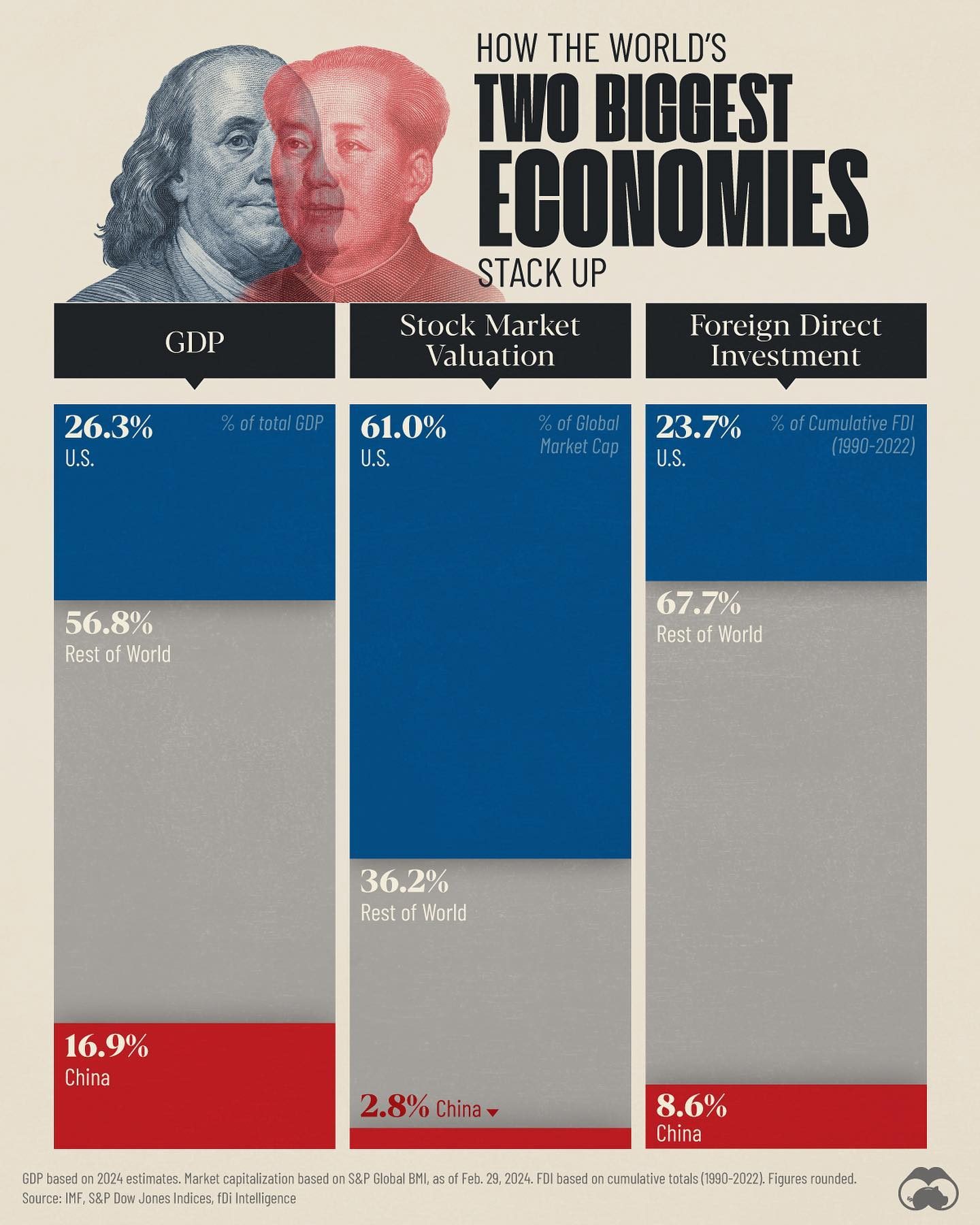
GDP, or Gross Domestic Product, is a critical measure of a country's economic health. It represents the total value of all goods and services produced within a country's borders in a specific time period. According to the latest estimates, the United States accounts for 26.3% of the global GDP, while China contributes 16.9%. The rest of the world makes up the remaining 56.8%. These figures highlight the significant economic power of both countries, with the U.S. leading slightly in terms of GDP contribution.
Equity Market Valuation: The Pulse of Financial Markets
Equity market valuation, often represented by stock market capitalization, provides a snapshot of the value of a country's publicly traded companies. The U.S. holds a dominant position in this area, accounting for 61.0% of the global market capitalization. In contrast, China's share is 2.8%, with the rest of the world making up 36.2%. This disparity underscores the U.S. as a global leader in financial markets, attracting significant investment and innovation.
Foreign Direct Investment: Driving Economic Growth
Foreign direct investment (FDI) is crucial for economic growth and development. It involves investing in businesses and assets in another country, often leading to job creation, technology transfer, and economic expansion. The United States leads in FDI, representing 23.7% of the cumulative FDI from 1990 to 2022. China's share is 8.6%, with the rest of the world contributing 67.7%. These figures illustrate the U.S. as a favored destination for foreign investment, reflecting its stable economic environment and robust business opportunities.
Practical Tips
Understanding the economic dynamics between the U.S. and China can provide practical insights for investors, businesses, and policymakers. Here are some tips to leverage this knowledge:
- Investors: Consider diversifying your portfolio to include assets from both the U.S. and China. This can help mitigate risks and capitalize on opportunities in both economies.
- Businesses: Evaluate the potential for expansion into these markets. The U.S. offers a stable and mature market, while China provides rapid growth and a vast consumer base.
- Policymakers: Develop strategies that foster economic cooperation and reduce trade tensions. This can enhance global economic stability and growth.
Important Takeaways
- The U.S. and China are the world's two largest economies, accounting for nearly half of the global GDP.
- The U.S. leads in equity market valuation and FDI, reflecting its dominant position in global financial markets and investment.
- China's economic contributions are significant, particularly in terms of GDP, but lag behind the U.S. in market valuation and FDI.
- Understanding these economic metrics can provide valuable insights for investors, businesses, and policymakers.
Conclusion
The economic comparison between the United States and China reveals a complex interplay of strengths and opportunities. While the U.S. maintains a dominant position in equity market valuation and FDI, China's significant GDP contribution highlights its growing economic power. By leveraging these insights, investors, businesses, and policymakers can make informed decisions to navigate the global economic landscape effectively.
Watch the Reel
Questions readers ask
What is the significance of comparing the economies of the United States and China?
Comparing the economies of the U.S. and China is essential as these two countries together make up nearly half of the global economy. This comparison helps understand global economic trends, influences on commodity prices, and technological advancements. It also provides insights into how these economic powerhouses interact in financial markets and trade.
How does the GDP of the United States compare to that of China?
The GDP of the United States and China provides a clear picture of their economic output. While China has a larger population, the U.S. has traditionally had a higher GDP. However, China's rapid GDP growth has significantly narrowed this gap, making their economic comparison crucial for understanding global economic dynamics.
What is the importance of equity market valuation in the U.S. vs. China comparison?
Equity market valuation is a key metric that reveals the health and attractiveness of a country's stock market. Comparing the U.S. and China in this regard shows their respective economic strengths and investor confidence. It also provides insights into their financial stability and growth potential.
What role does foreign direct investment (FDI) play in the economic comparison between the U.S. and China?
Foreign direct investment (FDI) is crucial as it signifies a country's ability to attract international capital. Analyzing FDI flows between the U.S. and China highlights their competitive advantages and the level of trust global investors have in their economies. It also reflects their influence on global trade and economic policies.
How do the economic metrics of the U.S. and China influence the world economy?
The economic metrics of the U.S. and China, such as GDP, equity market valuation, and FDI, significantly influence the world economy. Their economic performance impacts global market trends, trade policies, and financial stability. Understanding these metrics helps predict global economic shifts and provides insights into how other countries might be affected.
What are the implications of China's GDP growth on the global economy?
China's rapid GDP growth has significant implications for the global economy. It has transformed China into a major player in international trade and financial markets. Furthermore, this growth has shifted global manufacturing and supply chains, affecting economies around the world. Comparing China's GDP growth to the U.S. provides a clear picture of their relative economic strengths and future trajectories.
Related deep dives
Similar reads based on topic and creator.


Recent articles
Fresh deep dives from the latest Reels we unpacked.




Comments
Be the first to comment.