US Tariffs on China
The U.S. government has announced a significant increase in tariffs on various Chinese imports, totaling over $18 billion in affected goods. President Biden's administration aims to counter what it perceives as "unfair trade practices" by China, focusing on sectors where the U.S. is ramping up domestic production. This move is part of a broader strategy to bolster American manufacturing and reduce reliance on foreign imports, particularly in critical industries.
Context / Why this matters
The new tariffs are expected to have far-reaching implications for both American and Chinese economies. These measures will impact a wide range of products, from electric vehicles (EVs) and semiconductors to medical supplies and critical minerals. The U.S. government is targeting these sectors to enhance domestic production, which could lead to long-term economic shifts in these industries. This isn’t just about economics; it’s also a strategic move to strengthen national security and reduce dependencies on foreign suppliers.
Main discussion
Understanding the new tariff rates
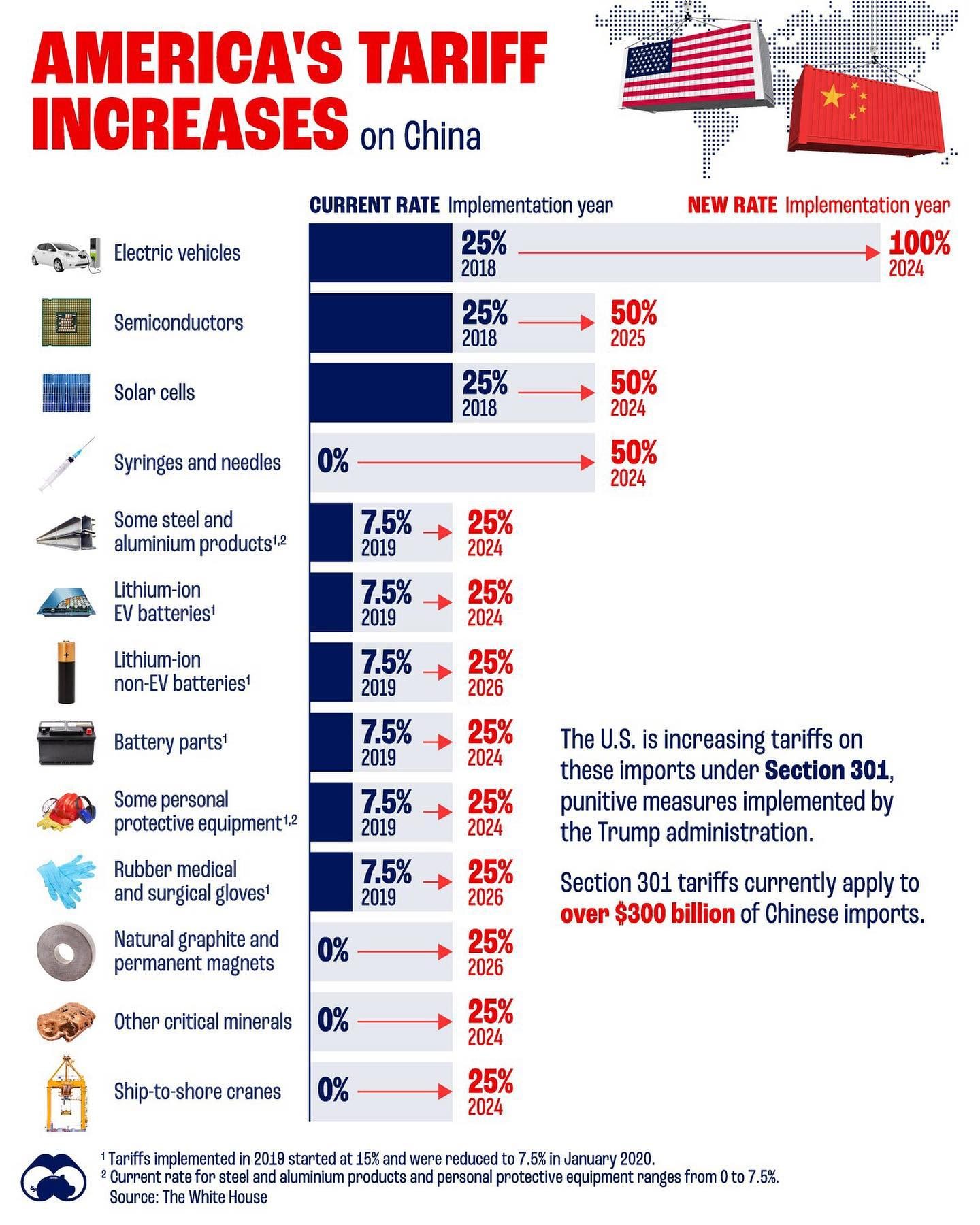
The tariff increases are scheduled to be implemented over the next few years. For instance, tariffs on electric vehicle batteries and semiconductors, which are crucial for the tech and automotive industries, will see significant jumps. The current 25% tariff on these items will increase to 50% by 2024. Other products like syringes, solar cells, and certain medical equipment will also face increased tariffs, moving from 7.5% to 50% by 2024. Medical protective equipment and minerals like lithium will also be impacted by these tariffs, with rates increasing to 50% by 2026. Department of Commerce aims to protect domestic manufacturers by implementing these tariffs.
Section 301 tariffs
The new tariffs are part of the broader Section 301 tariffs, which were initially implemented by the Trump administration. These tariffs, which currently apply to over $300 billion worth of Chinese imports, are punitive measures aimed at addressing unfair trade practices. The tariffs were first set up in 2018, with rates starting at 15% and later reduced to 7.5% in January 2020. The current administration is doubling down on these measures, indicating a continuation of a firm stance on trade with China.
The impact on specific industries
Electric Vehicles and Batteries
The automotive industry, particularly the electric vehicle (EV) sector, will be significantly affected. Tariffs on electric vehicle batteries, both for EVs and non-EVs, will increase to 50% by 2024. This move is aimed at protecting domestic manufacturers of electric vehicle batteries, which are essential for the transition to clean energy and reducing reliance on fossil fuels. The increased tariffs could incentivize domestic production, potentially leading to job growth in the battery manufacturing sector.
Semiconductors and Tech
Semiconductors are the backbone of modern technology, powering everything from smartphones to advanced medical equipment. The U.S. is increasing tariffs on semiconductors to 50% by 2024, a move that could spur domestic production in this critical industry. This could have significant implications for the tech industry, as semiconductors are a vital component in most electronic devices. The increased tariffs could encourage innovation and investment in domestic semiconductor manufacturing, potentially reducing the reliance on foreign suppliers.
Medical Equipment and Supplies
Medical supplies, including syringes, needles, personal protective equipment, and surgical gloves, will also face increased tariffs. This move is part of a broader strategy to ensure the U.S. has a reliable supply of critical medical equipment, particularly in light of recent global health crises. By increasing tariffs on these items, the U.S. aims to boost domestic production and reduce dependencies on foreign suppliers.
Practical tips
Understanding the tariff schedule
To navigate these new tariffs, businesses and consumers need to understand the implementation timeline. Tariffs on many items, including electric vehicle batteries and semiconductors, will increase to 50% by 2024. Other items, such as medical supplies and critical minerals, will see their tariffs increase to 50% by 2026. Knowing the implementation dates can help businesses plan for these changes and make strategic decisions about their supply chains.
Assessing the impact on your business
Businesses that rely on imported goods from China should assess the impact of these new tariffs on their operations. For companies in sectors like electric vehicles and semiconductors, the increased tariffs could significantly affect costs and supply chains. It may be beneficial to explore alternative suppliers, consider domestic production, or look for ways to mitigate the financial impact of the tariffs.
Looking for opportunities
While the new tariffs present challenges, they also offer opportunities for domestic manufacturers. Companies that can pivot to domestic production may benefit from reduced competition and increased demand for domestically produced goods. This could be a time for innovation and growth in sectors like electric vehicle batteries, semiconductors, and medical supplies.
Important takeaways
The U.S. government’s decision to increase tariffs on Chinese imports is a significant move with far-reaching implications. These tariffs are part of a broader strategy to counter what the administration sees as unfair trade practices and to boost domestic production in critical industries. By understanding the new tariff rates and their implementation timeline, businesses and consumers can better prepare for these changes and navigate the evolving trade landscape. The increased tariffs present both challenges and opportunities, and it will be crucial for companies to adapt and innovate in response to these changes.
Conclusion
The new tariffs on Chinese imports mark a significant shift in U.S. trade policy, aimed at countering perceived unfair trade practices and boosting domestic production. With tariffs on a wide range of products set to increase over the next few years, businesses and consumers will need to adapt to these changes. By understanding the new tariff rates and their impact on specific industries, stakeholders can better navigate the evolving trade landscape and position themselves for success in the years to come.
Watch the Reel
Questions readers ask
What specific products are affected by the new US tariffs on Chinese imports?
The new tariffs cover a broad range of products, including electric vehicles, semiconductors, medical supplies, and critical minerals. These sectors have been targeted to support domestic production and reduce dependence on foreign supplies.
Why has the US imposed these tariffs on China?
The Biden administration has imposed these tariffs to counter perceived unfair trade practices by China. The goal is to bolster American manufacturing, enhance national security, and reduce reliance on foreign imports in critical industries.
How much are the new tariffs worth?
The new tariffs amount to approximately $18 billion in affected goods. This significant increase in tariffs is part of a broader strategy to support key U.S. industries and reduce foreign reliance.
What is the impact of these tariffs on the US-China trade relations?
The new tariffs are likely to strain US-China trade relations further, potentially leading to retaliatory measures from China. This could escalate the ongoing US-China trade war and have broader economic implications for both countries.
What are Section 301 tariffs, and how do they relate to these new tariffs?
Section 301 tariffs are trade measures imposed by the U.S. under Section 301 of the Trade Act of 1974. The new tariffs on Chinese imports are part of the ongoing Section 301 investigation into China's trade practices. These tariffs are designed to address perceived unfair practices and protect U.S. industries.
Recent articles
Fresh deep dives from the latest Reels we unpacked.




Comments
Be the first to comment.