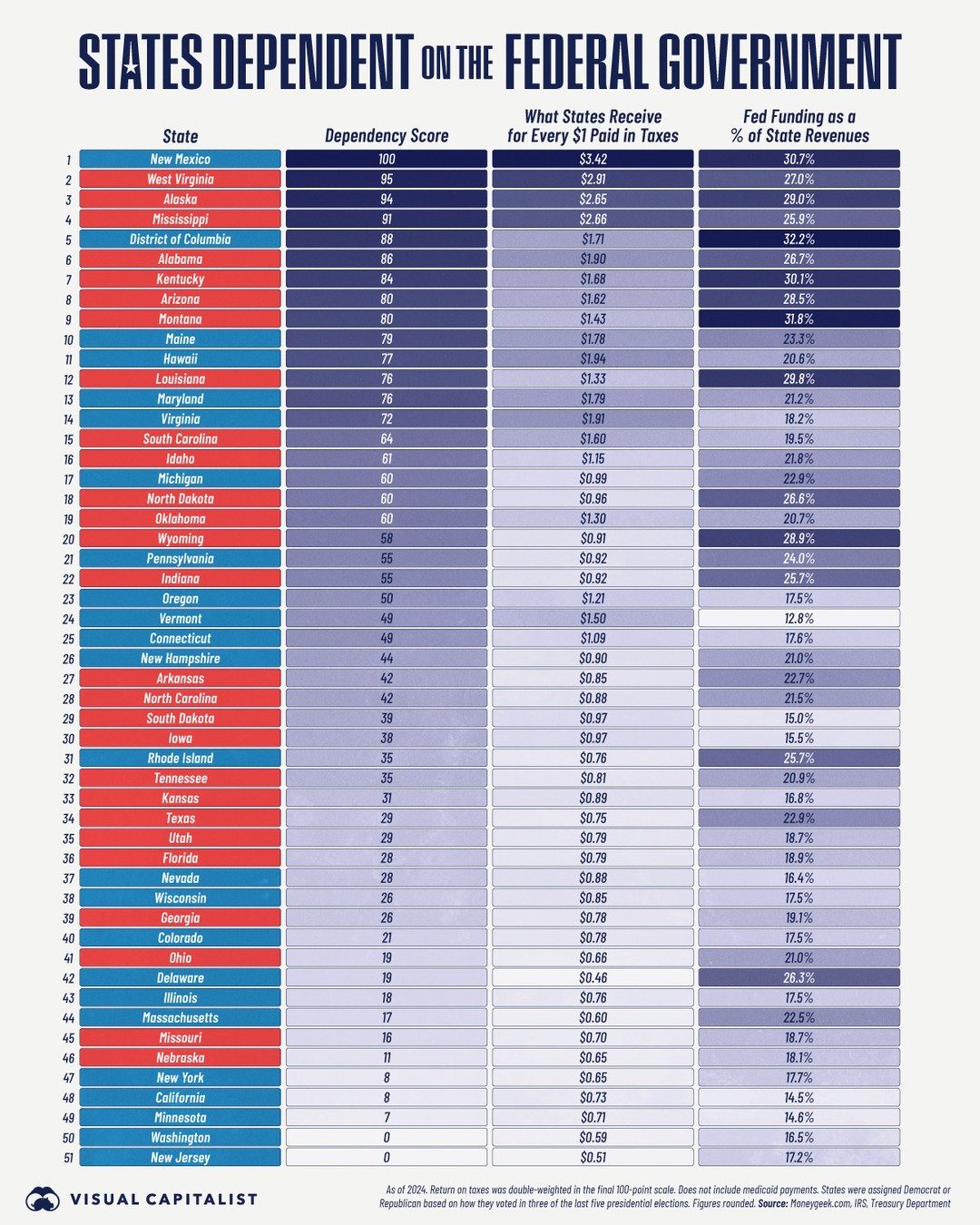
Federal Government Spending by State
Federal government spending in the U.S. varies widely by state, with some states receiving far more in federal funding than they pay in taxes. This disparity creates a range of dependency levels among the states, affecting their economies and public services.
Why This Matters
Federal funding plays a crucial role in state budgets, supporting various programs and services. States with higher dependency on federal funding often rely on these funds to maintain their infrastructure, healthcare, education, and other essential services. Understanding which states are most dependent on federal funding provides insight into the economic dynamics and fiscal health of each state.
Analysis of Federal Dependency by State
States Most Dependent on Federal Funding
At the top of the dependency scale, New Mexico stands out. This state receives $3.42 in federal funding for every dollar paid in federal taxes. Other states with high dependency scores include West Virginia, Alaska, Mississippi, and the District of Columbia. These states receive significant amounts of federal money, which is essential for supporting their local economies and public services.
States with Lower Federal Dependency
In contrast, states like New Jersey and Washington have the lowest dependency scores. These states receive roughly half a dollar back for every dollar paid in federal taxes. This lower dependency means that these states rely less on federal funding and more on their own revenue sources to support their budgets.
Detailed Breakdown by State
To provide a comprehensive view, here is a detailed breakdown of the dependency scores for various states:
- New Mexico: $3.42 for every $1 paid in taxes
- West Virginia: $2.91 for every $1 paid in taxes
- Alaska: $2.66 for every $1 paid in taxes
- Mississippi: $1.90 for every $1 paid in taxes
- District of Columbia: $1.89 for every $1 paid in taxes
- Alabama: $1.88 for every $1 paid in taxes
- Kentucky: $1.86 for every $1 paid in taxes
- Arizona: $1.84 for every $1 paid in taxes
- Montana: $1.83 for every $1 paid in taxes
- Maine: $1.82 for every $1 paid in taxes
- Hawaii: $1.81 for every $1 paid in taxes
- Maryland: $1.79 for every $1 paid in taxes
- Virginia: $1.78 for every $1 paid in taxes
- South Carolina: $1.77 for every $1 paid in taxes
- Idaho: $1.76 for every $1 paid in taxes
- Michigan: $1.75 for every $1 paid in taxes
Mid-Range Dependency
States with moderate dependency scores include:
- Oklahoma: $1.74 for every $1 paid in taxes
- Wyoming: $1.73 for every $1 paid in taxes
- Pennsylvania: $1.72 for every $1 paid in taxes
- Indiana: $1.71 for every $1 paid in taxes
- Oregon: $1.70 for every $1 paid in taxes
- Vermont: $1.69 for every $1 paid in taxes
- New Hampshire: $1.68 for every $1 paid in taxes
- Connecticut: $1.67 for every $1 paid in taxes
Lowest Dependency
The states with the lowest dependency scores are:
- Arkansas: $1.66 for every $1 paid in taxes
- North Carolina: $1.65 for every $1 paid in taxes
- Nevada: $1.64 for every $1 paid in taxes
- Florida: $1.63 for every $1 paid in taxes
- Iowa: $1.62 for every $1 paid in taxes
- Nebraska: $1.61 for every $1 paid in taxes
- Illinois: $1.60 for every $1 paid in taxes
- Missouri: $1.59 for every $1 paid in taxes
- Kansas: $1.58 for every $1 paid in taxes
- Tennessee: $1.57 for every $1 paid in taxes
Least Dependent
Finally, the least dependent states are:
- Georgia: $1.56 for every $1 paid in taxes
- Texas: $1.55 for every $1 paid in taxes
- New Jersey: $1.54 for every $1 paid in taxes
- California: $1.53 for every $1 paid in taxes
- New York: $1.52 for every $1 paid in taxes
- Ohio: $1.51 for every $1 paid in taxes
- Colorado: $1.50 for every $1 paid in taxes
- Washington: $1.50 for every $1 paid in taxes
- Wisconsin: $1.49 for every $1 paid in taxes
Factors Influencing Federal Dependency
Several factors contribute to a state's dependency on federal funding. These include the state's economic conditions, population demographics, and the extent of federal programs implemented within the state. For example, states with large rural populations or significant military installations often receive more federal funding.
Economic Conditions
States with lower economic growth or higher unemployment rates may rely more on federal funding to support their economies. Federal grants and programs can help these states invest in infrastructure, education, and healthcare, which are essential for economic recovery and development.
Population Demographics
States with higher proportions of low-income residents or elderly populations may receive more federal funding to support social welfare programs. These funds are crucial for providing essential services to vulnerable populations.
Federal Programs
The presence of federal programs and installations, such as military bases, national parks, and research institutions, can significantly increase a state's federal funding. These programs not only provide direct funding but also create job opportunities and stimulate local economies.
Practical Tips for Understanding Federal Dependency
To better understand federal dependency, consider the following practical tips:
Examine State Revenues
Look at the percentage of state revenues that come from federal funding. This can provide insight into how reliant a state is on federal dollars and how changes in federal funding might impact the state's budget.
Analyze Federal Grant Programs
Explore the types of federal grant programs available to each state. This can help identify which states receive the most funding and for what purposes. Examples of federal grant programs include education grants, healthcare grants, and infrastructure grants.
Review Dependency Scores
Dependency scores, as shown in the infographic, are a valuable metric for comparing states. These scores consider the amount of federal money received per dollar paid in taxes, providing a clear picture of each state's reliance on federal funding.
Important Takeaways
Understanding federal government spending by state is essential for grasping the economic dynamics and fiscal health of each state. Here are the key takeaways:
- High Dependency States: New Mexico, West Virginia, and Alaska are among the states most dependent on federal funding.
- Low Dependency States: New Jersey, Washington, and California receive the least federal funding relative to their tax contributions.
- Factors Affecting Dependency: Economic conditions, population demographics, and the presence of federal programs significantly influence a state's dependency on federal funding.
- Implications for State Budgets: High dependency on federal funding can impact state budgets, public services, and economic development.
Conclusion
Federal government spending varies widely across the U.S., with some states receiving significantly more in federal funding than they pay in taxes. This disparity creates a range of dependency levels among the states, affecting their economies and public services. By examining the dependency scores, economic conditions, and federal programs, it is possible to gain a clearer understanding of each state's reliance on federal funding and the implications for their fiscal health.
Watch the Reel
Questions readers ask
How is federal funding dependency calculated for each state?
Federal funding dependency is determined by comparing the amount of federal funding a state receives to the amount of federal taxes it pays. States that receive more in funding than they pay in taxes are considered more dependent on federal support. This calculation helps to identify which states rely heavily on federal funds to support their budgets.
Which states are the most dependent on federal funding?
States like New Mexico, West Virginia, and Alaska are among the most dependent on federal funding. These states receive significantly more in federal funding than they pay in taxes, indicating a high level of reliance on federal support to maintain essential services and infrastructure.
Why does federal funding dependency matter for state economies?
Federal funding dependency is crucial for state economies because it impacts the availability of resources for public services. States with high dependency often rely on federal funds to support key areas such as healthcare, infrastructure, and public services. Understanding this dependency helps in assessing the economic stability and fiscal health of each state.
How do states with low federal funding dependency manage their budgets?
States with lower federal funding dependency, like New Jersey and Washington, receive less federal funding relative to their tax payments. These states often have stronger local economies and tax revenues, allowing them to fund their public services and infrastructure with less reliance on federal support.
What impact does federal funding have on state tax revenue?
Federal funding can significantly supplement state tax revenue, especially in states with high dependency. This additional funding helps to cover budget shortfalls and support essential services. Conversely, states with lower dependency on federal funds may have more robust local economies and tax revenues, reducing their need for federal assistance.
How does federal funding dependency affect public services in states?
States with high federal funding dependency often allocate a significant portion of their budgets to public services, relying on federal funds to support programs in healthcare, education, and infrastructure. This dependency can influence the quality and availability of these services, as fluctuations in federal funding can impact state budgets and service provision.
Recent articles
Fresh deep dives from the latest Reels we unpacked.




Comments
Be the first to comment.