Poverty Rates in America: A State-by-State Breakdown
Poverty rates in the United States vary significantly from state to state, with some regions facing much higher levels of economic struggle than others. The data, sourced from the U.S. Census Bureau, reveals that the highest poverty rates are concentrated in the South and Southwestern states, while the lowest rates are found in the Western and Northeastern parts of the country. This geographic disparity is crucial for understanding the broader economic landscape of the nation.
Context / Why This Matters
Understanding the distribution of poverty across the United States is essential for policymakers, economists, and social activists. It highlights areas that require targeted interventions and resources to alleviate economic hardships. The data also serves as a benchmark for measuring the effectiveness of existing programs and policies aimed at reducing poverty.
Main Discussion
Geographic Disparities in Poverty Rates
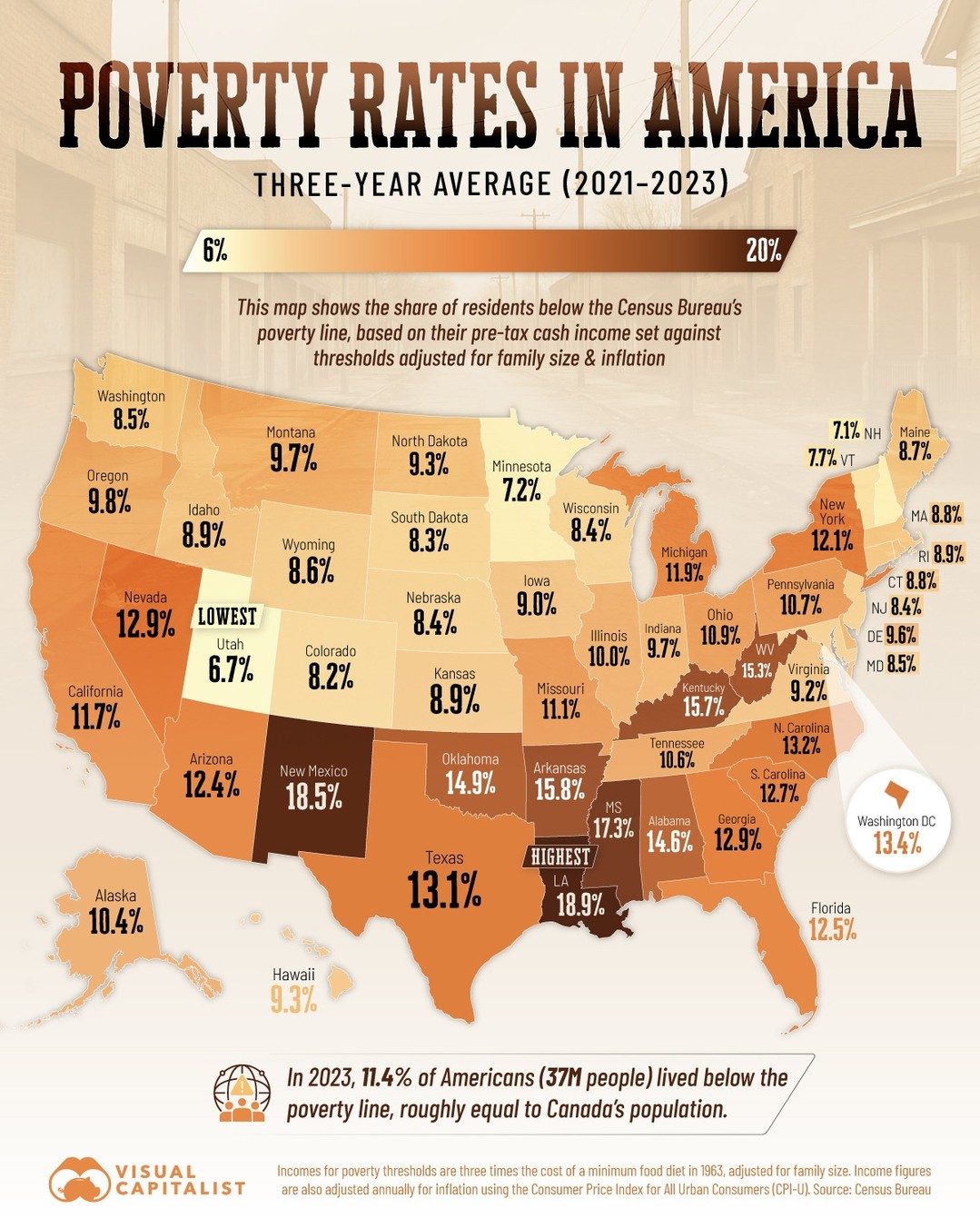
The infographic from Visual Capitalist provides a clear visual representation of the poverty rates across the United States. The data, which spans a three-year average from 2021 to 2023, shows that Louisiana has the highest poverty rate, with 18.9% of its residents living below the poverty line. This figure is nearly three times higher than the lowest poverty rate in the country, which is found in Utah at 6.7%.
Key States and Their Poverty Rates
Highest Poverty Rates
-
Louisiana (18.9%): Louisiana stands out with the highest poverty rate in the nation. This high rate underscores the significant economic challenges faced by many of its residents. Factors contributing to this include a high cost of living, limited job opportunities, and a lack of economic diversification.
-
Mississippi (17.3%): Mississippi closely follows Louisiana with a poverty rate of 17.3%. The state has long struggled with economic issues, and this high poverty rate reflects the ongoing challenges faced by its population.
-
New Mexico (15.8%): With a poverty rate of 15.8%, New Mexico also faces substantial economic difficulties. The state has a relatively low median income and high levels of unemployment, contributing to its high poverty rate.
Lowest Poverty Rates
-
Utah (6.7%): Utah boasts the lowest poverty rate in the country at 6.7%. The state's strong economy, driven by sectors such as technology, finance, and healthcare, has contributed to its relatively low poverty rate. Additionally, Utah has a high percentage of homeownership and a low cost of living compared to other states.
-
North Dakota (7.2%): North Dakota's poverty rate is slightly higher than Utah's but still notably low at 7.2%. The state's economy is diversified, with significant contributions from agriculture, energy, and manufacturing.
-
Wisconsin (7.1%): With a poverty rate of 7.1%, Wisconsin is another state that performs well in terms of economic stability. The state has a strong manufacturing sector and a relatively low cost of living, which helps to keep poverty rates low.
Factors Influencing Poverty Rates
Several factors contribute to the varying poverty rates across states, including:
-
Economic Diversification: States with a diverse economy are better equipped to weather economic downturns and provide a range of job opportunities. States that rely heavily on a single industry, such as oil or tourism, may be more vulnerable to economic fluctuations.
-
Cost of Living: The cost of living, including housing, healthcare, and basic necessities, plays a significant role in determining poverty rates. States with a lower cost of living can offer more affordable housing and essential services, making it easier for residents to meet their basic needs.
-
Job Opportunities: Access to well-paying jobs is crucial for reducing poverty. States with strong job markets and opportunities for career advancement tend to have lower poverty rates.
-
Social Safety Nets: The availability and effectiveness of social safety nets, such as welfare programs, unemployment benefits, and healthcare assistance, can significantly impact poverty rates. States with robust social safety nets can provide additional support to those in need, helping to reduce poverty levels.
Practical Tips
For Policymakers
-
Invest in Economic Diversification: Policymakers should focus on diversifying the economy to create a broader range of job opportunities and reduce reliance on a single industry.
-
Improve Access to Education and Training: Providing access to quality education and job training programs can help individuals acquire the skills needed to secure better-paying jobs.
-
Enhance Social Safety Nets: Strengthening social safety nets can provide additional support to those in need, helping to reduce poverty levels. This includes improving access to healthcare, housing assistance, and unemployment benefits.
For Individuals
-
Seek Job Training and Education: Investing in education and job training can significantly enhance employment prospects and earning potential.
-
Explore Job Opportunities in Growing Industries: Individuals should consider seeking employment in growing industries that offer better job security and higher wages.
-
Take Advantage of Social Services: Utilizing available social services, such as healthcare assistance and housing programs, can help alleviate the financial burden and improve overall well-being.
Important Takeaways
-
Geographic Disparities: Poverty rates vary significantly across the United States, with the highest rates in the South and Southwestern states and the lowest in the Western and Northeastern regions.
-
Key Factors: Economic diversification, cost of living, job opportunities, and the availability of social safety nets are crucial factors influencing poverty rates.
-
Policy Interventions: Policymakers can play a critical role in reducing poverty by investing in economic diversification, improving access to education and training, and enhancing social safety nets.
-
Individual Strategies: Individuals can take proactive steps to improve their economic situation, such as seeking job training and education, exploring job opportunities in growing industries, and utilizing available social services.
Conclusion
Understanding the poverty rates across the United States is essential for addressing economic disparities and improving the well-being of all residents. By examining the geographic distribution of poverty, identifying key factors, and implementing targeted interventions, it is possible to make significant progress in reducing poverty levels. Whether through policy changes or individual actions, addressing poverty requires a concerted effort from all stakeholders.
Watch the Reel
Questions readers ask
Which states have the highest poverty rates in the U.S.?
The states with the highest poverty rates are primarily in the South and Southwest. Louisiana, Mississippi, and New Mexico are among the states with the highest poverty rates, with Louisiana leading the way at 18.9%.
How do Southern poverty rates compare to Western poverty rates?
Southern and Southwestern states generally have higher poverty rates compared to Western states. For instance, Louisiana has a poverty rate of 18.9%, while Western states like Utah have a much lower rate of 6.7%.
What is the lowest poverty rate in the U.S.?
Utah has the lowest poverty rate in the U.S. at 6.7%. This is significantly lower than the national average and most other states.
Which regions in the U.S. have the most economic struggle?
The regions with the most economic struggle are the South and Southwest. States in these regions consistently rank high in poverty rates compared to other parts of the country. Louisiana, Mississippi, and New Mexico are among the states facing the greatest economic challenges.
How do poverty thresholds vary by state?
Poverty thresholds vary by state due to differences in the cost of living and other regional factors. While the national poverty line is a fixed measure, the actual economic conditions in states like Louisiana and Utah can result in significant differences in the living standards for residents.
What insights can be gained from the latest census data on poverty?
The latest census data shows a clear geographic disparity in poverty rates. It highlights that Southern and Southwestern states have higher poverty rates, while Western and Northeastern states have lower rates. This information is crucial for policymakers and social activists in developing targeted interventions and understanding broader economic trends.
Which states have the highest poverty rates in the Southwest?
New Mexico has the highest poverty rate in the Southwest, with a significant portion of its residents living below the poverty line. Arizona and Oklahoma also have relatively high poverty rates compared to other regions in the country.
Related deep dives
Similar reads based on topic and creator.


Recent articles
Fresh deep dives from the latest Reels we unpacked.




Comments
Be the first to comment.