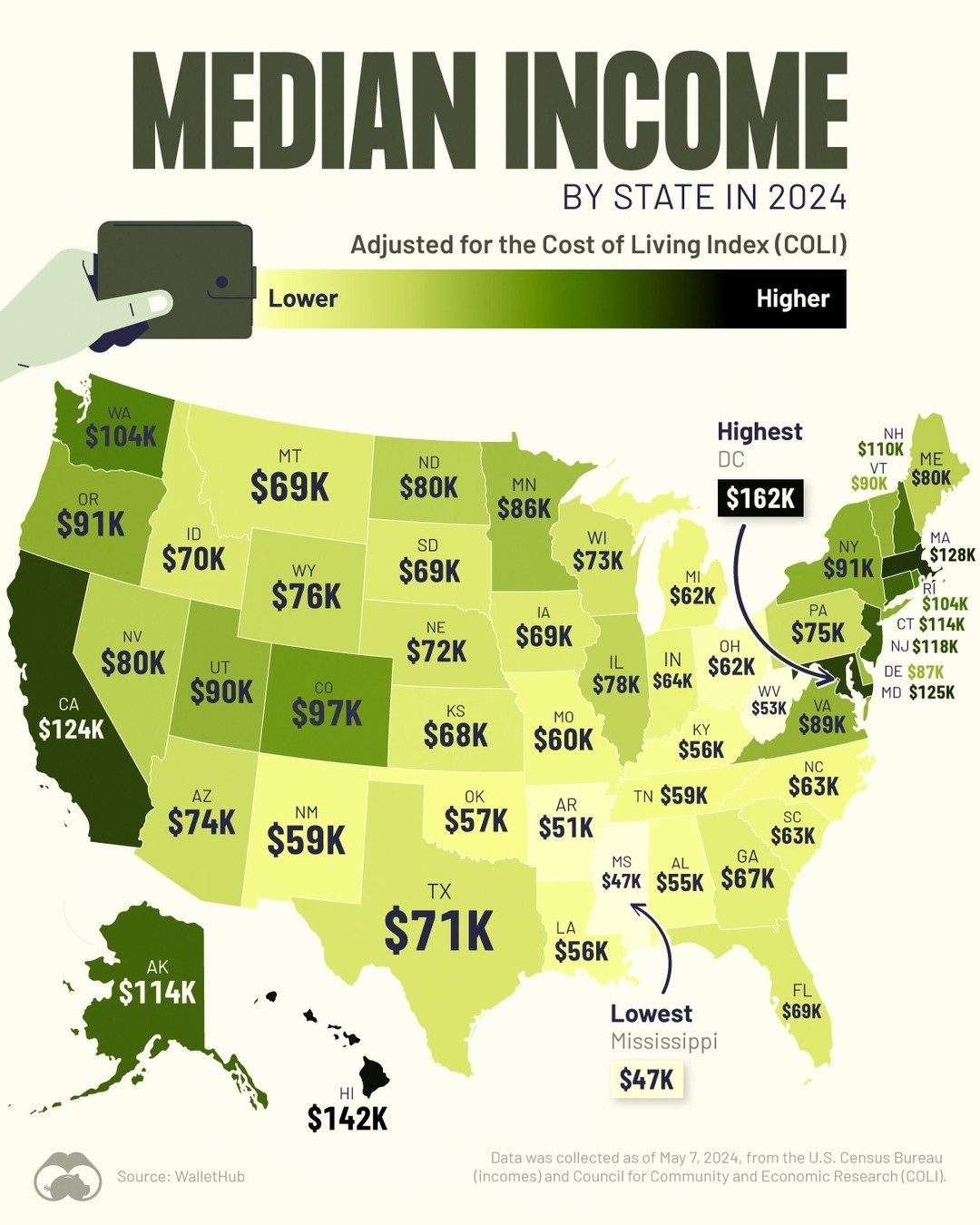
US Median Income by State
The District of Columbia (D.C.) leads the nation with the highest median annual income of $162,265. This reflection of income metrics is more than just a number. It's a result of significant economic factors that include the presence of federal government agencies and the city's high cost of living. Understanding the median income by state, particularly when adjusted for the cost of living, provides a clearer picture of economic disparities and opportunities across the country.
Context: Why This Matters
Median income serves as a critical economic indicator, offering insights into the financial health of a region. It reflects the middle point of income distribution, meaning half of the households earn more and half earn less. This metric is essential for various reasons:
- Economic Planning: Policymakers use median income data to create programs that address financial inequalities.
- Cost of Living: Adjusting income for the cost of living provides a more accurate reflection of purchasing power.
- Quality of Life: Understanding income distribution helps assess the standard of living and social welfare.
Main Discussion
Federal Influence in D.C.
Federal government agencies are the largest employers in D.C., contributing significantly to the high median income. These agencies often offer competitive salaries and benefits, driving up the average income in the district. The presence of high-paying government jobs in D.C. is a direct result of the federal government's role in the city's economy.
Cost of Living
D.C. is known for its high cost of living, which can impact income figures. High housing, transportation, and groceries expenses contribute to the need for higher incomes just to maintain a standard of living. The adjusted median income takes this into account, providing a clearer picture of economic well-being.
State-by-State Breakdown
While D.C. tops the list, other states and regions also showcase diverse economic landscapes. Here are some key highlights:
- High-Income States: New York, California, and Massachusetts also boast high median incomes, driven by strong economies and high-paying sectors like finance, technology, and healthcare.
- Low-Income States: Mississippi, with a median income of $47,000, has the lowest income among the states, highlighting the significant economic disparities within the country.
- Middle-Income States: States like Indiana, Ohio, and Missouri fall in the middle range, reflecting more moderate economic conditions and a mixture of high and low-paying sectors.
Data Source: WalletHub
The data for this analysis comes from WalletHub, a reputable source for financial and economic data. WalletHub compiles and analyzes data from the U.S. Census Bureau and other reliable sources, ensuring the accuracy and relevance of the information.
Practical Tips
Understanding median income can help individuals and families make informed decisions. Here are a few practical tips:
Assess Your Financial Situation
Knowing the median income in your state can help you assess how your financial situation compares to others. This can be particularly useful when planning for major life events, such as buying a house, starting a family, or planning for retirement.
Consider Cost of Living
When considering a move to a new state, factor in the cost of living. High median incomes might not necessarily mean a higher standard of living if the cost of living is proportionally high. Conversely, lower median incomes in states with a lower cost of living might offer a better quality of life.
Explore Job Opportunities
For those looking to move, consider states or regions with a higher median income, especially if they align with your career goals. Opportunities in sectors like federal government, finance, and technology can offer competitive salaries and benefits.
Important Takeaways
- D.C. Leads the Pack: With a median income of $162,265, D.C. stands out due to abundant high-paying federal jobs and a high cost of living.
- Economic Disparities: There are significant economic disparities across states, with Mississippi at the lower end and states like New York and California at the higher end.
- Adjust for Cost of Living: Median income data adjusted for the cost of living provides a better understanding of purchasing power and financial well-being.
Conclusion
Median income by state, when adjusted for the cost of living, paints a comprehensive picture of the economic landscape in the U.S. Understanding this data can guide individuals and policymakers in making informed decisions. Whether you're planning a move, assessing your financial situation, or looking for job opportunities, this information is invaluable.
Watch the Reel
Questions readers ask
What is the median income by state in 2024 and why does it matter?
Median income by state in 2024 is a key indicator of a region's economic health. It represents the middle point of income distribution. This means that half of the households in a given state earn more than this amount, and half earn less. This metric helps in understanding the financial well-being and economic disparities across different states, highlighting the areas with higher income levels and those that may need more economic support. While it's important to note, that D.C. has the highest median income in 2024, at $162,265, because of the presence of federal government agencies, it's just as important to consider the cost of living in this area. WalletHub provides useful data on income adjustments that consider the cost of living.
How does the cost of living by state in 2024 affect median income?
The cost of living by state in 2024 significantly impacts the true value of median income. For example, while a state may have a high median income, the high cost of living in that state can reduce the economic benefits. Adjusting median income for the cost of living provides a more accurate picture of economic health. This adjustment helps in understanding how far money goes in a particular region and reveals the true purchasing power of households, making it possible to understand the economic health of a state more fully. WalletHub allows you to compare states in terms of income adjusted for cost of living in 2024.
Which state has the highest median income in 2024 and what factors contribute to this?
The District of Columbia (D.C.) has the highest median income in 2024, with a median annual income of $162,265. This high income is attributed to several factors, including the presence of numerous federal government agencies, a strong job market, and a highly skilled workforce. Economic opportunities in industries like healthcare, technology, and finance also play a significant role in boosting the median income in D.C. These factors contribute to a higher concentration of high-paying jobs, which in turn increases the median income.
What does it mean when a state's median income is $69,000 in 2024?
When a state's median income is $69,000 in 2024, it means that half of the households in that state earn more than this amount, and half earn less. This figure serves as a benchmark for comparing the economic health of different states, and gives an indication of the standard of living in that state. However, it's crucial to consider the cost of living in that state to fully understand the economic situation. For example, a state with a median income of $69,000 and a high cost of living may have a lower quality of life compared to a state with the same median income but a lower cost of living. WalletHub provides more data on median income by states in 2024.
How can I compare the economic health of different states in 2024 using median income and cost of living?
To compare the economic health of different states in 2024, you should consider both the median income and the cost of living. First, identify the median income for each state. Then, adjust this income for the cost of living in that state. This adjustment will give you a clearer picture of the true economic health and purchasing power of households in each state. States with a higher adjusted median income generally have a better economic situation. WalletHub has a list of states ranked by income adjusted for cost of living in 2024.
Why is it important to adjust median income for the cost of living?
Adjusting median income for the cost of living is important because it provides a more accurate measure of economic well-being. The cost of living varies significantly across different states. For instance, a higher median income in a state with a high cost of living may not translate to a better quality of life compared to a state with a lower median income but a lower cost of living. Therefore, adjusting for the cost of living helps in understanding the true economic health of a region and comparing it with other states more effectively. WalletHub has useful data on income adjustments that consider the cost of living.
Related deep dives
Similar reads based on topic and creator.


Recent articles
Fresh deep dives from the latest Reels we unpacked.




Comments
Be the first to comment.