Understanding U.S. Interest Payments and Their Impact
Background on Interest Payments
Without a doubt, 2023 was a pivotal year for U.S. debt management. The nation’s debt servicing costs surpassed defense spending for the first time in history, highlighting a significant shift in government expenditure priorities. This was driven by the ballooning national debt, which now stands at a record $34 trillion, and high interest rates.
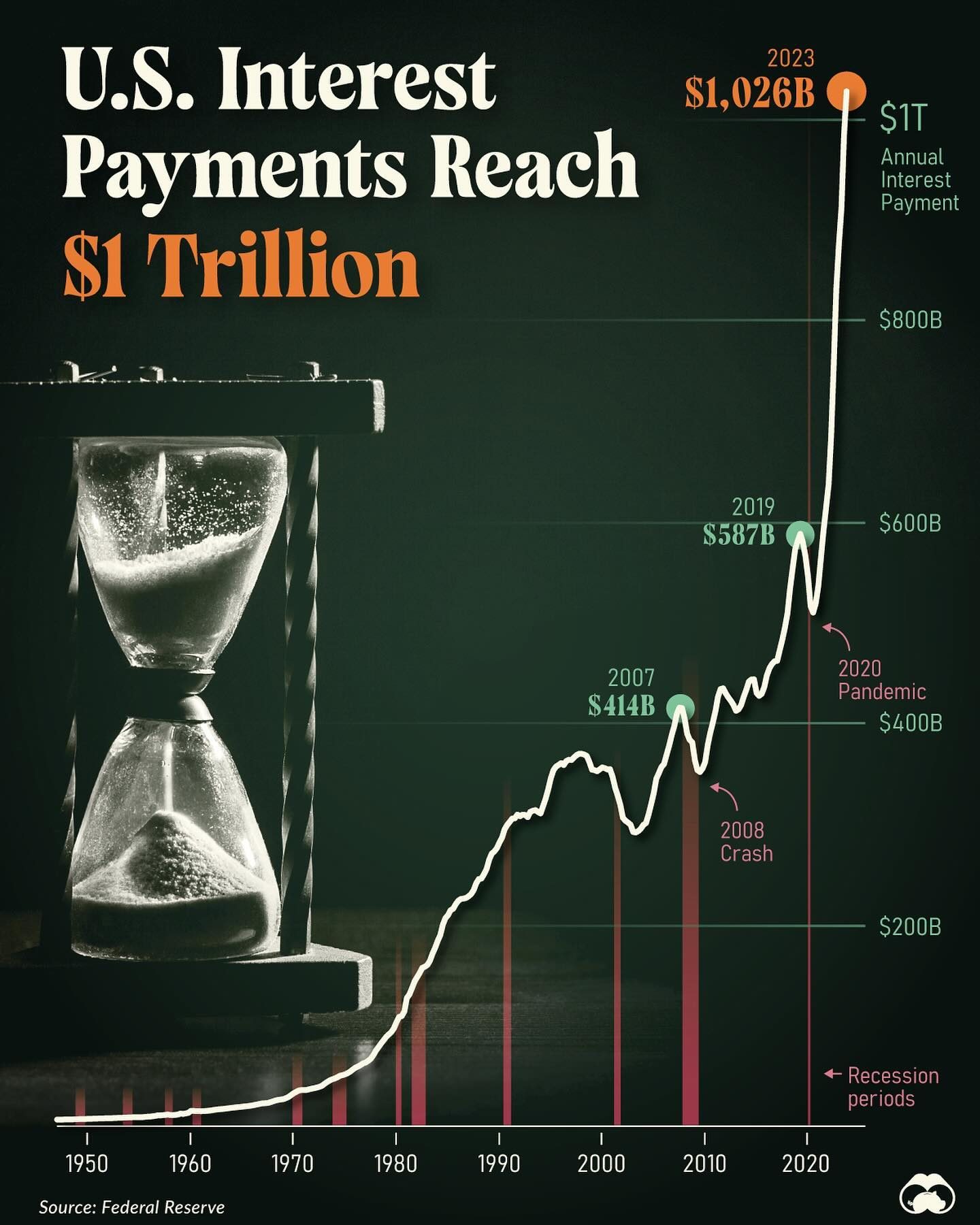
U.S. interest payments soared to $1.026 trillion in 2023, a stark contrast to earlier years. To put this into perspective, in 2019, the annual interest payment was $587 billion. This exponential growth underscores the escalating cost of servicing the national debt, driven by the accumulation of debt and rising interest rates.
Why This Matters
The rise in U.S. debt servicing costs is not just a financial metric; it has far-reaching implications for the economy and public policy. When interest payments consume an increasing portion of the federal budget, it leaves less room for other critical expenditures like infrastructure, healthcare, and social services. This financial burden can also influence monetary policy, as the Federal Reserve adjusts interest rates to manage inflation and economic stability.
Historical Context
Interest payments have not always been this high. The historical data reveals significant milestones and downturns:
- 1960s and 1970s: These decades marked a period of relative stability in interest payments, with moderate increases. However a notable uptick occurred in 1980, reaching $145.3 billion.
- 1990s: The 1990s saw a period of economic growth, and interest payments were relatively stable.
- 2000s: Significant economic events like the 2008 financial crisis led to a spike in interest payments. In 2007, the interest payment was $414 billion, reflecting the economic instability of the time.
- 2020s: The 2020 pandemic brought unprecedented challenges, and the interest payment in 2020 was $400 billion, reflecting the economic disruptions caused by the pandemic.
How Recessions Affect Interest Payments
Economic downturns, such as recessions, have a significant impact on interest payments. When the economy is in a recession, the government often increases spending to stimulate recovery. This increased spending, combined with lower tax revenues, can lead to a higher national debt, which in turn increases interest payments. The graph highlights key recession periods, showing how these events correlate with spikes in interest payments. For instance, the 2008 financial crisis and the 2020 pandemic both saw notable increases in interest payments.
Driving Factors
There are several key factors behind the surge in interest payments:
High Interest Rates
Interest rates play a crucial role in determining the cost of servicing the national debt. When interest rates rise, the cost of borrowing increases, and so does the cost of servicing existing debt. This is a significant factor in the recent surge in interest payments, as the Federal Reserve has raised interest rates to combat inflation.
Accumulation of Debt
The national debt has been growing steadily, reaching a record $34 trillion in 2023. This accumulation of debt means that the government has more debt to service, increasing the overall interest payments.
Inflation
Inflation erodes the value of money, making it more expensive to service debt. When inflation is high, the real cost of interest payments increases, even if the nominal value remains the same. This is another factor contributing to the rising cost of servicing the national debt.
Practical Tips for Understanding Financial Data
Understanding financial data, especially complex metrics like interest payments, can be daunting. Here are some tips to help you navigate this information:
Use Visual Aids
Graphs and charts can make complex data more accessible. For example, the graph illustrating the growth of U.S. interest payments from 1950 to 2023 provides a clear visual representation of the trends and spikes in interest payments.
Stay Updated
Financial data is constantly changing, so it's essential to stay updated with the latest information. Follow reliable sources like the Federal Reserve for accurate and timely data.
Understand Key Terms
Familiarize yourself with key terms like interest payments, national debt, and interest rates. This will help you understand the context and implications of the data.
Important Takeaways
The surge in U.S. interest payments to over $1 trillion in 2023 is a critical development with wide-ranging implications. High interest rates, a record national debt, and inflation are the primary drivers of this increase. The historical data shows that economic downturns also play a significant role in spiking interest payments. Understanding these factors and their impact on the economy is crucial for informed public policy and financial management.
Conclusion
The rise in U.S. interest payments is a complex issue driven by various economic factors. As the national debt continues to grow and interest rates fluctuate, understanding the implications of these trends is vital. By staying informed and leveraging visual aids, you can gain a deeper understanding of this critical financial metric and its impact on the economy.
Watch the Reel
Questions readers ask
What caused the U.S. to spend more on interest payments than on defense in 2023?
The primary drivers were the record national debt of $34 trillion and elevated interest rates, which combined to make the cost of servicing the debt exceed defense spending for the first time in history.
How much did the U.S. spend on interest payments in 2023 compared to previous years?
In 2023, the U.S. spent $1.026 trillion on interest payments. In 2019, this figure was $587 billion, showing a significant increase in just a few years.
What is the current national debt and how does it impact interest payments?
As of 2023, the national debt is $34 trillion. This high level of debt, combined with rising interest rates, has led to a substantial increase in the cost of servicing the debt, which is the interest payments the government must make.
How do high interest rates affect the U.S. government's expenditure?
High interest rates increase the cost of borrowing, which in turn raises the amount the government must pay to service its debt. This can lead to shifts in federal spending priorities, as seen in 2023 when interest payments outpaced defense spending.
What does the shift in spending from defense to interest payments indicate about the U.S. economy?
This shift indicates that the U.S. economy is facing significant challenges due to high levels of debt and rising interest rates. It suggests that a larger portion of the federal budget is being allocated to debt servicing, potentially at the expense of other areas like defense and public services.
How might a recession affect U.S. debt servicing costs?
A recession can exacerbate debt servicing costs in several ways. Lower tax revenues can reduce the government's income, making it harder to service the debt, and a recession can also lead to increased borrowing, which compounds the debt. Additionally, interest rates can fluctuate, potentially increasing the cost of servicing existing debt.
What are the potential long-term impacts of high interest payments on the U.S. government's budget?
Sustained high interest payments can lead to a vicious cycle of increased borrowing and higher debt servicing costs. This can crowd out other government expenditures, potentially affecting public services, infrastructure, and social programs. Over time, it could lead to a reduction in the government's fiscal flexibility and economic stability.
Recent articles
Fresh deep dives from the latest Reels we unpacked.




Comments
Be the first to comment.