U.S. GDP by Industry
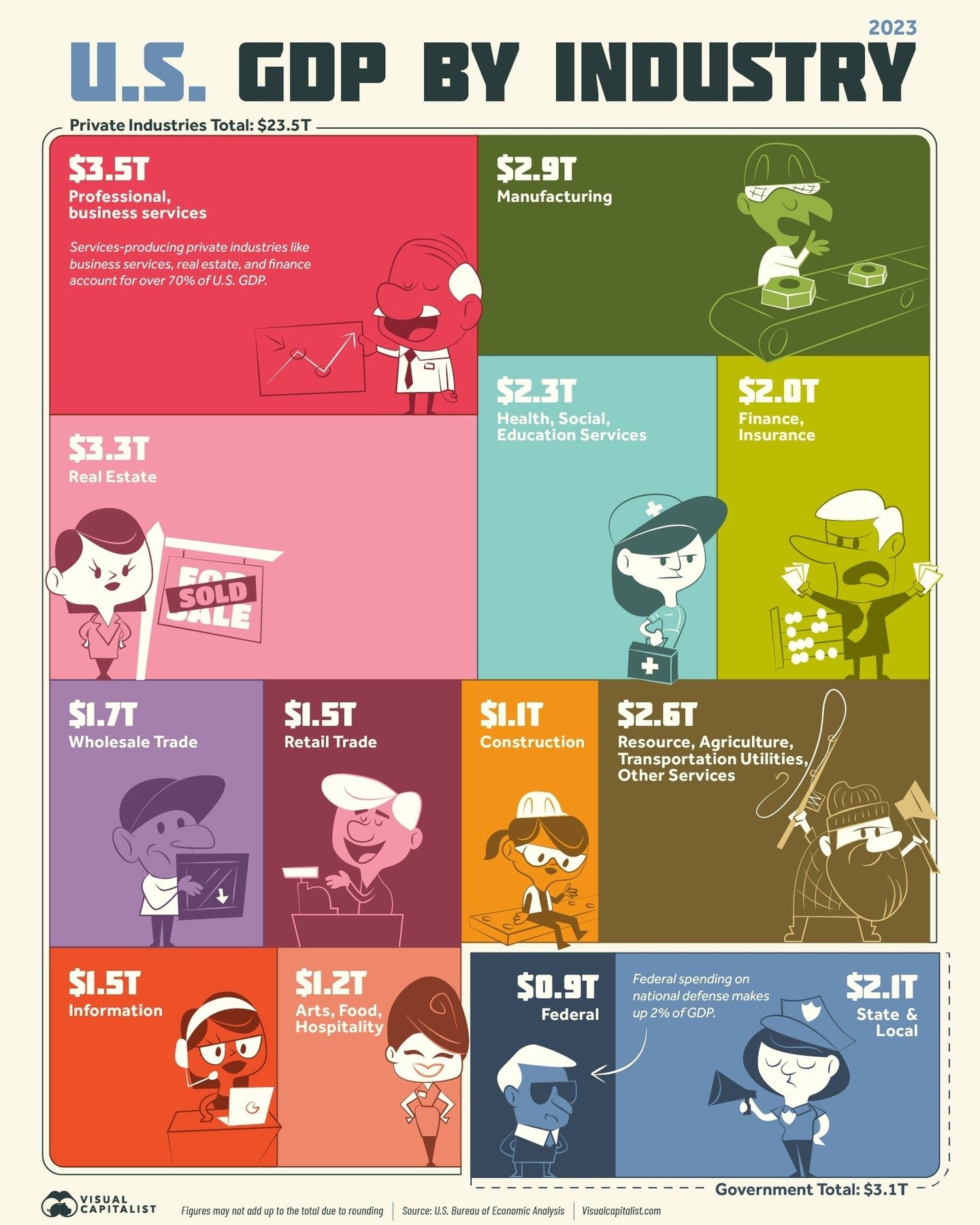
Understanding the breakdown of the U.S. Gross Domestic Product (GDP) by industry provides a clear picture of where commercial activity is most robust and how diverse the economy truly is. This analysis uses data from the Bureau of Economic Analysis to visualize the contributions of various sectors to the total GDP in 2023. By examining value added by industry, which reflects the difference between gross output and the cost of intermediate inputs, we can gain insights into the economic landscape.
Context / Why This Matters
The U.S. economy is a complex tapestry woven from the contributions of numerous industries. By breaking down the GDP by industry, we can identify which sectors are driving economic growth and understand the relative importance of each. This information is crucial for policymakers, investors, and businesses alike, as it helps in making informed decisions about resource allocation, investment strategies, and economic planning.
Main Discussion
Private vs. Government Sectors
Private industries are the backbone of the U.S. economy, contributing over 70% of the total GDP. In 2023, private industries accounted for $23.5 trillion, while government spending totaled $3.1 trillion. This disparity highlights the significant role that private enterprises play in driving economic activity.
Leading Private Industries
Several key sectors stand out in terms of their contributions to the GDP. Among these, professional and business services lead the way with an impressive $3.5 trillion. This sector includes a wide range of activities such as consulting, legal services, and administrative support, which are essential for the smooth operation of other industries. Following closely is real estate, which contributed $3.3 trillion, reflecting the robust demand for residential, commercial, and industrial properties. Manufacturers contribute a substantial $2.9 trillion, showcasing the strength of the U.S. manufacturing sector. Additionally, wholesale and retail trade sectors add significant value, with $1.7 trillion and $1.5 trillion respectively. These industries are pivotal in the distribution and retail of goods, ensuring that products reach consumers efficiently.
Government Spending
Government spending plays a crucial role in the economy, albeit to a lesser extent compared to private industries. Federal spending, particularly on national defense, accounts for 2% of the total GDP. State and local government spending, on the other hand, contribute significantly to areas such as education, healthcare, and infrastructure, which are vital for societal well-being and economic development.
Other Notable Sectors
The economy's diversity is further illustrated by the contributions of other sectors. The construction industry, valued at $1.1 trillion, is a key driver of infrastructure development and housing. Agriculture, transportation, utilities, and other services together add $2.6 trillion. This includes essential services such as healthcare, social services, and education, which are fundamental to the economy and society. Finance and insurance contribute $2.1 trillion, reflecting the sophisticated financial services sector. Information and arts, entertainment, and hospitality sectors contribute $1.1 trillion, showcasing the thriving creative and leisure industries.
Practical Tips
Investing in Key Sectors
For investors looking to capitalize on the strongest sectors, it's essential to consider the leading contributors to the GDP. Sectors such as professional and business services, real estate, and manufacturing offer ample opportunities for growth. However, it's also vital to diversify investments across various sectors to mitigate risks associated with economic fluctuations.
Policy Implications
Policymakers can use this data to identify areas that require support and investment. For instance, sectors like healthcare, education, and infrastructure need sustained investment to ensure long-term economic health. Additionally, fostering innovation and supporting small businesses can drive growth in various sectors, contributing to overall economic prosperity.
Business Strategy
Businesses can leverage this information to align their strategies with the most dynamic sectors. For example, investing in technology and innovation can offer a competitive edge in sectors like manufacturing and professional services. Furthermore, understanding the economic landscape can help businesses adapt to changing market conditions and identify new opportunities for growth.
Important Takeaways
- The U.S. economy is highly diversified, with private industries contributing over 70% of the GDP.
- Professional and business services, real estate, and manufacturing are the leading contributors, highlighting their economic significance.
- Government spending, particularly in areas like education, healthcare, and infrastructure, is crucial for societal well-being and economic development.
- The economy's diversity is evident in the contributions of various sectors, from healthcare and finance to information and hospitality.
- Investors, policymakers, and businesses can use this data to make informed decisions, strategize for growth, and foster economic prosperity.
Conclusion
The breakdown of U.S. GDP by industry reveals a dynamic and diversified economy. By analyzing the contributions of various sectors, we gain valuable insights into where economic activity is most robust and how different industries interplay to drive growth. This information is essential for stakeholders looking to make informed decisions, strategize for the future, and contribute to the overall economic health of the nation.
Watch the Reel
Questions readers ask
Which industries are the top contributors to the U.S. GDP in 2023?
In 2023, the top contributors to the U.S. GDP include professional services, real estate, and manufacturing. These sectors have shown significant growth and play a pivotal role in the nation's commercial activity, outpacing government spending in terms of economic contribution.
How does the finance industry contribute to the national GDP in 2023?
The finance industry is a substantial contributor to the U.S. GDP in 2023. It encompasses banking, insurance, and investment services, which collectively add significant value to the economy through their various financial activities and services.
What is the role of the trade industry in the U.S. economic analysis for 2023?
The trade industry, including wholesale and retail trade, plays a significant role in the U.S. economy for 2023. It facilitates the distribution of goods and services, connecting producers with consumers and contributing to overall economic activity and GDP.
How does government spending compare to private sector contributions in the 2023 GDP breakdown?
In 2023, private sector contributions significantly outperform government spending in the GDP breakdown. This highlights the importance of industries like professional services, real estate, and manufacturing in driving economic growth and stability.
What is the significance of understanding the GDP breakdown by sector for 2023?
Understanding the GDP breakdown by sector for 2023 is crucial for identifying which industries are thriving and contributing the most to the economy. This analysis helps in making informed decisions about investment, policy, and economic strategy, ensuring that resources are allocated effectively.
How does the manufacturing sector contribute to the U.S. GDP in 2023?
The manufacturing sector is a key player in the U.S. GDP in 2023. It encompasses a wide range of production activities, from automotive to technology, and contributes significantly to the nation's commercial activity and overall economic output.
What insights can be gained from examining the value added by industry in 2023?
By examining the value added by industry in 2023, we gain insights into the economic landscape, revealing the true economic contribution of each sector. This approach, using data from the Bureau of Economic Analysis, helps to understand the efficiency and productivity of each industry, beyond just their gross output.
Recent articles
Fresh deep dives from the latest Reels we unpacked.




Comments
Be the first to comment.