Currency Performance vs. USD
The U.S. dollar has been a remarkable safe haven for investors in the midst of a volatile global market. While many currencies and equities faced significant challenges, the greenback provided exceptional stability, with almost every currency worldwide declining against the U.S. dollar in 2022.
Context / Why this matters
Understanding the performance of major currencies against the U.S. dollar is crucial for investors, traders, and economists. The U.S. dollar's strength can influence global trade, investment flows, and economic policies. It's essential to analyze how different currencies have fared against the dollar, especially in a year marked by unprecedented volatility.
Main discussion
The Dollar Index: A Long-Term Perspective
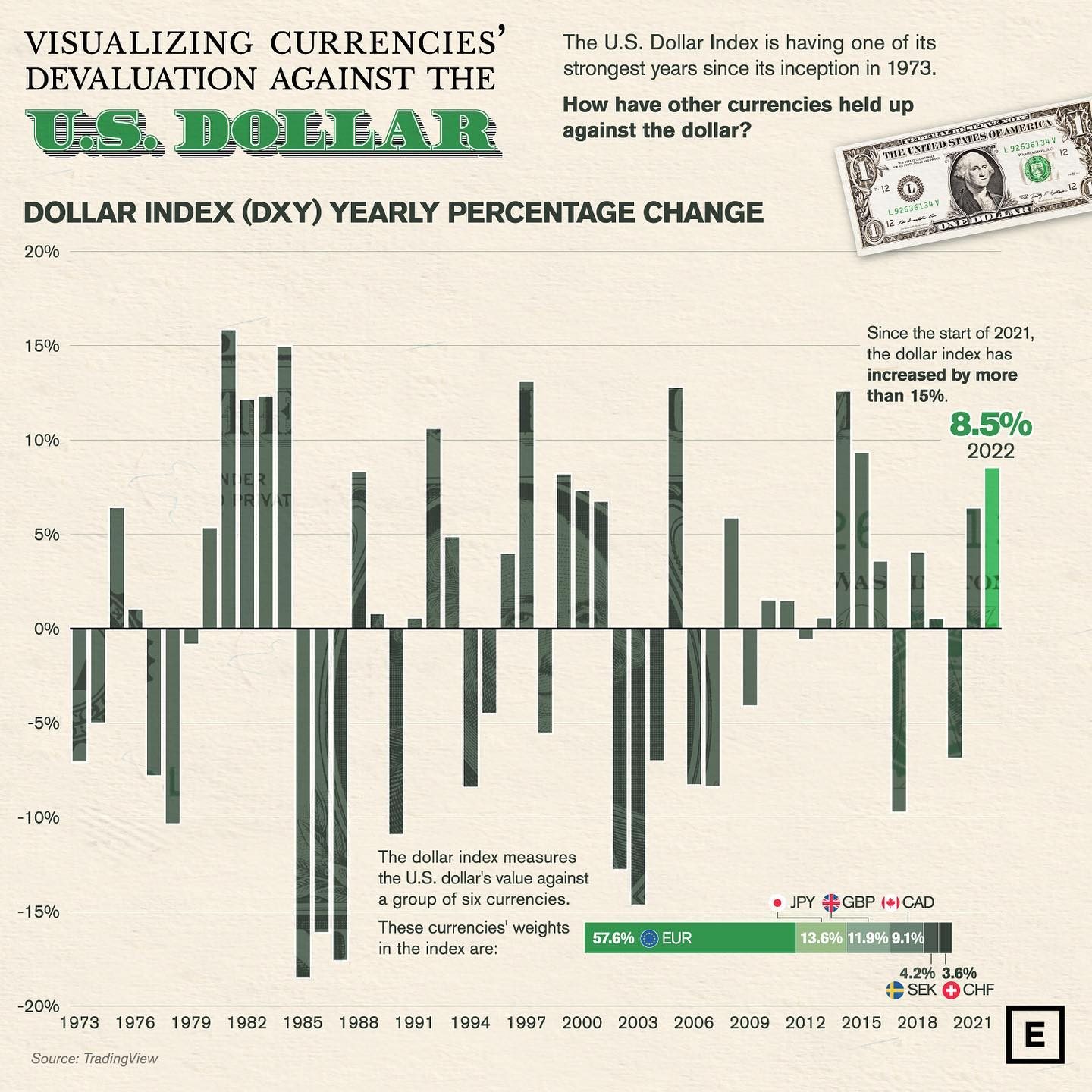
The Dollar Index (DXY) is a crucial measure of the U.S. dollar’s value relative to a basket of six major currencies: the euro, Japanese yen, British pound, Canadian dollar, Swedish krona, and Swiss franc. The index provides a comprehensive view of the dollar’s performance over time.
The DXY has seen significant fluctuations over the past five decades. From 1973 to 2021, the index's yearly percentage change offers a detailed look at the dollar’s strength and weaknesses. Notably, the dollar index has increased by more than 15% over this period, reflecting its overall resilience and attractiveness as a safe-haven asset.
Major Currency Performance in 2021 and 2022
In the past two years, several major currencies have experienced notable declines against the U.S. dollar. Here’s a breakdown of how some of the world's leading currencies have performed:
Canadian Dollar (CAD)
The Canadian dollar has shown relative resilience compared to other currencies. Elevated crude oil and commodity prices have supported the CAD, helping it stay stronger than many of its peers. However, it still recorded a decline of -6.0% against the USD.
Chinese Yuan (CNY)
The Chinese yuan has also faced challenges, with a decline of -6.1% against the USD. This decline can be attributed to various factors, including fluctuations in global trade and economic policies in China.
Indian Rupee (INR)
The Indian rupee has seen a more significant decline, with a -11.5% drop against the USD. This decline can be linked to India's economic challenges, including rising inflation and geopolitical tensions.
Swiss Franc (CHF)
The Swiss franc, traditionally seen as a safe-haven currency, experienced a decline of -4.1% against the USD. This reflects the complex interplay between global economic conditions and the franc's safe-haven status.
Australian Dollar (AUD)
The Australian dollar faced a decline of -10.7% against the USD. This drop can be attributed to factors such as fluctuations in commodity prices and global trade dynamics.
British Pound (GBP)
The British pound has had a turbulent time, with a -9.0% decline against the USD. Brexit-related uncertainties, along with economic challenges, have contributed to this decline.
Euro (EUR)
The euro faced a decline of -12.7% against the USD. The eurozone's economic struggles, including energy crises and geopolitical tensions, have significantly impacted the euro's performance.
Japanese Yen (JPY)
The Japanese yen experienced the most significant decline among the major currencies, with a -25.6% drop against the USD. This decline can be attributed to Japan's unique economic challenges, including low-interest rates and deflationary pressures.
Practical tips
Understanding the Factors Driving Currency Fluctuations
Staying informed about global economic trends and geopolitical events can help investors and traders anticipate currency movements. Economic indicators, such as inflation rates, interest rates, and trade balances, play a pivotal role in determining a currency's strength. Additionally, geopolitical tensions and policy changes can significantly impact currency performance.
Diversifying Your Portfolio
Given the volatility in currency markets, diversifying your portfolio across different asset classes, including currencies, equities, and commodities, can help mitigate risks. A balanced portfolio can provide stability and potential returns even during turbulent market conditions.
Monitoring the Dollar Index
The Dollar Index (DXY) serves as a valuable indicator of the U.S. dollar’s strength. Monitoring the DXY can provide insights into the overall direction of the dollar and help investors make informed decisions about their portfolios.
Important takeaways
The U.S. Dollar’s Role as a Safe Haven
The U.S. dollar's performance in 2022 underscores its role as a safe-haven asset. Despite global economic uncertainties, the dollar’s resilience and stability have made it a preferred choice for investors seeking to preserve their wealth.
Global Economic Conditions and Currency Performance
The performance of major currencies against the U.S. dollar reflects the broader global economic conditions. Understanding these conditions and their impact on currency performance can provide valuable insights for investors and traders.
The Importance of Diversification
Diversifying your portfolio and staying informed about economic indicators and geopolitical events are essential strategies for navigating the volatile currency markets. These strategies can help investors mitigate risks and achieve their financial goals.
Conclusion
The U.S. dollar's exceptional stability in 2022 highlights its enduring strength as a safe-haven asset. Understanding the performance of major currencies against the dollar can provide valuable insights into global economic conditions and help investors make informed decisions about their portfolios.
Watch the Reel
Questions readers ask
What is the Dollar Index (DXY) and why is it important for understanding USD performance in 2022?
The Dollar Index (DXY) is a measure that tracks the value of the U.S. dollar against a basket of six major currencies. It's important for understanding USD performance in 2022 because it provides a clear picture of how the dollar has fared against other major global currencies, highlighting its strength and stability.
How did the US dollar perform against the Euro in 2022?
In 2022, the U.S. dollar showed significant strength against the Euro. This was driven by various factors, including monetary policy differences and economic uncertainties in the Eurozone. The yearly change in the US dollar against the Euro reflected this trend, with the greenback appreciating notably.
Which currencies experienced the most significant declines against the US dollar in 2022?
In 2022, almost every major currency worldwide experienced a decline against the U.S. dollar. While the extent varied, currencies like the Japanese Yen and the Euro faced significant challenges in 2022, highlighting the greenback's exceptional stability and strength.
What factors contributed to the US dollar's strength in 2022?
Several factors contributed to the U.S. dollar's strength in 2022. These included the dollar's safe-haven status during global market volatility, differences in monetary policy, and economic uncertainties affecting other currencies. Additionally, the historically high yearly change in the US dollar reflects these influences.
How can investors and traders use the Dollar Index to inform their strategies?
Investors and traders can use the Dollar Index to gauge the relative strength of the U.S. dollar compared to other major currencies. By analyzing the DXY performance, they can make informed decisions about currency trades, investments in dollar-denominated assets, and hedging strategies to navigate the volatile market.
What is the historical performance of the Dollar Index and how does 2022 compare?
The historical performance of the Dollar Index shows periods of strength and weakness influenced by various economic and geopolitical factors. 2022 stands out as a year of exceptional strength for the U.S. dollar, with the DXY showing a remarkable rise against other currencies, reflecting the dollar's role as a safe haven in uncertain times.
Why is the performance of major currencies against the USD important for global trade and economic policies?
The performance of major currencies against the USD is vital for global trade and economic policies because it affects trade flows, investment decisions, and economic policies worldwide. A strong U.S. dollar can influence export competitiveness, foreign investment, and the effectiveness of monetary policies in other countries.
Recent articles
Fresh deep dives from the latest Reels we unpacked.




Comments
Be the first to comment.