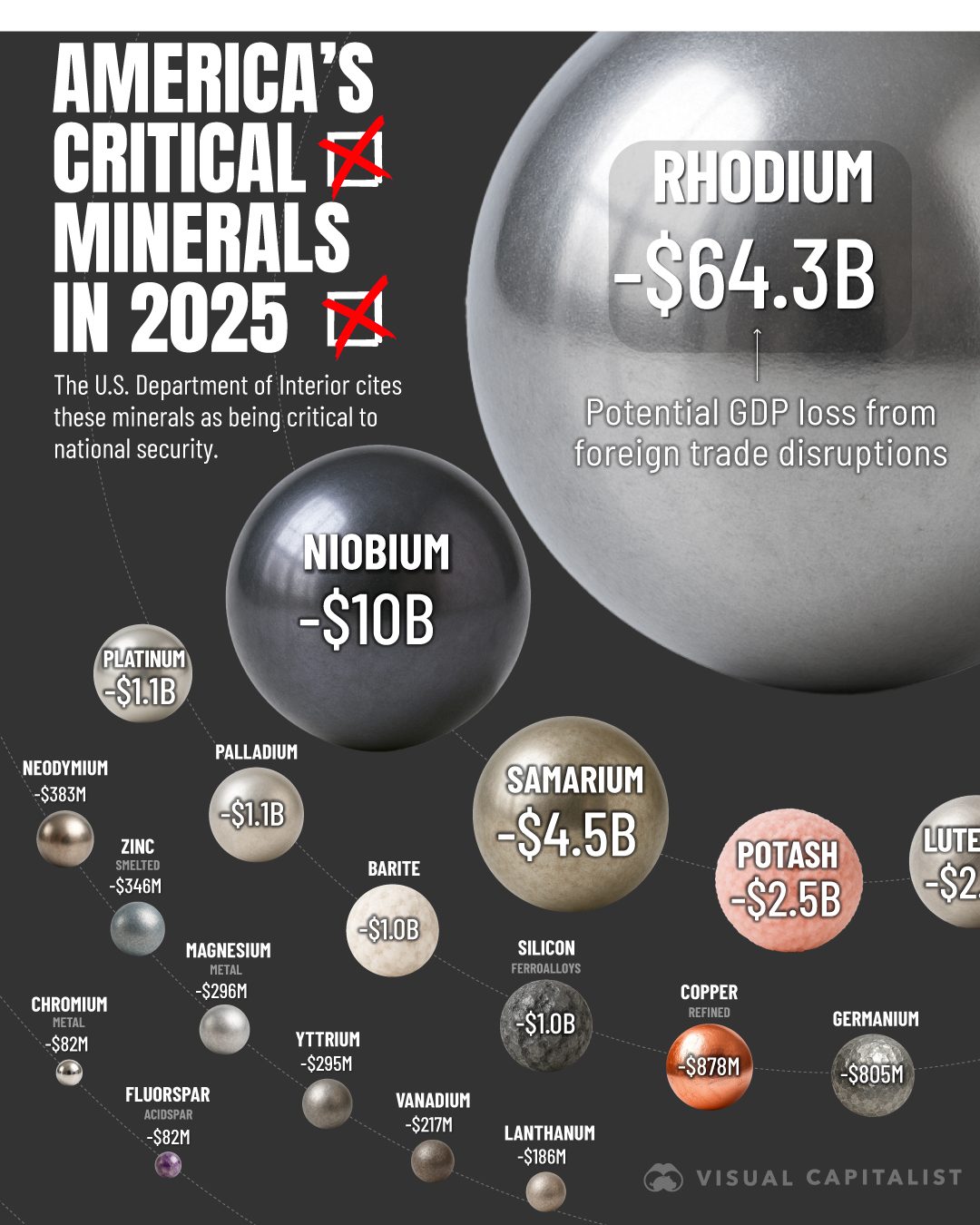
Critical Minerals and GDP Loss
The United States relies heavily on foreign suppliers for critical minerals, with China being the top source for a significant number of these resources. A disruption in the supply of these minerals, particularly rhodium, could have catastrophic economic consequences. Let's delve into the specifics of these critical minerals, their importance, and the potential economic impact of supply disruptions.
Context / Why This Matters
Critical minerals are essential for various industries, including technology, defense, and energy. They are vital for manufacturing critical components such as batteries, electronics, and advanced materials. The U.S. Department of the Interior identifies these minerals as critical to national security, which underscores their significance. Understanding the potential risks associated with their supply is crucial for strategic planning and economic stability.
Main Discussion
The Role of Critical Minerals
Critical minerals play a pivotal role in modern economies. They are used in a wide range of applications, from high-tech devices to infrastructure. For instance, rhodium is used in catalytic converters for automobiles, while neodymium is essential for the production of permanent magnets used in wind turbines and electric vehicles. The disruption of their supply can have far-reaching effects on various sectors.
Top Sources and Supply Risks
China is the primary source for 46 of the 84 critical minerals examined by the U.S. Geological Survey (USGS). This heavy reliance on a single country poses significant risks. Political tensions, trade disruptions, and changes in trade policies can all impact the supply chain and lead to shortages. For example, a disruption in rhodium imports from South Africa alone could cost the U.S. over $64.3 billion in GDP. Other minerals like platinum, neodymium, and samarium also have substantial financial implications, with potential GDP losses ranging from hundreds of millions to billions of dollars.
Specific Minerals and Their Impact
- Rhodium: This precious metal is crucial for automotive catalytic converters. A disruption in its supply could lead to a GDP loss of $64.3 billion. Rhodium is primarily sourced from South Africa, making it vulnerable to geopolitical risks.
- Platinum: Used in various industrial applications, including jewelry and catalytic converters, a disruption in platinum supply could result in a GDP loss of $1.1 billion. South Africa and Russia are the primary sources of platinum.
- Neodymium: Essential for permanent magnets, neodymium is used in wind turbines and electric vehicles. A supply disruption could cause a GDP loss of $383 million. China is a significant supplier of neodymium.
- Samarium: Used in magnets and for nuclear applications, a disruption in samarium supply could lead to a GDP loss of $4.5 billion. China is again a major source.
- Potash: Critical for agriculture, a disruption in potash supply could result in a GDP loss of $2.5 billion. Canada, Russia, and Belarus are the primary suppliers.
Importance of Diversifying Suppliers
Given the heavy dependence on foreign suppliers, particularly China, diversifying the sources of critical minerals is essential. This can be achieved through several strategies, including:
- Domestic Production: Encouraging and investing in domestic mining to reduce reliance on foreign suppliers.
- International Partnerships: Strengthening trade relationships with other countries to secure alternative sources of critical minerals.
- Research and Development: Investing in research to find alternative materials or technologies that can reduce the reliance on critical minerals.
- Strategic Stockpiling: Maintaining strategic reserves of critical minerals to mitigate the impact of supply disruptions.
Practical Tips
Strategies for Businesses
- Supply Chain Diversification: Businesses should explore multiple suppliers for critical minerals to reduce the risk of shortages.
- Risk Management: Implement risk management strategies to prepare for potential disruptions. This includes financial hedging, contingency planning, and maintaining strategic reserves.
- Adoption of Recycling: Promote recycling programs to recover critical minerals from end-of-life products, reducing the need for new supply.
Strategies for Policy Makers
- Incentivize Domestic Mining: Provide tax incentives and regulatory support for domestic mining operations.
- Foster International Alliances: Develop strong trade agreements and partnerships with countries that can supply critical minerals.
- Invest in Research: Support research and development in materials science to find alternatives or improve recycling technologies.
Important Takeaways
In summary, the U.S. faces significant risks due to its heavy reliance on foreign suppliers for critical minerals. A disruption in the supply of minerals like rhodium, platinum, and neodymium could have substantial economic consequences. Addressing these risks requires a multi-faceted approach, including diversifying suppliers, promoting domestic production, and investing in research and development. By taking proactive measures, the U.S. can mitigate the impact of supply disruptions and ensure the stability of its critical industries.
Conclusion
Critical minerals are indispensable for modern technologies and industries. The potential economic impact of supply disruptions underscores the need for strategic planning and risk management. By diversifying suppliers, promoting domestic production, and investing in research, the U.S. can safeguard its economic interests and maintain its competitive edge in the global market.
Watch the Reel
Questions readers ask
Which critical minerals pose the most significant risk to the U.S. in 2025?
The most significant risks are associated with minerals like rhodium, which are crucial for industries such as automotive and renewable energy. Other minerals, such as rare earth minerals, platinum, and titanium, also present notable risks due to their widespread use in technology and defense sectors.
How does U.S. dependency on foreign minerals impact the economy?
The U.S. dependency on foreign suppliers, primarily China, for critical minerals leaves the economy vulnerable to supply disruptions. These disruptions can lead to increased production costs, delays in manufacturing, and potential shortages, all of which can negatively impact the GDP.
What role do critical minerals play in the defense sector?
Critical minerals are essential for manufacturing advanced materials, electronics, and other components crucial for national defense. A disruption in the supply of these minerals could compromise the production of military equipment and technologies, posing significant risks to national security.
What are the potential impacts of a rhodium supply disruption on the U.S.?
Rhodium is vital for automotive catalytic converters and renewable energy technologies. A supply disruption could lead to increased costs for these industries, potential shortages, and reduced economic output, all of which could have serious consequences for the GDP.
How does the U.S. aim to mitigate risks associated with critical minerals?
The U.S. Department of the Interior identifies critical minerals essential to national security, and efforts are underway to reduce dependency on foreign suppliers. This includes diversification of suppliers, increased domestic production, and strategic stockpiling to ensure a stable supply and mitigate economic risks.
What is the significance of rare earth minerals in 2025?
Rare earth minerals are crucial for a wide range of technologies, including electronics, clean energy, and defense. In 2025, the demand for these minerals is expected to rise, making supply disruptions a significant concern. Ensuring a stable supply of rare earth minerals is essential for maintaining technological advancement and economic stability.
What steps can industries take to prepare for potential supply disruptions in 2025?
Industries can prepare by diversifying their supply chains, investing in domestic production capabilities, and developing contingency plans. Regularly assessing the supply risks and maintaining open communication with suppliers can also help mitigate the impacts of potential disruptions and ensure business continuity.
Related deep dives
Similar reads based on topic and creator.

Recent articles
Fresh deep dives from the latest Reels we unpacked.




Comments
Be the first to comment.