U.S. Office Vacancy Rates
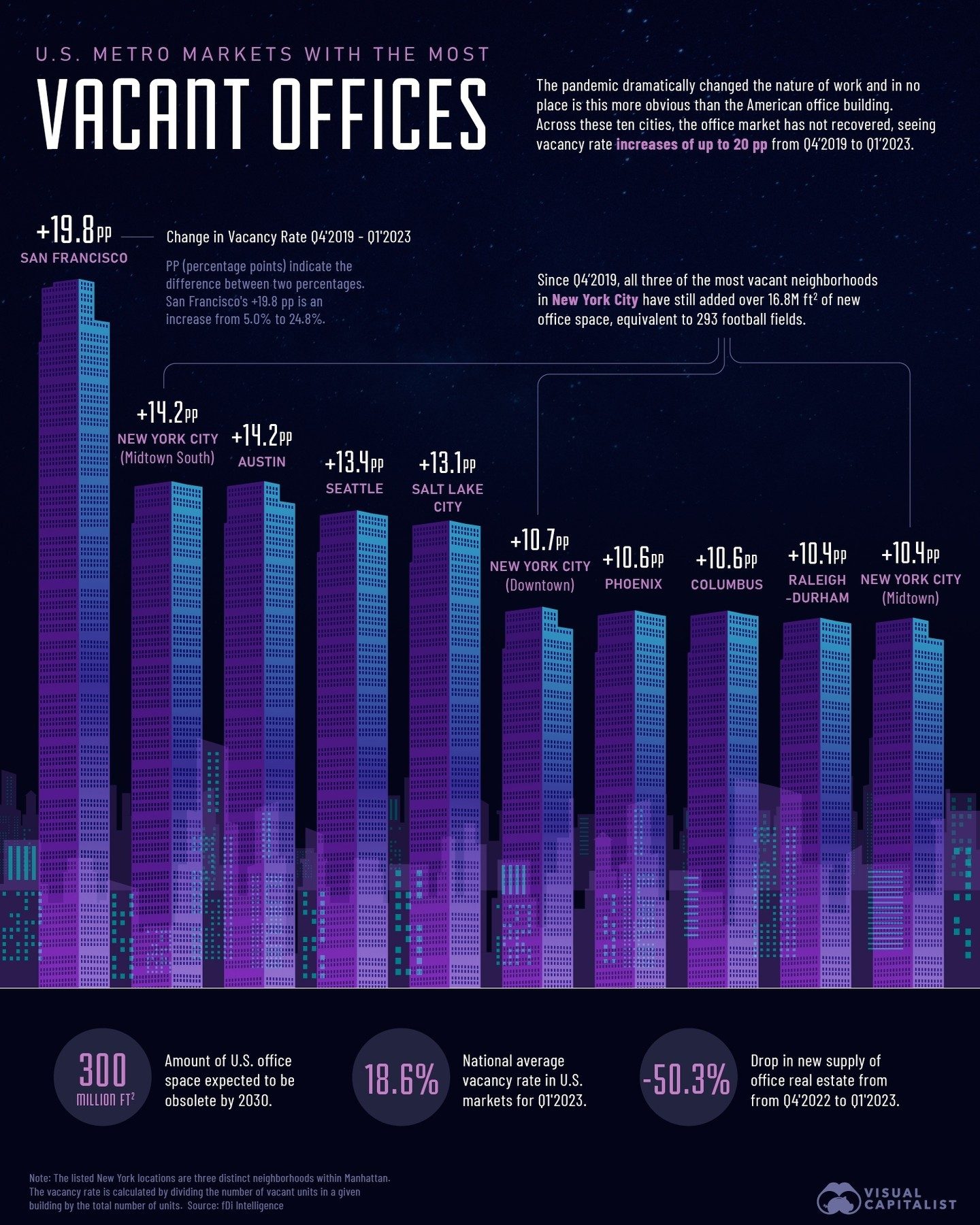
The shift to remote work has left many offices across the U.S. vacant. By March 2023, the national average vacancy rate for U.S. offices hit 18.6%. This shift has varied significantly among different cities, with some experiencing much higher increases in vacancy rates than others. Let's delve into how major U.S. cities have been impacted by this trend.
Context / Why This Matters
Understanding the current state of office vacancy rates is crucial for several reasons. For one, it provides insights into the evolving nature of work and urban development. Additionally, it has significant implications for commercial real estate investors, urban planners, and policymakers. The data can inform decisions about future office space development, urban planning strategies, and economic policies.
Main Discussion
The Impact on Major Cities
The changes in office vacancy rates have been stark and varied across different cities. San Francisco, for example, has seen a dramatic increase of 19.8 percentage points, rising from a 5.0% vacancy rate in April 2019 to 24.8% by January 2023. This shift highlights the significant impact of remote work on high-density urban areas.
San Francisco
- Vacancy Rate Increase: +19.8 percentage points
- Vacancy Rate Increase: From 5.0% to 24.8%
New York City, another major urban center, has also felt the effects of increased vacancies. Despite high vacancy rates, certain neighborhoods in New York City have continued to add new office space. Specifically, the three most vacant neighborhoods have added over 16.8 million square feet of new office space since April 2019. This area is equivalent to 293 football fields, indicating a continued investment in office infrastructure despite the shift to remote work.
Trends in Other Major Cities
Other cities have also seen notable increases in office vacancy rates:
- Austin: +13.4 percentage points
- Salt Lake City: +13.1 percentage points
- Seattle: +10.7 percentage points
- Phoenix: +10.6 percentage points
- Columbus: +10.4 percentage points
These cities, like San Francisco and New York, have experienced significant increases in office vacancies, reflecting broader trends in the U.S. office market.
Broader Implications
The shift towards remote work has led to a substantial amount of office space becoming obsolete. It is estimated that 300 million square feet of U.S. office space will be obsolete by 2030. This trend is exacerbated by a -50.3% drop in new office supply from April 2022 to January 2023. This decline in new construction contrasts sharply with the pre-pandemic period, indicating a significant shift in the real estate market.
Practical Tips
For those involved in commercial real estate, understanding these trends is essential for making informed decisions. Here are some practical tips:
For Investors
Investors should consider the potential for long-term vacancy in urban areas and assess the viability of converting office spaces into residential or mixed-use properties. Additionally, investing in suburban or hybrid office spaces that can accommodate both in-person and remote work may be a more sustainable strategy.
For Urban Planners
Urban planners should focus on redeveloping vacant office spaces into community-focused areas that can support local economic growth and provide essential amenities. This could include converting offices into affordable housing, community centers, or retail spaces.
For Businesses
Businesses should consider the benefits and drawbacks of hybrid work models, taking into account the cost savings from reduced office space as well as the potential impact on employee morale and productivity. It may also be worth investing in remote work infrastructure to support a hybrid model.
Important Takeaways
- Vacancy Rates: The national average vacancy rate for U.S. offices reached 18.6% by the end of March 2023.
- City-Specific Trends: Cities like San Francisco, New York, and Austin have seen significant increases in office vacancy rates.
- Urban Development: The trend towards remote work is impacting office space demand and influencing urban development strategies.
- Future Outlook: The future of office space is uncertain, with significant amounts of space expected to become obsolete by 2030.
Conclusion
The shift to remote work has had a profound impact on office vacancy rates across the U.S. Understanding these trends is essential for making informed decisions in commercial real estate, urban planning, and business strategy. By staying informed and adaptable, stakeholders can navigate this evolving landscape and contribute to the transformation of urban areas.
Watch the Reel
Questions readers ask
Why have office vacancy rates increased so significantly in many U.S. cities?
The primary driver behind the increase in office vacancy rates is the widespread shift to remote work, accelerated by the COVID-19 pandemic. Many companies have reduced their office space needs as employees continue to work from home, leading to a surge in vacant properties.
Which cities have experienced the most dramatic increases in office vacancy rates?
Cities like San Francisco and New York have seen some of the most dramatic increases. San Francisco, for example, experienced a more than fourfold increase in some areas, while New York has also witnessed a substantial rise in vacancies.
What is the national average office vacancy rate as of 2023?
By March 2023, the national average vacancy rate for U.S. offices reached 18.6%. This figure highlights the broader impact of remote work trends on commercial real estate across the country.
How do varying office vacancy rates across cities impact urban development?
The differing office vacancy rates across cities can influence urban development by affecting demand for new office spaces and shaping the future of commercial real estate. Cities with high vacancy rates may need to adapt their urban planning strategies to accommodate this shift.
What implications do high office vacancy rates have for commercial real estate investors?
High office vacancy rates present both challenges and opportunities for commercial real estate investors. Investors may face lower rental income and potential devaluation of properties, but there are also opportunities for acquiring properties at lower prices for future development or repurposing.
How might the current office vacancy trends influence future office space development?
Current trends suggest that future office space development may prioritize flexibility, hybrid work models, and amenities that cater to the evolving needs of employees. This could include more collaborative spaces and technology integration to support remote and in-office work.
What factors should policymakers consider in response to increasing office vacancies?
Policymakers should consider the potential economic and social impacts of increasing office vacancies, such as changes in local tax revenues and the need for repurposing commercial spaces. Developing policies that support sustainable urban development and economic growth in the face of these changes will be crucial.
Recent articles
Fresh deep dives from the latest Reels we unpacked.




Comments
Be the first to comment.