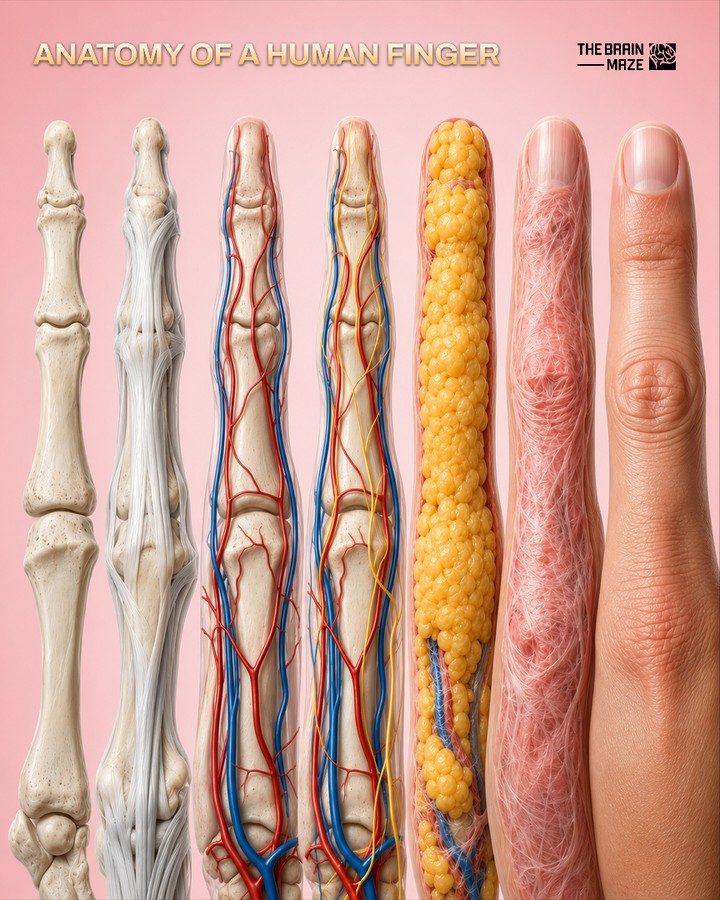
Human Finger Anatomy
Your fingers are remarkable structures, each composed of multiple specialized layers designed to work together seamlessly. These layers provide strength, movement, sensation, and protection, enabling precise motion and constant sensory feedback. Beneath the skin lie connective tissues, fat, nerves, blood vessels, tendons, ligaments, and bones, all playing crucial roles in the functions your fingers perform daily.
Context / Why This Matters
Understanding the anatomy of a human finger is essential for appreciating the intricate design that allows for such a wide range of movements and functions. Whether gripping a tool, typing on a keyboard, or performing delicate tasks, your fingers are capable of thousands of complex movements every day. Each layer of the finger, from the skin to the bones, contributes to its overall functionality and resilience.
Anatomy and Function
The Skin and Subcutaneous Tissue
The outermost layer of the finger is the skin, which provides a protective barrier. Beneath the skin is the subcutaneous tissue, a layer of fat and connective tissue that cushions the deeper structures and helps insulate the finger.
Blood Vessels and Nerves
Blood vessels and nerves run throughout the finger, supplying it with oxygen and nutrients and transmitting sensory information to the brain. The arteries carry blood to the fingertips, while the veins return blood to the heart. Nerves provide the sensory feedback that allows us to feel texture, temperature, and pressure. The median and ulnar nerves are particularly important, controlling movement and sensation in the fingers.
Bones
The bones of the finger are small but incredibly strong. Each finger, except the thumb, has three phalanges: the proximal, middle, and distal. The thumb has only two. These bones are connected by joints, which allow for a wide range of motion. The ligaments and tendons that surround these joints provide stability and facilitate movement.
Connective Tissues, Tendons, and Ligaments
Connective tissues, such as fascia, surround the muscles and tendons, providing support and structure. Tendons attach muscles to bones, enabling movement. For example, the flexor tendons allow you to bend your fingers, while the extensor tendons help straighten them. Ligaments connect bones to other bones, providing stability and preventing excessive movement at the joints.
Fatty Tissue
Fat is an important component of the finger, acting as a cushion and insulator. It helps protect the delicate structures within the finger, such as nerves and blood vessels, and aids in the absorption of shock during impact. Additionally, fatty tissue provides a layer of insulation, helping to regulate temperature and prevent heat loss.
Muscles
Small muscles in the hand and forearm control the movements of the fingers. These muscles are connected to the bones by tendons, which cross the wrist and extend into the fingers. The intricate arrangement of these muscles and tendons allows for precise and coordinated movements, essential for tasks requiring fine motor skills.
Supporting Structures
Nail
The nail on the fingertip is a hard, keratinized structure that provides protection and support. It also plays a role in fine-tuning sensory feedback, enhancing the ability to feel and manipulate objects.
Sweat Glands
Sweat glands in the finger help regulate temperature and maintain skin moisture. These glands are particularly important in the finger pads, where they aid in gripping by keeping the skin hydrated and improving friction.
Hair Follicles
Although not as prominent as on other parts of the body, hair follicles in the fingers play a role in sensory perception. They are sensitive to touch and pressure, contributing to the overall sensory feedback from the finger.
Practical Tips
Maintaining Finger Health
Maintaining the health of your fingers involves proper care and awareness of their functionality. Here are some practical tips:
- Avoid overuse and repetitive strain: Repetitive movements can lead to injuries such as tendinitis and carpal tunnel syndrome. Take breaks and use ergonomic tools to reduce strain.
- Keep your nails trimmed: Proper nail care helps prevent infections and maintains the health of the nail bed.
- Protect your fingers: Wear gloves when handling sharp objects or performing tasks that could cause injury.
- Stay hydrated: Drinking plenty of water helps maintain skin moisture and overall finger health.
Strengthening Exercises
Regular exercises can help strengthen the muscles and tendons in your fingers, improving dexterity and reducing the risk of injury. Some examples include:
- Finger stretches: Gently stretch your fingers by spreading them apart and holding the position for a few seconds. Repeat this several times a day.
- Finger lifts: Place your hand flat on a table and lift each finger individually, holding for a few seconds before lowering. Repeat with each finger.
- Squeeze exercises: Use a stress ball or putty to squeeze and release, which helps strengthen the muscles in the hand and fingers.
Important Takeaways
Functionality
Each layer of the finger plays a crucial role in its overall functionality. The bones, muscles, tendons, and ligaments work together to provide strength and movement, while the skin, nerves, and blood vessels ensure sensation and protection.
Complexity
The human finger is a complex structure with multiple specialized layers. Understanding these layers can help appreciate the intricate design and functionality of the finger.
Maintenance
Proper care and maintenance are essential for keeping your fingers healthy and functional. Regular exercises and protective measures can help prevent injuries and maintain overall finger health.
Sensory Feedback
The constant sensory feedback from the fingers allows us to perform tasks with precision and accuracy. The nerves and blood vessels, along with other supportive structures, ensure that the fingers remain sensitive and responsive.
Conclusion
The anatomy of the human finger is a testament to the body's remarkable design, with each layer performing specific functions to enable a wide range of movements and tasks. From gripping and feeling to healing and performing complex actions, the fingers are essential for daily activities. Whether you're a musician, athlete, or simply appreciate the intricacies of the human body, understanding the anatomy of the finger provides valuable insight into one of the most versatile and important parts of the human body.
Watch the Reel
Questions readers ask
How many bones are present in a single human finger?
A single human finger contains three bones, known as phalanges. These bones are the distal, middle, and proximal phalanges, and they are interconnected by joints that allow for a wide range of movements.
What role do tendons and ligaments play in finger anatomy?
Tendons and ligaments are crucial for finger movement and stability. Tendons connect muscles to bones, enabling flexion and extension. Ligaments connect bones to other bones, providing stability and preventing excessive movement, especially at the joints.
How does the internal structure of a finger support sensory feedback?
The internal structure of a finger includes a network of nerves and blood vessels that work together to provide sensory feedback. These nerves transmit signals to the brain, allowing you to sense touch, pressure, and temperature, which is essential for performing intricate tasks.
What is the role of the connective tissues in the fingers?
Connective tissues in the fingers, such as fascia and fat, provide a supportive framework and protection for the internal structures. They help distribute forces, absorb shock, and maintain the overall structure and shape of the fingers during movement and daily activities.
What are the different types of movements the anatomy of the hand allows?
The anatomy of the hand allows for various types of movements, including flexion (bending the fingers), extension (straightening the fingers), abduction (moving the fingers away from the midline), and adduction (moving the fingers towards the midline). These movements are essential for gripping, grasping, and manipulating objects.
How do the layers of the finger work together for precise movements?
The layers of the finger, including the skin, connective tissues, and bones, work together to enable precise movements. The skin and connective tissues provide a protective covering and support, while the bones and joints allow for controlled motion, allowing for the intricate tasks the fingers perform daily.
Related deep dives
Similar reads based on topic and creator.


Recent articles
Fresh deep dives from the latest Reels we unpacked.




Comments
Be the first to comment.