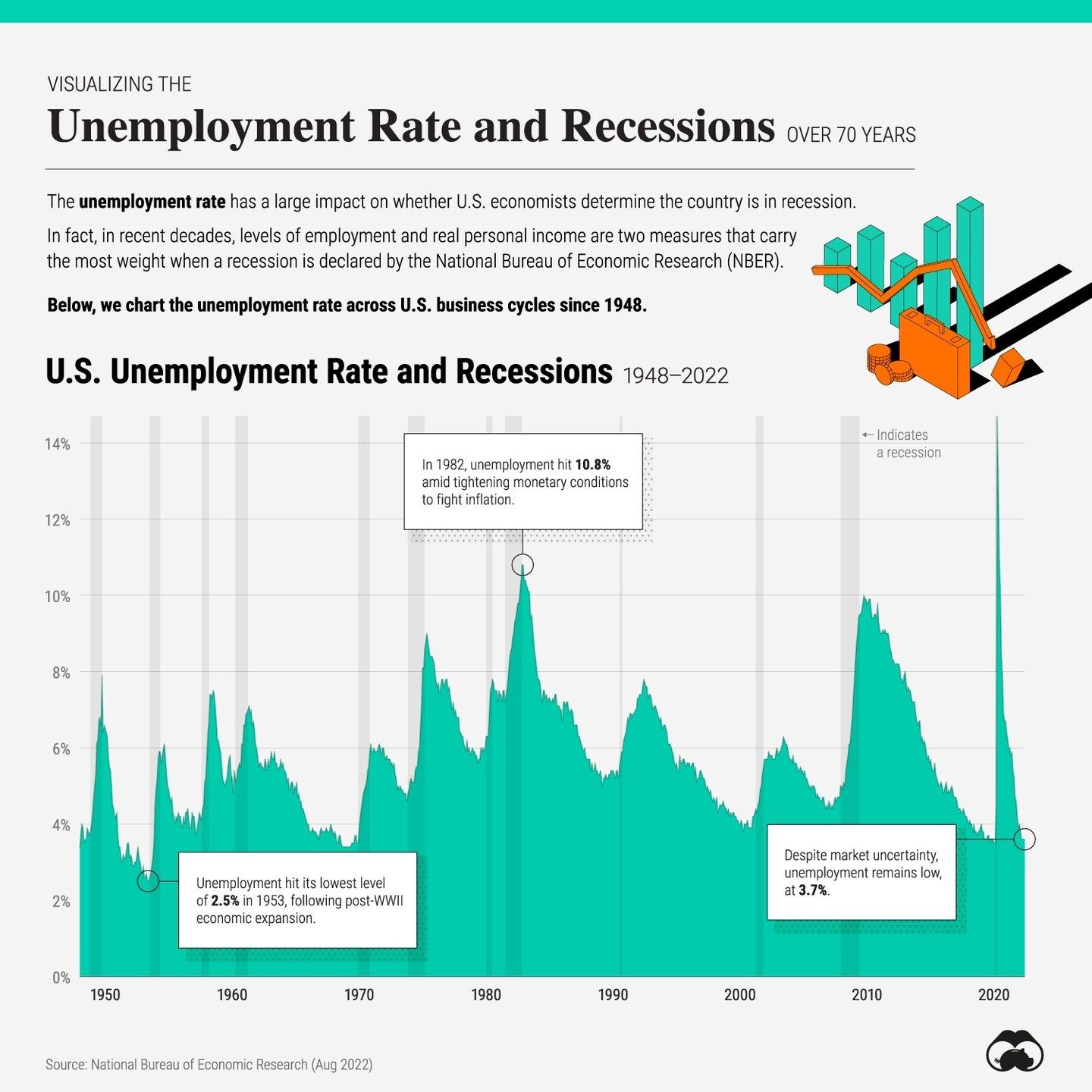
U.S. Unemployment Rate and Recessions
The U.S. unemployment rate, as of August 2022, stands at 3.7%, significantly below its 74-year average of 5.5%. Understanding this figure is crucial for gauging the current economic health and predicting potential recessions.
Why This Matters
Employment data is a cornerstone for economists when determining whether the country is in a recession. Over the past few decades, employment-related factors have carried substantial weight in these assessments. Unemployment rates provide a direct measure of economic stress, reflecting the number of people actively seeking jobs but unable to find them. This, in turn, influences consumer spending, business investment, and overall economic confidence.
Historical Context
Post-WWII Economic Recovery
Following World War II, the U.S. economy experienced robust growth. By 1953, the unemployment rate hit an astonishing low of 2.5%. This period was characterized by high levels of consumer demand, government spending, and industrial production, driving the economy to new heights.
The Recession of 1982
In stark contrast, 1982 marked one of the most challenging periods for the U.S. economy. Unemployment soared to 10.8% amid tightening monetary conditions. The Federal Reserve, under Paul Volcker, implemented stringent measures to combat double-digit inflation. Although these actions eventually stabilized prices, they resulted in a deep recession and a significant spike in unemployment.
Recent Trends
Despite ongoing market uncertainties, the current unemployment rate of 3.7% is significantly lower than historical averages. This low rate reflects a relatively stable job market and continued economic growth, though it does not entirely insulate the economy from future shocks.
The Role of Unemployment in Recession Determinations
Economists rely on a variety of indicators to determine recessions, but unemployment is a key metric. A rising unemployment rate often signals economic distress, while a stable or declining rate suggests a healthy job market.
Factors Influencing Unemployment
Several factors influence unemployment rates, including fiscal and monetary policies, economic growth, and technological advancements. For instance, during periods of economic expansion, businesses tend to hire more, reducing unemployment. Conversely, during contractions, layoffs increase, pushing up the unemployment rate. Policies aimed at stimulating economic activity can also mitigate the rise in unemployment.
Unemployment Rate Fluctuations
Unemployment rates fluctuate over time, reflecting both cyclical and structural changes in the economy. Cyclical changes are tied to the business cycle, with unemployment rising during recessions and falling during expansions. Structural changes, such as shifts in industry composition or technological advancements, also affect unemployment levels. For example, the advent of automation can lead to job displacement in certain sectors, contributing to higher unemployment rates.
The 1948–2022 Timeline
Key Economic Events
From 1948 to 2022, the U.S. economy has experienced numerous cycles of growth and contraction. Key events, such as the post-WWII economic recovery, the recessions of the 1980s, and the Great Recession of 2008, have significantly impacted unemployment rates. These events highlight the cyclical nature of the economy and the importance of monitoring unemployment trends.
Post-WWII Boom
The post-WWII period was marked by an economic boom driven by increased consumer demand and pent-up savings. This period saw significant job growth, with the unemployment rate reaching its lowest point in 1953. The economic expansion was fueled by government spending, industrial production, and technological advancements.
The 1980s Recession
The 1980s were characterized by significant economic volatility, with the unemployment rate fluctuating widely. The recession of 1982 was particularly severe, with unemployment peaking at 10.8%. This period saw the Federal Reserve raise interest rates to combat inflation, leading to a sharp economic downturn and high levels of unemployment.
The Great Recession
The Great Recession of 2008, triggered by the financial crisis, saw unemployment rates rise to 10%. The economic downturn was marked by a collapse in the housing market, a financial crisis, and a decline in consumer confidence. The recovery was slow, with unemployment rates gradually declining over several years.
Practical Tips for Understanding Economic Trends
Analyzing Unemployment Data
Understanding unemployment data involves analyzing various metrics, such as the unemployment rate, underemployment rate, and labor force participation rate. These metrics provide a comprehensive view of the job market and economic health. For instance, a high underemployment rate might indicate that while people are employed, they are not working in jobs that utilize their full skill set.
Monitoring Economic Indicators
In addition to unemployment data, monitoring other economic indicators, such as GDP growth, inflation, and consumer confidence, can provide a broader perspective on the economy. These indicators help in assessing the overall health of the economy and predicting future trends.
Staying Informed
Staying informed about economic trends and policies is crucial for making informed decisions. Keeping up with economic news, reports, and analyses can help individuals and businesses navigate economic uncertainties more effectively.
Important Takeaways
- The unemployment rate is a critical indicator of economic health, with significant fluctuations over the years.
- Employment-related factors weigh heavily in recession determinations.
- Understanding historical trends and key economic events provides context for current unemployment levels.
- Monitoring multiple economic indicators offers a more comprehensive view of the economy.
Conclusion
The U.S. unemployment rate, currently at 3.7%, provides valuable insights into the current economic landscape. Historical data shows how unemployment rates have fluctuated over the years, reflecting the cyclical and structural changes in the economy. By understanding these trends and factors, individuals and businesses can better navigate economic uncertainties and make informed decisions.
Watch the Reel
Questions readers ask
What does the current U.S. unemployment rate indicate about the economy?
The current U.S. unemployment rate of 3.7% suggests a strong job market and overall economic health. It is significantly lower than the historical average of 5.5%, indicating that fewer people are actively seeking jobs but unable to find them. This can boost consumer spending and business investment, contributing to a more stable economy.
How has the U.S. unemployment rate influenced recession predictions in the past?
Historically, the unemployment rate has been a key indicator for predicting recessions. A rising unemployment rate often signals economic stress and can precede a recession by several months. Economists closely monitor changes in unemployment to assess the likelihood of an economic downturn.
What are some other key indicators alongside the unemployment rate for predicting recessions?
While the unemployment rate is a crucial indicator, other factors such as GDP growth, consumer confidence, and stock market performance are also closely watched. A combination of these indicators helps economists make more accurate predictions about potential recessions.
How has the U.S. unemployment rate changed from 1948 to 2022?
From 1948 to 2022, the U.S. unemployment rate has fluctuated, reflecting periods of economic expansion and contraction. It reached a peak of 14.7% in April 1982 and a low of 2.5% in May 1953. Understanding these historical trends can provide context for interpreting current unemployment figures and their implications for the economy.
Why is the unemployment rate a better economic indicator than job creation numbers?
The unemployment rate is often considered a more reliable economic indicator than job creation numbers because it reflects the percentage of the labor force that is jobless and actively seeking employment. Job creation numbers can fluctuate month to month and may not always reflect the overall health of the job market.
How does the unemployment rate influence consumer spending and business investment?
A low unemployment rate typically translates to higher consumer spending as more people have jobs and disposable income. This increased spending can drive business investment, as companies see opportunities for growth. Conversely, a high unemployment rate can lead to reduced consumer spending and decreased business investment, slowing economic growth.
What role do historical unemployment rates play in understanding current economic trends?
Historical unemployment rates provide a benchmark for assessing current economic conditions. By comparing today's rates with historical data, economists can identify trends, such as whether the current rate is unusually high or low, and anticipate potential shifts in the economy. This historical context is invaluable for making informed predictions about future economic performance.
Recent articles
Fresh deep dives from the latest Reels we unpacked.




Comments
Be the first to comment.