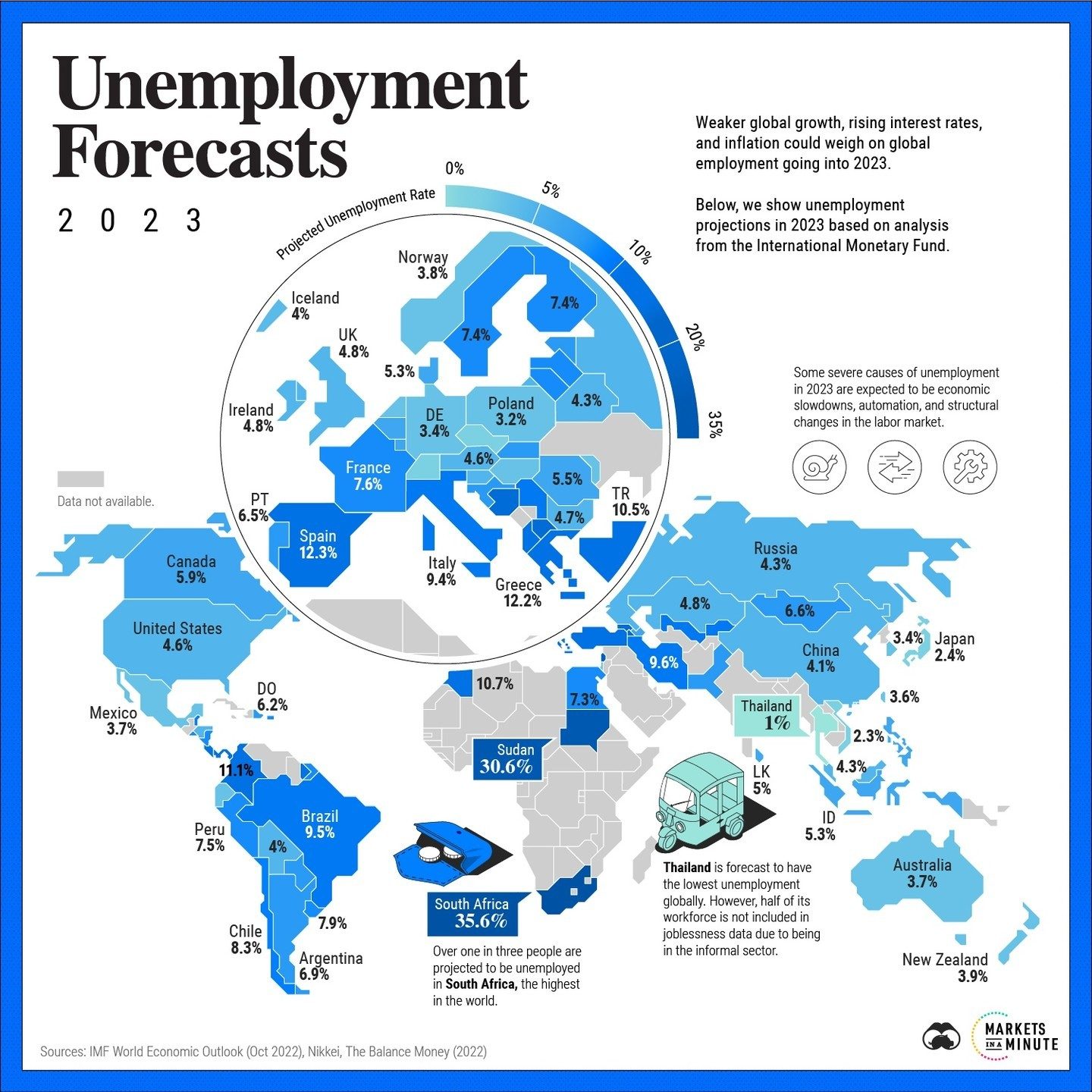
Unemployment Forecasts for 2023
Unemployment rates are always a crucial indicator of a country's economic health, and 2023 is no exception. The global job market has shown remarkable volatility, with some economies experiencing historically low unemployment rates while others grapple with significant challenges. Here’s a closer look at the unemployment forecasts for 2023, highlighting the stark differences across various regions.
Why This Matters
Understanding unemployment forecasts is essential for policymakers, economists, and job seekers alike. These forecasts help in formulating economic strategies, predicting future trends, and preparing for potential challenges. As 2023 unfolds, these projections will guide how nations navigate the interplay between strong labor markets, high inflation, and hawkish monetary policies. By examining these forecasts, we can gain insights into the global economic landscape and what to expect in the coming months.
Global Unemployment Trends
Europe
Several European countries are expected to maintain relatively stable unemployment rates. For instance, Norway and Iceland are projected to have unemployment rates of 3.8% and 4%, respectively. France, with a forecast of 4.6%, and Ireland, at 4.8%, are also expected to see steady, albeit slightly higher, unemployment rates. Poland's unemployment rate is projected at 4.7%, while Italy faces a higher rate of 9.4%. Spain, with 7.6%, and Greece, with 4.3%, present a mixed picture with higher unemployment in Spain and moderate rates in Greece.
North America
In North America, the unemployment forecast varies significantly. The United States is expected to have a 4.6% unemployment rate, reflecting a strong labor market. Mexico, with a projected 5.9% rate, shows a more challenging employment scenario.
South America
Latin American countries present a diverse range of unemployment projections. Brazil is expected to have the highest unemployment rate in the region at 9.5%, while Chile, Peru, and Argentina are forecast to have unemployment rates of 7.9%, 7.5%, and 6.9%, respectively. These figures indicate a range of economic conditions across the continent.
Asia and Africa
Asia and Africa show the most dramatic contrasts in unemployment projections. Thailand is forecast to have the lowest unemployment globally, at a remarkable 1%. In contrast, South Africa is projected to have the highest unemployment rate worldwide, at 35.6%. Russia, with a 6.6% unemployment rate, and China, at 4.1%, present stable yet modest unemployment rates. Japan, with 3.6%, and Australia and New Zealand, both at 3.9%, reflect strong labor markets. Sri Lanka (LK), with 4.3%, also shows a relatively low unemployment rate.
Factors Influencing Unemployment
Several key factors influence these unemployment forecasts. High inflation and hawkish monetary policies, aimed at curbing inflation, can lead to job losses. Conversely, strong labor markets, as seen in some countries, can drive down unemployment rates. Additionally, economic policies, technological advancements, and global economic conditions all play a role in shaping these forecasts.
Practical Tips for Job Seekers
Given these projections, job seekers can take proactive steps to navigate the labor market:
- Stay Informed: Keep an eye on industry trends and economic forecasts to anticipate shifts in the job market.
- Upskill and Reskill: Continuously enhancing skills can make you more competitive in a changing job market.
- Network: Building a strong professional network can open doors to new opportunities, especially in a tight labor market.
- Flexibility: Be open to different job roles or industries, especially in regions with higher unemployment rates.
- Government Programs: Utilize government job training and placement programs, which often increase during periods of high unemployment.
Important Takeaways
Unemployment forecasts for 2023 highlight both opportunities and challenges. Countries like Thailand and Japan are poised for strong labor markets, while South Africa faces significant unemployment. Policymakers and job seekers alike must stay informed and adaptive to navigate these projections effectively. Understanding these forecasts can help in preparing for future economic conditions and making informed decisions.
Conclusion
The unemployment landscape for 2023 is diverse and complex, with some countries experiencing near-record-low unemployment rates while others face significant challenges. By analyzing these forecasts, we gain valuable insights into the economic health of different regions and the factors influencing job markets. Whether you are a policymaker, economist, or job seeker, staying informed about these trends is crucial for navigating the global economic landscape in 2023.
Watch the Reel
Questions readers ask
What are the expected unemployment rates for Norway and Iceland in 2023?
Norway and Iceland are anticipated to maintain low unemployment rates in 2023. This is due to their robust economies and strong labor markets, which are expected to provide ample job opportunities. These countries are often highlighted as models of economic stability and job creation.
Which countries are expected to face higher unemployment rates in 2023?
Countries like Italy and Brazil are expected to face higher unemployment rates in 2023. This is due to ongoing economic challenges and slower recovery from previous setbacks. These higher unemployment rates are a reflection of the varied economic landscapes across the globe.
How does the global job market volatility in 2023 impact different regions?
The global job market volatility in 2023 is causing significant differences in unemployment rates across various regions. While some areas, such as Northern Europe, may experience low unemployment, others, like parts of South America and Southern Europe, may see higher rates. This disparity underscores the importance of regional economic policies and job creation strategies.
What are the implications of the 2023 unemployment forecasts for policymakers and job seekers?
The 2023 unemployment forecasts are crucial for policymakers in guiding economic strategies and predicting future trends. For job seekers, these forecasts help in understanding the job market and preparing for potential challenges. Policymakers and job seekers can use these projections to make informed decisions and navigate the global job market effectively.
What are the underlying factors contributing to the varied unemployment forecasts by country in 2023?
The varied unemployment forecasts by country in 2023 are influenced by several factors, including economic stability, labor market policies, and the impact of global economic trends. Countries with strong economic foundations and effective job creation initiatives are likely to experience lower unemployment, while those facing economic challenges may see higher rates.
Where can I access the latest global unemployment data for 2023?
The latest global unemployment data for 2023 can be accessed through various sources, including international organizations like the International Labour Organization (ILO) and the Organisation for Economic Co-operation and Development (OECD). These organizations provide up-to-date statistics, reports, and analyses on global unemployment trends, aiding in understanding the complex dynamics of the job market.
Recent articles
Fresh deep dives from the latest Reels we unpacked.




Comments
Be the first to comment.