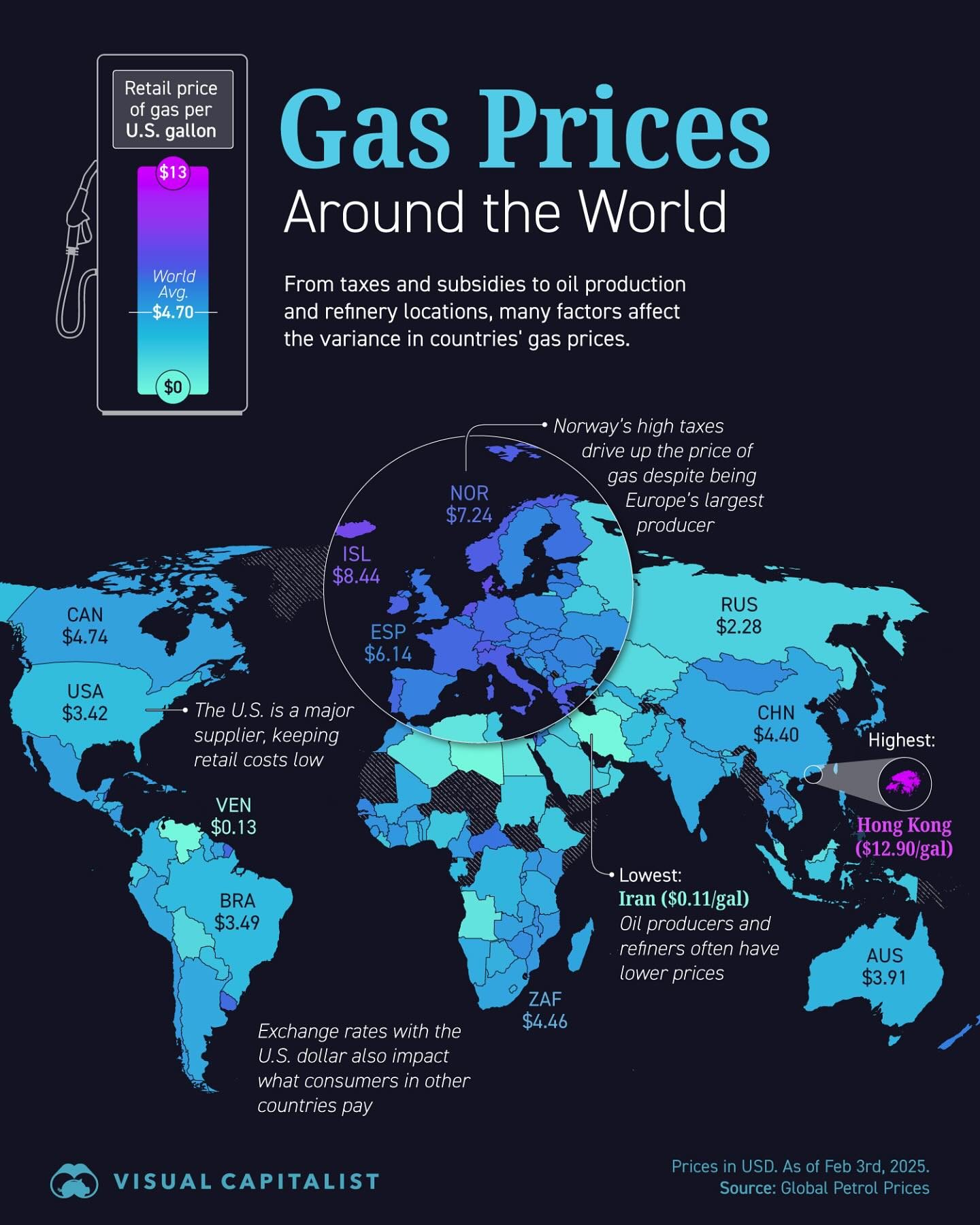
Gas Prices Around the World in 2025
Gas prices around the world vary dramatically, from as low as $0.11 per gallon in Iran to a staggering $12.90 in Hong Kong. This wide price range is influenced by a multitude of factors, including taxes, subsidies, and the geographical locations of oil producers and refiners. Countries that produce and refine their own oil, such as Russia, Saudi Arabia, and the U.S., often enjoy lower prices.
Why This Matters
Understanding the global variation in gas prices is crucial for both consumers and policymakers. For consumers, it helps in budgeting for fuel costs, especially when traveling or moving to another country. For policymakers, it provides insights into how different economic and political factors impact fuel prices. Additionally, for businesses involved in global logistics and supply chains, knowing the cost of fuel in different regions can significantly affect operational costs and profitability.
Factors Affecting Gas Prices
Taxes and Subsidies
Taxes and subsidies play a significant role in determining gas prices. Countries with high taxes on fuel tend to have higher prices, even if they are major oil producers. For example, Norway, Europe's largest oil producer, has some of the highest gas prices due to heavy taxation. On the other hand, countries that provide subsidies to keep fuel prices low can have significantly lower prices. Venezuela, for instance, has gas prices as low as $0.13 per gallon due to government subsidies.
Oil Production and Refinery Locations
Countries that produce and refine their own oil often have lower gas prices. These countries have a more stable and often cheaper supply of fuel. The U.S., for example, is a major oil supplier, which helps keep retail costs low for its consumers. The cost of importing oil can significantly affect prices in countries that rely on it.
Exchange Rates
Exchange rates with the U.S. dollar also impact what consumers in different countries pay for gas. Fluctuations in currency values can make fuel more or less expensive. For instance, a weaker currency against the U.S. dollar can increase the cost of imported fuel, pushing up gas prices.
Prices in Various Countries
Let's take a closer look at gas prices in some specific countries:
- Norway: $4.70 per gallon. Despite being a major oil producer, Norway's high taxes drive up the price of gas.
- Iceland: $8.44 per gallon. Iceland's remote location and reliance on imports contribute to its high fuel costs.
- United States: $3.42 per gallon. The U.S. benefits from being a major oil producer and refiner, keeping prices relatively low.
- Venezuela: $0.13 per gallon. Heavy government subsidies keep fuel prices extremely low.
- Brazil: $3.49 per gallon. Brazil's prices are influenced by a combination of oil production, taxation, and subsidies.
- South Africa: $4.46 per gallon. Prices in South Africa are affected by both import costs and local taxation.
- Russia: $2.28 per gallon. Russia's status as a major oil producer helps keep prices stable and relatively low.
- China: $2.28 per gallon. China's fuel prices are influenced by its extensive oil production and refining capabilities.
- Australia: $3.91 per gallon. Australia's prices are affected by import costs and local production.
- Hong Kong: $12.90 per gallon. High import costs and taxes contribute to Hong Kong's extremely high fuel prices.
Practical Tips
Traveling or moving to a new country can be an exciting adventure, but understanding the local fuel prices can help you manage your budget better. Here are some practical tips:
- Research Local Fuel Prices: Before you travel or move, research the current fuel prices in your destination. This will help you budget accordingly.
- Consider Public Transportation: If you're moving to a country with high fuel prices, consider using public transportation or carpooling to save money.
- Plan Your Routes: Plan your trips efficiently to minimize fuel consumption. This is especially important if you're in a country with high fuel prices.
- Check for Government Subsidies or Tax Breaks: Some countries offer subsidies or tax breaks on fuel for certain groups, such as low-income residents or electric vehicle owners.
Important Takeaways
Gas prices around the world are influenced by a variety of factors, including taxes, subsidies, oil production, refinery locations, and exchange rates. Understanding these factors can help consumers and businesses make informed decisions. For example:
- Countries with high taxes on fuel, such as Norway, often have higher prices despite being major oil producers.
- Subsidies can significantly lower fuel prices in countries like Venezuela.
- The U.S. benefits from being a major oil producer and refiner, keeping prices relatively low.
- Exchange rates can affect the cost of imported fuel, influencing prices in countries that rely on imports.
Conclusion
The global variation in gas prices is a complex issue influenced by multiple factors. Understanding these factors can help consumers, businesses, and policymakers make better decisions. Whether you're planning a trip, moving to a new country, or managing a global supply chain, knowing the factors that affect fuel prices can save you money and help you plan more effectively.
Watch the Reel
Questions readers ask
What are the average gas prices in 2025 in countries where gas is relatively affordable?
In 2025, gas prices are notably low in countries like Iran, where they can go as low as $0.11 per gallon. Other countries with cheap gas prices include Saudi Arabia, Russia, and the United States. These countries often benefit from local oil production, which helps to reduce the cost of fuel.
Which countries have the highest gas prices in 2025 and why?
By 2025, countries like Hong Kong are expected to have some of the highest gas prices, with costs reaching as high as $12.90 per gallon. These high prices can be attributed to a combination of heavy taxation, lack of local oil production, and reliance on imports. Other countries with high gas prices include the Netherlands, Greece, and Denmark.
What are the main factors influencing global gas price variations in 2025?
Global gas price variations in 2025 are primarily influenced by taxes and subsidies, with countries that heavily tax fuel often seeing higher prices. Additionally, geographical proximity to oil producers and refiners plays a significant role, as does the cost of oil production and transportation.
Why is it important for businesses to understand the global gas price map in 2025?
Understanding the global gas price map in 2025 is essential for businesses as it enables better planning and management of logistics and supply chains. Price fluctuations can impact delivery costs and overall operational budgets, making it crucial for businesses to anticipate and adapt to these variations.
How do gas tax and subsidies affect global gas prices in 2025?
Gas taxes and subsidies are key drivers of global gas prices in 2025. Countries that impose high taxes on fuel generally have higher gas prices, while those that offer subsidies tend to keep prices lower. These measures are implemented to achieve various economic and environmental goals, such as reducing dependence on oil or encouraging the use of public transportation.
What are some of the cheapest and most expensive countries for gas prices in 2025?
Some of the cheapest countries in 2025 for gas prices include Iran, Saudi Arabia, and Russia, where prices can be as low as $0.11 per gallon. On the other end, countries like Hong Kong, the Netherlands, and Greece are expected to have some of the highest gas prices, with costs potentially reaching $12.90 per gallon or even higher.
How do local oil production and refining impact gas prices in 2025?
Local oil production and refining can significantly lower gas prices in 2025. Countries with substantial domestic oil reserves, like the United States, Saudi Arabia, and Russia, often benefit from reduced fuel costs due to lower transportation expenses and controlled supply chains. This local production helps in stabilizing prices and reducing reliance on imports.
Related deep dives
Similar reads based on topic and creator.

Recent articles
Fresh deep dives from the latest Reels we unpacked.




Comments
Be the first to comment.