Democracy Index Visualization: A Global Perspective
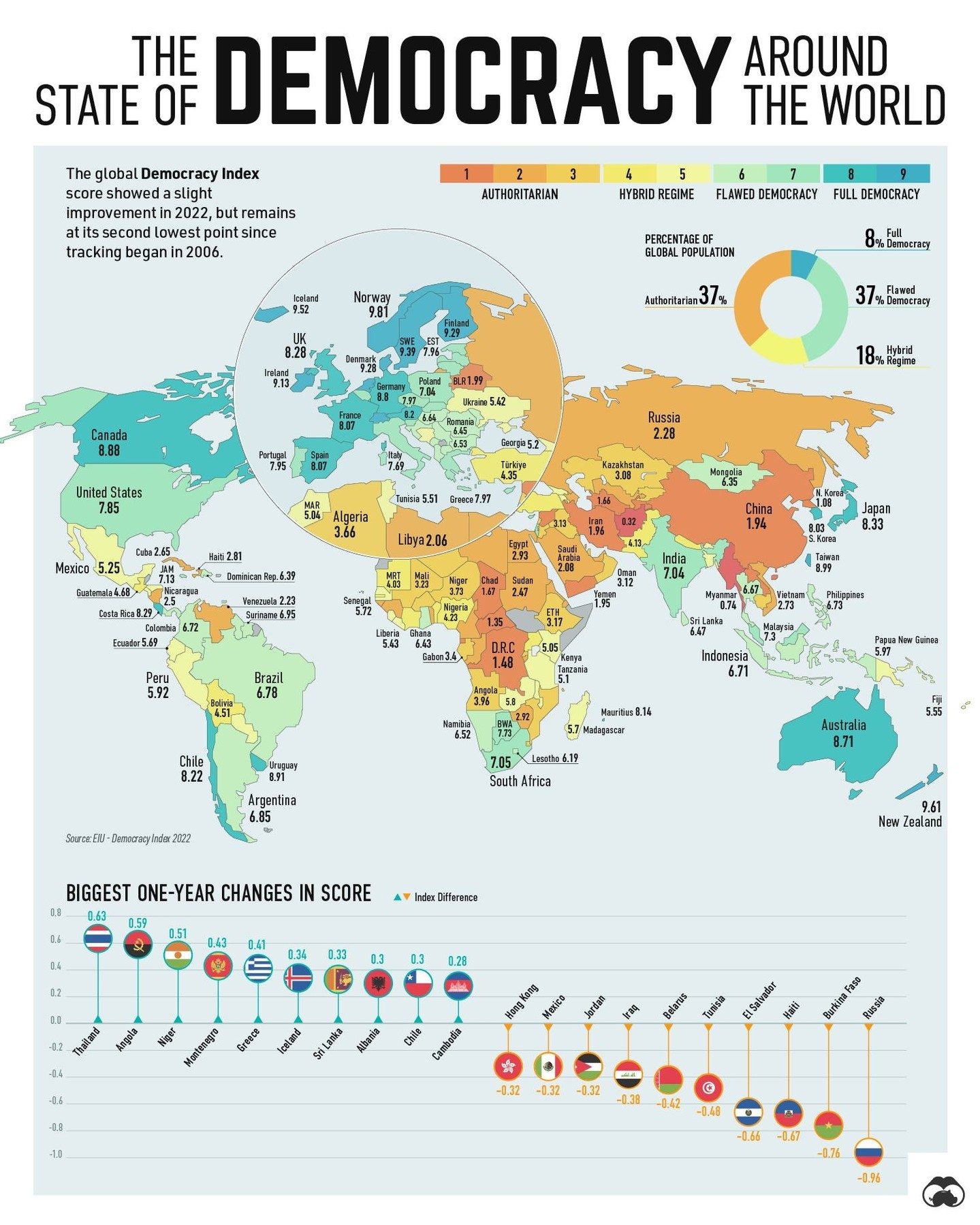
Only 8% of the world’s population resides in a full, functioning democracy, according to the Economist Intelligence Unit (EIU). Meanwhile, another 37% live in "flawed democracies," while 55% of the global population reside in non-democratic regimes. These statistics highlight the stark disparities in democratic governance around the world. Understanding the nuances of the Democracy Index can provide valuable insights into global political landscapes and the state of democracy worldwide.
Context: Why This Matters
The Democracy Index is a comprehensive measure that evaluates the state of democracy in 167 countries and two territories. It is based on five categories: electoral process and pluralism, civil liberties, the functioning of government, political participation, and political culture. The index categorizes countries into four types of regimes: full democracies, flawed democracies, hybrid regimes, and authoritarian regimes.
By visualizing the Democracy Index, we can better understand the distribution of democratic governance across the globe. This visualization helps to identify patterns and trends, providing a clearer picture of where democracies are thriving and where they are faltering.
Main Discussion
Full Democracies
Just 8.28% of the global population lives in full democracies. Countries classified in this category include Norway, Denmark, Sweden, New Zealand, Finland, and Iceland. These nations have strong democratic institutions, robust civil liberties, and high levels of political participation. They serve as benchmarks for democratic governance and are often cited as examples of well-functioning democracies.
Flawed Democracies
The majority of democratic countries fall into the flawed democracy category, accounting for 37% of the global population. These nations have democratic institutions but face significant challenges, such as corruption, weak rule of law, and limited civil liberties. Examples include the United States, Japan, and South Korea. While these countries have democratic systems, they grapple with issues that hinder their democratic performance.
Hybrid Regimes
Hybrid regimes, which encompass 18% of the global population, exhibit elements of both democratic and authoritarian governance. These countries often have elections but suffer from severe restrictions on civil liberties and significant flaws in the electoral process. Examples include Russia, Turkey, and Egypt. Hybrid regimes represent a middle ground between democracy and authoritarianism, making them particularly complex and challenging to classify.
Authoritarian Regimes
Authoritarian regimes, which account for 55% of the global population, lack democratic institutions and severely restrict civil liberties. These countries are characterized by a lack of free and fair elections, limited political participation, and significant restrictions on freedom of speech and the press. Examples include China, Syria, and North Korea. Authoritarian regimes often face criticism for their human rights records and lack of democratic governance.
Practical Tips
Understanding the Democracy Index can be beneficial for various stakeholders, including policymakers, political scientists, and the general public. Here are some practical tips for interpreting and utilizing the Democracy Index:
-
Contextualize Data: When analyzing the Democracy Index, it's essential to consider the historical, cultural, and economic context of each country. Factors such as historical legacies, cultural norms, and economic development can significantly impact a country's democratic performance.
-
Identify Trends: Look for trends over time to identify improvements or deteriorations in democratic governance. This can provide valuable insights into the effectiveness of democratic reforms and the impact of political events.
-
Compare Countries: Use the Democracy Index to compare countries within the same region or with similar economic development levels. This can help identify best practices and areas for improvement.
-
Monitor Changes: Regularly monitor changes in the Democracy Index to stay informed about shifts in global democratic governance. This can be particularly useful for policymakers and international organizations seeking to promote democracy and human rights.
Important Takeaways
- Only a small percentage of the global population lives in full democracies, highlighting the challenges faced by democratic governance worldwide.
- Flawed democracies, hybrid regimes, and authoritarian regimes each present unique challenges and require tailored approaches to promote democratic values.
- Understanding the Democracy Index can provide valuable insights into global political landscapes and the state of democracy.
- Contextualizing data, identifying trends, comparing countries, and monitoring changes are practical tips for interpreting the Democracy Index.
Conclusion
The Democracy Index serves as a critical tool for assessing democratic governance worldwide. By understanding the nuances of the Democracy Index and visualizing the data, we can gain a clearer picture of global democratic trends. This information is invaluable for policymakers, political scientists, and the general public, providing a foundation for promoting democratic values and addressing the challenges faced by democratic governance. Through continued monitoring and analysis, we can work towards a more democratic world.
Watch the Reel
Questions readers ask
What are the five categories used to evaluate countries in the 2022 Global Democracy Index?
The five categories are: electoral process and pluralism, civil liberties, the functioning of government, political participation, and political culture.
Which organisation publishes the Global Democracy Index?
The Economist Intelligence Unit (EIU) publishes the Global Democracy Index.
How many countries are evaluated in the 2022 Global Democracy Index?
The 2022 Global Democracy Index evaluates 167 countries and two territories.
What percentage of the world's population lives in non-democratic regimes, according to the 2022 index?
According to the 2022 Global Democracy Index, 55% of the world's population reside in non-democratic regimes.
What are the three categories of democracy in the 2022 Global Democracy Index?
The three categories of democracy in the 2022 Global Democracy Index are full democracies, flawed democracies, and non-democratic regimes.
What percentage of the world's population live in full democracies, according to the 2022 index?
According to the 2022 Global Democracy Index, only 8% of the world's population lives in full democracies.
How does the Democracy Index help in understanding global political landscapes?
The Democracy Index helps by providing a comprehensive measure of democratic governance, highlighting disparities, and tracking trends in electoral processes, civil liberties, and political participation worldwide.
Recent articles
Fresh deep dives from the latest Reels we unpacked.




Comments
Be the first to comment.