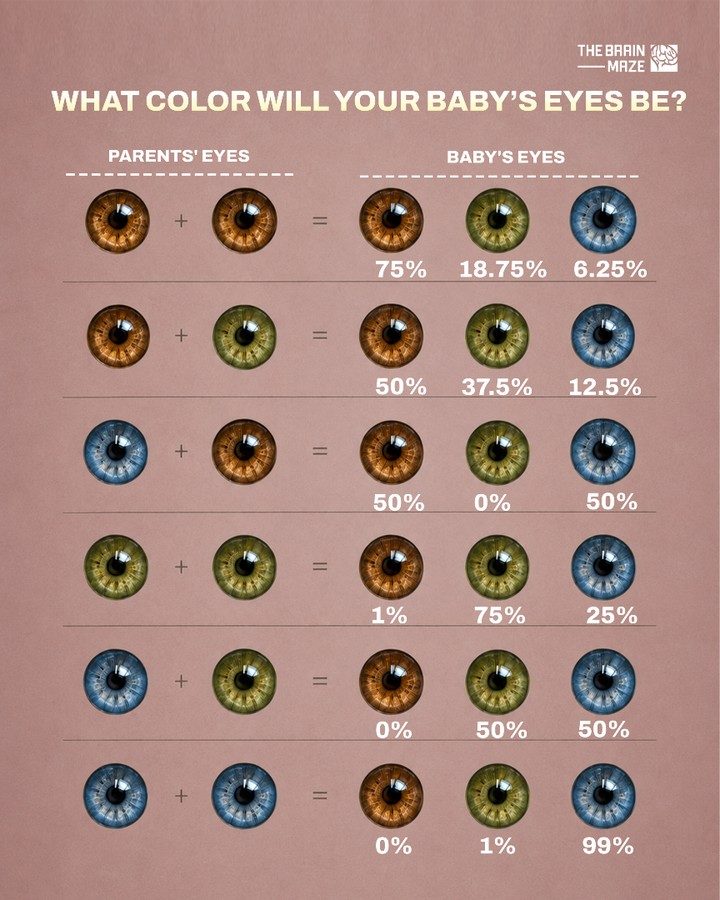
Baby Eye Color Genetics
Eye color is one of the most intriguing features passed down from parents to their children. Predicting a baby's eye color involves a complex interplay of genetics, with some colors being more dominant than others. Understanding the likelihood of different eye colors can provide expectant parents with a fascinating glimpse into their baby's future.
Why This Matters
Genetics play a crucial role in determining a baby's eye color. While it's essential to note that genetics are complex and actual outcomes may vary, having a basic understanding of how eye color is inherited can be both intriguing and practical. This knowledge can help manage expectations and provide a sense of excitement as parents anticipate their baby's arrival.
Main Discussion
The Role of Genetics
Eye color is primarily determined by the amount and type of melanin in the iris, which is influenced by multiple genes. Brown eyes are generally the most dominant, followed by green, while blue eyes are often recessive. This means that if one parent has brown eyes and the other has blue, the chances of the baby inheriting brown eyes are higher.
Predicting Eye Color
While predicting a baby's eye color with absolute certainty is impossible, understanding the probabilities can be both fun and informative. An infographic can provide a simplified calculation of a baby's potential eye color based on the parents' eye colors. This tool presents various combinations of parental eye colors (brown, green, blue) and shows the resulting probabilities for different baby eye colors.
Common Scenarios
- Brown and Brown: If both parents have brown eyes, the likelihood of the baby having brown eyes is very high, often around 75%.
- Green and Green: If both parents have green eyes, the baby has about a 50% chance of having green eyes, with other colors possible as well.
- Blue and Blue: If both parents have blue eyes, the baby has a high chance of having blue eyes, around 99%.
- Mixed Combinations: If one parent has brown eyes and the other has green or blue, the probabilities vary. For example, if one parent has green eyes and the other has blue, the baby has about a 50% chance of having green eyes.
Factors Affecting Eye Color
Several factors can influence eye color beyond simple dominance. These include:
- Multiple Genes: Eye color is not determined by a single gene but by multiple genes, each contributing a small effect.
- Incomplete Dominance: This occurs when the traits from both parents are expressed in the offspring, resulting in a blending of colors, such as hazel or gray eyes.
- Environmental Factors: While rare, environmental factors can also play a small role in eye color, such as the amount of sunlight exposure, which can affect melanin production.
Practical Tips
While the infographic can provide a good estimate, it's essential to keep in mind that genetics are complex. Here are a few practical tips:
- Use the Infographic as a Guide: The infographic is a helpful tool for estimating probabilities, but remember that actual outcomes may vary.
- Understand the Influence of Multiple Genes: Eye color determination is not a straightforward process. Multiple genes and environmental factors can influence the outcome.
- Prepare for Surprises: While it's fun to guess, be prepared for the baby's eye color to be different from what you expected.
Important Takeaways
- Genetics are Complex: Eye color determination is influenced by multiple genes, making it difficult to predict with absolute certainty.
- Dominant and Recessive Traits: Brown eyes are generally the most dominant, followed by green, and blue eyes are often recessive.
- Use Probabilities as a Guide: The infographic can provide estimated probabilities, but actual outcomes may vary.
Conclusion
Predicting a baby's eye color involves understanding the complex interplay of genetics. While brown eyes are generally the most dominant, followed by green, and blue eyes are often recessive, environmental factors and multiple genes can influence the outcome. Using the infographic as a guide can provide a fascinating glimpse into a baby's future, but remember that genetics are complex and actual outcomes may vary. Embrace the excitement and prepare for the beauty of genetic diversity.
Watch the Reel
Questions readers ask
How does genetics influence a baby's eye color?
Genetics play a pivotal role in determining a baby's eye color. Multiple genes work together to influence the amount and type of melanin in the iris, with some colors being more dominant than others. For instance, brown eyes are generally more dominant, while blue or green eyes can result from less melanin.
Can brown-eyed parents have a blue-eyed baby?
Yes, it is possible. While brown is a dominant trait, the genetics of eye color are complex and involve multiple genes. There is a chance, albeit small, that brown-eyed parents can have a blue-eyed baby if both parents carry the recessive blue-eyed gene.
What is the likelihood of a baby having green eyes?
The likelihood of a baby having green eyes depends on the parents' eye colors. If neither parent has green eyes, the chance is unlikely, but still, there is a small possibility, especially if both parents carry the recessive gene for green eyes. Green eyes are less common and result from a moderate amount of melanin in the iris.
How accurate are eye color predictions based on parental traits?
Eye color predictions based on parental traits can give a general idea but are not always precise. The inheritance of eye color involves multiple genes, so outcomes can vary. Parents with similar eye colors may have a child with a different eye color, and vice versa. It's a complex interplay of genetics.
Can the eye color of a baby change over time?
Yes, a baby's eye color can change, especially in the first year of life. At birth, many babies have blue or gray eyes due to the lack of melanin. As the baby grows, melanin production increases, which can lead to a change in eye color, often darkening to the final color by around 6 to 12 months old.
What role does melanin play in determining eye color?
Melanin is a pigment that gives color to the iris, skin, and hair. The amount and type of melanin in the iris determine eye color. Eumelanin, which is brown, and pheomelanin, which is red or yellow, combine in different proportions to create various eye colors, from brown to green, hazel, and blue.
If both parents have blue eyes, can their baby have brown eyes?
No, if both parents have blue eyes, it is highly unlikely for their baby to have brown eyes. Blue eyes are recessive, and both parents would need to pass on the recessive gene for the baby to have blue eyes. Therefore, the baby is most likely to have blue eyes as well.
Related deep dives
Similar reads based on topic and creator.


Recent articles
Fresh deep dives from the latest Reels we unpacked.




Comments
Be the first to comment.