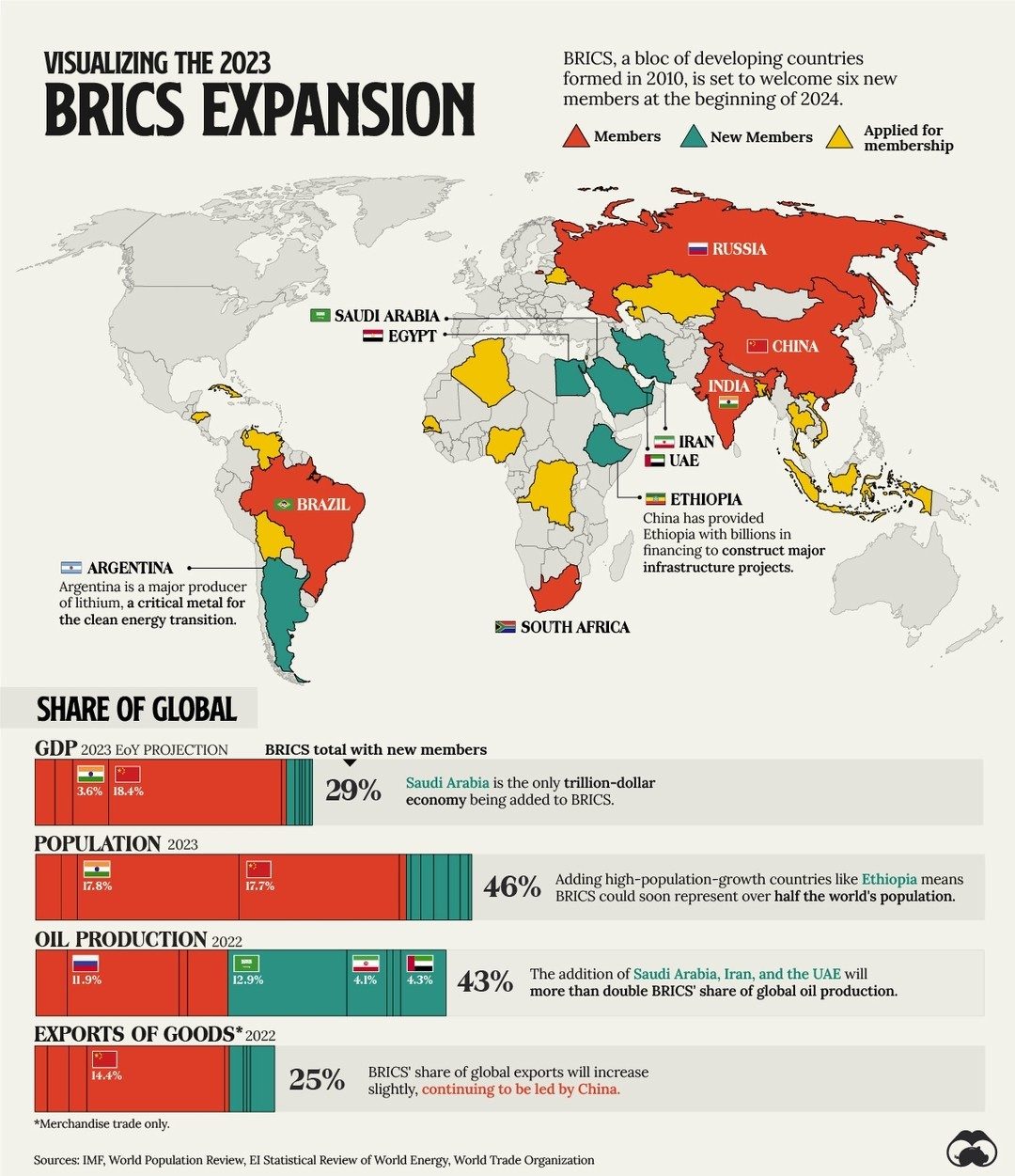
BRICS Expansion 2023
BRICS, which stands for Brazil, Russia, India, China, and South Africa, is a coalition of five major emerging economies. This bloc, formed in 2001, has aimed to bolster diplomatic collaboration, reshape global financial institutions, and act as a counterweight to Western economic dominance. On August 24, 2023, BRICS took a significant step forward by announcing the formal acceptance of six new members at the start of 2024: Saudi Arabia, Iran, Ethiopia, Egypt, Argentina, and the United Arab Emirates (UAE).
The decision to expand BRICS is more than a numerical increase; it is a strategic move that could reshape global economics and geopolitics. This expansion aims to bolster the group’s influence and reach, changing the dynamics of global markets and diplomatic relations.
Context: Why This Expansion Matters
The BRICS countries are distinguished by their emerging economies and growing influence on the world stage. The decision to expand the bloc is a response to the evolving global landscape, where economic power is increasingly shifting away from traditional Western powers. The inclusion of new members, especially those with significant economic and demographic clout, will amplify BRICS' voice in global affairs.
The Economic Landscape
The new members bring a diverse set of economic strengths and challenges. Saudi Arabia, for instance, is the only trillion-dollar economy among the new entrants, which will bolster BRICS' financial muscle. Ethiopia, on the other hand, is a high-population growth country, which will significantly boost the bloc’s demographic influence. This expansion could lead to BRICS representing over half the world’s population, making it a formidable economic player.
These new members will also significantly alter the BRICS' share of global oil production. Saudi Arabia, Iran, and the UAE together produce a substantial portion of the world's oil. Their addition to BRICS will more than double the bloc's share of global oil production, making it a key player in global energy markets.
Main Discussion
The New Members
The six new countries joining BRICS are geographically and economically diverse, each bringing unique strengths and challenges.
Saudi Arabia
Saudi Arabia is a significant addition to the bloc, given its trillion-dollar economy and its status as a leading oil producer. This addition will enhance the BRICS’ economic clout and its influence in the global energy market. Saudi Arabia’s inclusion also brings a strategic geopolitical advantage, as it is a key player in the Middle East.
Iran
Iran’s addition is notable for its geopolitical implications. Iran has been under significant international sanctions, and its inclusion in BRICS could signal a shift in global economic policies and alliances. Iran's robust economy, particularly in the energy sector, will further bolster the bloc’s economic strength.
Ethiopia
Ethiopia, though not as economically powerful as other members, is a vital addition for demographic reasons. It is one of the fastest-growing countries in terms of population, which will significantly boost the BRICS’ demographic influence. Ethiopia’s inclusion is a strategic move, given its growing influence in East Africa and its emerging status as a regional economic hub.
Egypt
Egypt is another critical addition, given its strategic location and influence in the Middle East and Africa. Its economic strengths, particularly in tourism and energy, will enhance the BRICS bloc’s economic prowess. Egypt’s membership will also bolster the bloc’s influence in African and Middle Eastern affairs.
Argentina
Argentina, with its diverse economy and strong economic ties with South America, will add depth to BRICS' economic diversity. Its inclusion is strategically important as it will bolster the bloc’s influence in the Latin American region.
United Arab Emirates (UAE)
The UAE is a global economic hub, particularly in finance, trade, and tourism. Its inclusion will enhance BRICS’ economic diversity and strengthen its influence in global financial markets. The UAE, like Saudi Arabia, will also bolster the bloc’s energy prowess, given its significant oil production.
Economic Indicators
The expansion of BRICS will have a far-reaching impact on global economic indicators. Let’s break down some key metrics:
GDP Growth
The combined GDP of BRICS with the new members is projected to grow significantly. The projection for 2023 shows an 18.4% increase in GDP, which will further solidify the bloc’s position as a major economic power.
Population
One of the most significant impacts of the expansion will be on the population. Ethiopia and other new members will bring a substantial demographic boost, potentially leading to BRICS representing over half the world’s population. This demographic shift will amplify the bloc’s global influence.
Oil Production
The addition of Saudi Arabia, Iran, and the UAE will significantly increase BRICS’ share of global oil production. This shift will make the bloc a dominant player in global energy markets, influencing global oil prices and supply.
Exports of Goods
The expansion will also increase BRICS’ share of global exports. China remains the leading exporter within the bloc, but the addition of new members will increase the overall export share, making BRICS a more significant player in global trade.
Practical Tips
Given the significant impact of the BRICS expansion on global markets, here are some practical tips for businesses and investors:
For Businesses
-
Market Diversification: Consider diversifying your business operations and supply chains to include BRICS countries. This will not only provide access to new markets but also mitigate risks associated with over-reliance on traditional economic powers.
-
Energy Sector Opportunities: The expansion will significantly boost the bloc’s oil production. For businesses in the energy sector, this presents both opportunities and challenges. Stay updated on policy changes and investment opportunities in the region.
-
Trade and Investment: The increase in the bloc’s export share presents new trade opportunities. Explore potential partnerships and investment opportunities in the new BRICS countries, particularly in sectors like technology, energy, and infrastructure.
For Investors
-
Portfolio Diversification: Include BRICS countries in your investment portfolio. The expansion will bring new growth opportunities, making it a strategic move to diversify your investments across BRICS countries.
-
Energy Sector Investments: The energy sector is a key player in the expansion. Consider investments in oil, gas, and renewable energy projects in BRICS countries, particularly Saudi Arabia, Iran, and the UAE.
-
Long-term View: The BRICS expansion is a long-term strategic move. Keep a long-term view on investments, focusing on sectors that will benefit from the demographic and economic growth in the bloc.
Important Takeaways
The BRICS expansion is a pivotal moment in global geopolitics and economics. The inclusion of Saudi Arabia, Iran, Ethiopia, Egypt, Argentina, and the UAE will significantly alter the dynamics of global markets and trade. This expansion will amplify the bloc’s economic, demographic, and geopolitical influence, making it a formidable player on the world stage. For businesses and investors, the expansion presents new opportunities and challenges, requiring strategic planning and adaptability.
Conclusion
The BRICS expansion is more than just an increase in membership; it is a strategic move to shift global economic and political power. The new members bring significant economic and demographic strengths, enhancing the bloc’s global influence. Businesses and investors should be prepared to navigate the changing landscape, leveraging the new opportunities while mitigating potential risks. This expansion is a clear indication of the shifting global power dynamics, and staying informed and adaptable will be crucial in the coming years.
Watch the Reel
Questions readers ask
Which countries are joining BRICS in 2024?
The six new members joining BRICS in 2024 are Saudi Arabia, Iran, Ethiopia, Egypt, Argentina, and the United Arab Emirates (UAE). These countries were formally accepted on August 24, 2023, and will officially join at the start of 2024.
What is the significance of Saudi Arabia and Argentina joining BRICS?
The addition of Saudi Arabia and Argentina brings significant economic and political weight to the BRICS coalition. Saudi Arabia is a major oil producer and Argentina is a large economy in South America, which will enhance BRICS' influence in global markets and diplomatic relations.
How will the BRICS expansion impact the world economy?
The expansion will likely intensify BRICS' global influence and alter the dynamics of the world economy. The new members contribute substantially to oil production, population growth, and GDP, thus strengthening the bloc's economic power and potentially creating new opportunities for trade and investment.
Why is the inclusion of Iran and Egypt in the BRICS expansion significant?
The inclusion of Iran and Egypt, both significant players in the Middle East and Africa, will enhance BRICS' geopolitical standing. Their membership will also diversify the coalition's economic and diplomatic ties, particularly in regions where the original members had minimal influence.
How will BRICS’ expansion affect China’s role in the group?
As one of the original members, China will continue to play a pivotal role in the expanded BRICS. With the addition of new members, China may further its economic and diplomatic goals, potentially gaining new allies in its global initiatives, while also facing new dynamics in decision-making processes.
What are the expected changes in global markets due to the BRICS expansion?
The expansion is expected to create new opportunities and challenges in global markets. With the inclusion of oil-producing nations, the energy sector may see significant shifts in supply and pricing. Additionally, increased trade and investment flows, particularly in the new members' key economic sectors, are anticipated.
Recent articles
Fresh deep dives from the latest Reels we unpacked.




Comments
Be the first to comment.