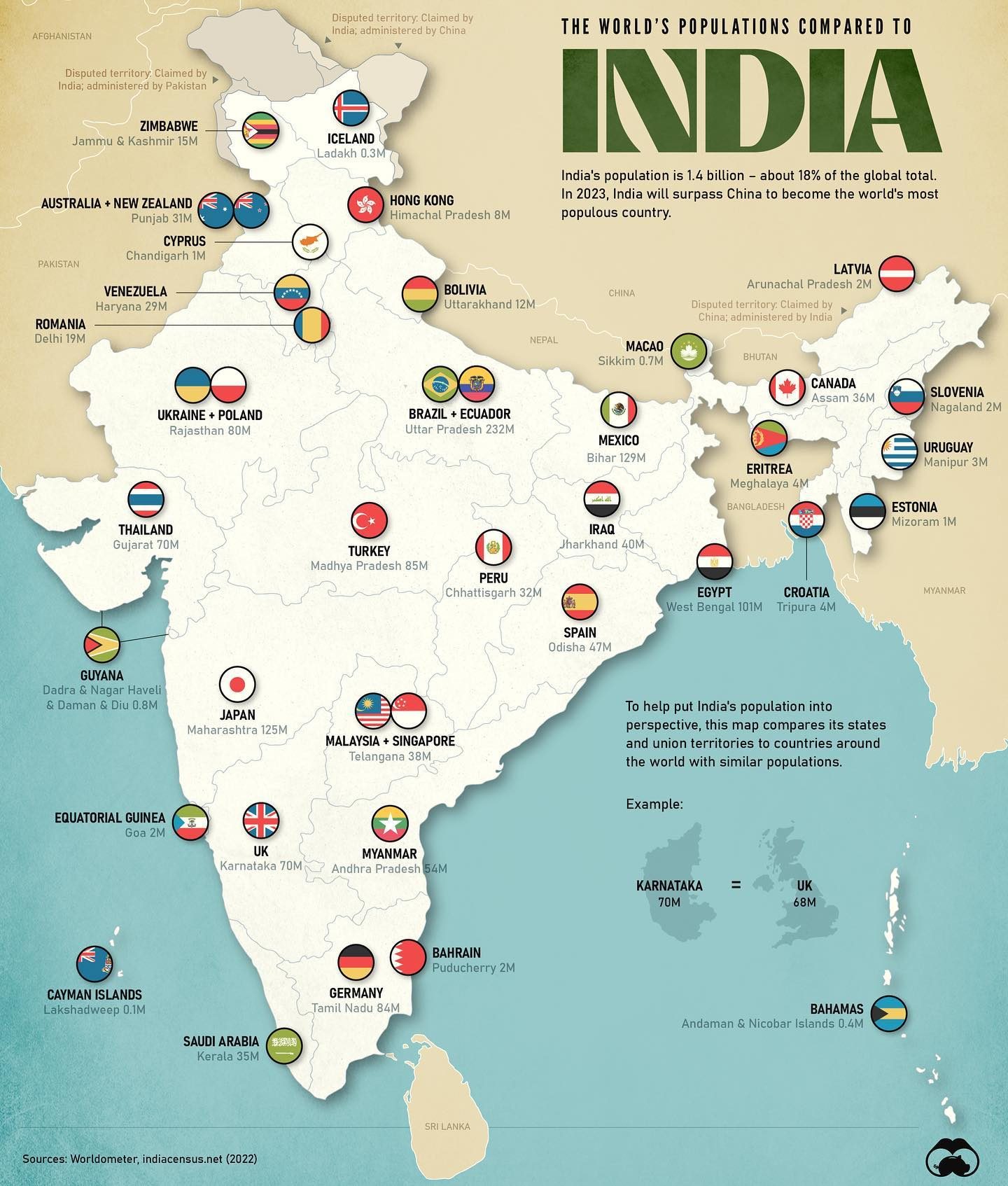
World Population Comparison
India, with its 1.4 billion population, has an immense scale of its own. But when compared to the global population, which has touched eight billion, the sheer magnitude of India's population data begins to feel more complex. These numbers can quickly lose their impact. This visual comparison offers a unique perspective on the population figures of various countries and regions, giving a new frame of reference to understand and visualize the world's population dynamics.
Why This Matters
Understanding global population dynamics is crucial, not just for demographers and policymakers, but for everyone. It affects everything from resource allocation to economic strategies and environmental policies. By grasping the scale and distribution of the world's population, we can better anticipate challenges and opportunities in various regions. This comparison helps in breaking down the vast numbers into comprehensible units.
Visualizing Global Population
India and China: The Population Giants
India's 1.4 billion people represent 18% of the global population, making it a significant chunk of the world's inhabitants. Notably, 2023 is set to be a landmark year as India surpasses China to become the most populous country in the world.
Breaking Down India's Population
India's vast population is spread across diverse states and territories, each with its own demographic character. Here are some key regions and their population figures:
- Uttar Pradesh: 232 million
- Maharashtra: 124 million
- Bihar: 106 million
- West Bengal: 98 million
- Madhya Pradesh: 75 million
- Tamil Nadu: 72 million
- Rajasthan: 80 million
- Karnataka: 70 million
- Gujarat: 68 million
- Odisha: 46 million
- Andhra Pradesh: 64 million
- Telangana: 38 million
- Haryana: 25 million
- Punjab: 31 million
- Himachal Pradesh: 8 million
- Arunachal Pradesh: 2 million
While these numbers give a sense of the sheer scale, it's also crucial to consider the population densities and geographical distribution.
Regional Populations
The comparison extends beyond India and China, covering various countries and regions.
-
Australia and New Zealand: Combined, these countries have a much smaller population compared to India. Australia's population is around 26 million, while New Zealand has approximately 5 million people.
-
Brazil and Ecuador: Brazil has a substantial population of 215 million, while Ecuador has around 18 million people.
-
Ukraine and Poland: These eastern European countries have populations of 41 million and 38 million, respectively.
-
Germany: With a population of about 83 million, Germany stands as a significant European nation.
-
Indonesia and Thailand: Indonesia is the fourth most populous country globally, with a population of around 276 million. Thailand has a smaller population of about 70 million.
-
The United Kingdom and Sri Lanka: The UK has a population of 67 million, while Sri Lanka has around 22 million.
-
Malaysia and Singapore: Malaysia has a population of 32 million, and Singapore, a city-state, has around 5.7 million.
The visualization provides a quick glance at how different regions stack up against one another, offering a much-needed perspective that traditional numerical comparisons often lack.
Disputed Territories
Some regions present more complexity, especially disputed territories such as Jammu & Kashmir and Ladakh. While Jammu & Kashmir has a population of approximately 15 million, Ladakh has around 300,000 people. These areas are claimed by India but administered by Pakistan, highlighting the political and demographic intricacies of such regions.
Practical Tips for Understanding Population Data
When dealing with population data, it's essential to look beyond the raw numbers. Here are some practical tips to help you gain a deeper understanding:
-
Consider Population Density: The population density can vary greatly even within a country. For instance, while India's population is vast, rural areas may have lower densities compared to urban centers.
-
Understand Growth Rates: Population growth rates can provide insights into future trends. Countries with high growth rates may face different challenges and opportunities compared to those with stable or declining populations.
-
Look at Age Distribution: The age distribution of a population can significantly impact economic and social policies. A younger population may require more investment in education, while an aging population may need better healthcare and retirement benefits.
-
Examine Migration Patterns: Migration can significantly influence population dynamics. Understanding where people are moving to and from can provide valuable context.
-
Evaluate Data Sources: Reliable data is crucial. The visualization uses data from reputable sources like Worldometer and indiacensus.net, ensuring accuracy and credibility in the numbers presented.
Important Takeaways
-
India's Population Impact: India's 1.4 billion people represent 18% of the global population. This scale can be difficult to grasp without visual comparisons.
-
Population Dynamics: Visualizing population data helps in understanding the distribution and demographics of various regions, making it easier to grasp the sheer scale and diversity.
-
Regional Differences: Comparing populations across different countries and regions highlights the vast differences in population densities and distributions.
-
Data Accuracy: Reliable data sources are essential for making accurate and meaningful comparisons.
Conclusion
The visualization of global population data offers a unique and valuable perspective on the world's demographic landscape. By providing a different frame of reference, it allows us to better understand and appreciate the complexities of population dynamics. As populations continue to evolve, these insights will become increasingly important for navigating the challenges and opportunities that lie ahead.
Watch the Reel
Questions readers ask
What is the current population of India and how does it compare to the global total?
India's population is approximately 1.4 billion people. In comparison, the global population has reached 8 billion, making India's population roughly 17.5% of the world's total.
Why is India expected to become the most populous country?
India is projected to surpass China as the most populous country due to its high population growth rate. This growth is driven by factors such as high birth rates and improved healthcare, which have led to a significant increase in life expectancy.
How does India's population compare to China's?
India is expected to surpass China in population within the next few years. While China's population is currently around 1.4 billion, India's growth rate is higher, which will eventually make it the most populous country.
What are some key factors driving global population growth?
Global population growth is influenced by several factors, including high birth rates in certain regions, improved healthcare leading to lower mortality rates, and increased life expectancy. However, these factors can vary significantly by region and country.
What are the implications of India's high population density?
India's high population density can lead to challenges in areas such as resource allocation, infrastructure development, and environmental sustainability. However, it also presents opportunities for economic growth and innovation, as well as a large workforce.
Which countries are the largest by population after India and China?
After India and China, the next largest countries by population are the United States, Indonesia, and Pakistan. These countries, along with India and China, account for a significant portion of the global population. Indonesia and Pakistan are also experiencing notable population growth, though not at the same rate as India.
Why is understanding global population trends important for policymakers and individuals alike?
Understanding global population trends is crucial for effective resource allocation, economic planning, and environmental policy development. It helps policymakers anticipate future needs and challenges, while individuals can gain insights into global dynamics and their personal impact on the world's resources.
Related deep dives
Similar reads based on topic and creator.

Recent articles
Fresh deep dives from the latest Reels we unpacked.




Comments
Be the first to comment.