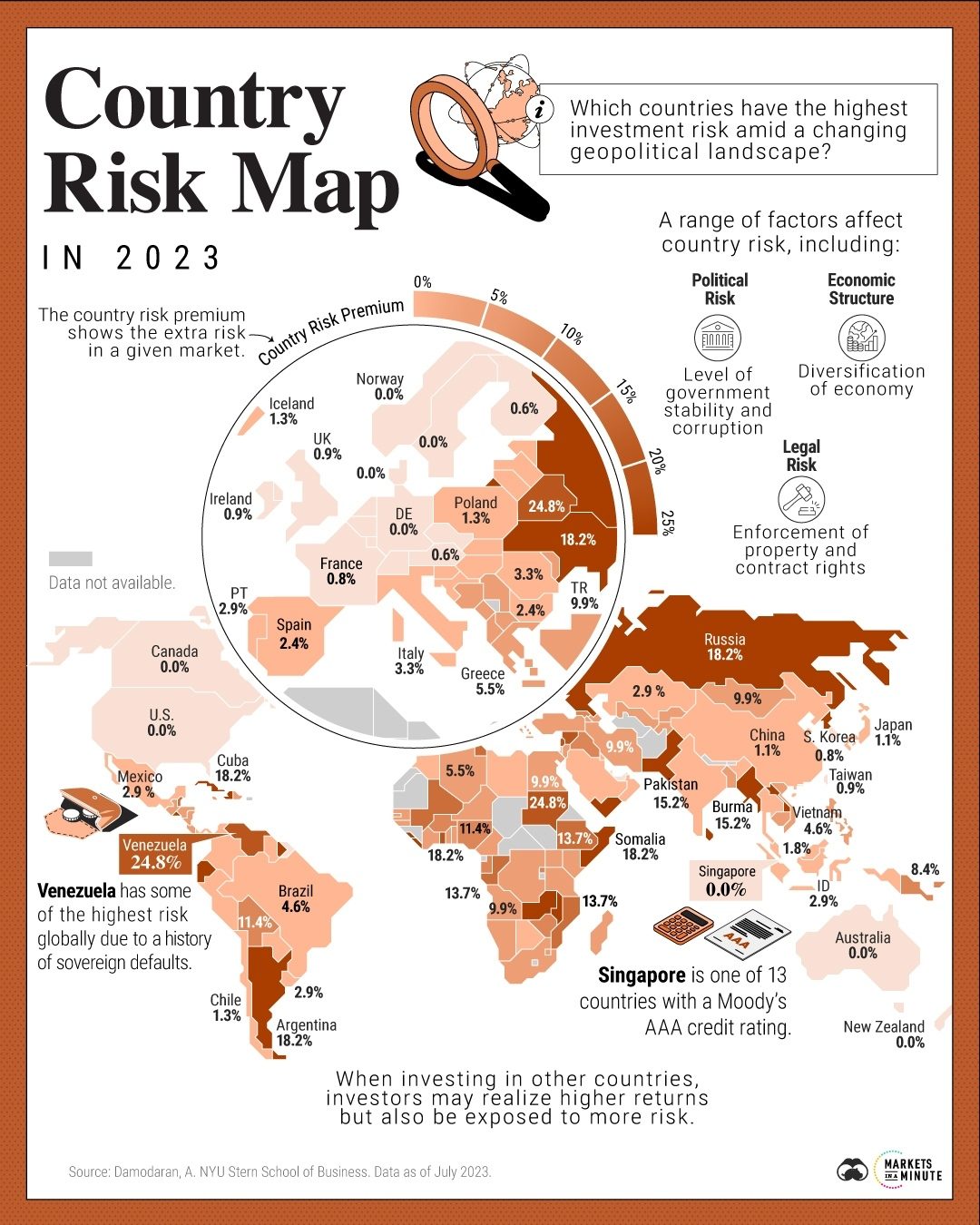
The Country Risk Map for 2023
Investing in foreign markets can be a lucrative venture, but it also comes with its own set of risks. With the rapid growth of emerging economies, investors are increasingly looking abroad for opportunities. However, understanding the risks associated with these investments is crucial. The Country Risk Map for 2023 provides a comprehensive overview of these risks, helping investors make informed decisions.
Why This Matters
The global economy is interconnected, and investing in foreign markets can offer significant returns. However, these investments come with varying levels of risk. Factors such as political instability, economic diversification, government corruption, and sovereign defaults can significantly impact investment performance. The Country Risk Map helps investors assess these risks by providing a visual representation of the country risk premiums across different nations.
Understanding the Country Risk Premium
The country risk premium is a measure of the extra risk associated with investing in a particular market. It is essentially the additional return that investors demand to compensate for the higher risk. The premium is influenced by several factors, including:
Political Stability
Political instability can significantly impact investments. Countries with unstable governments or frequent political upsets are generally considered riskier. This instability can lead to policy changes that negatively affect businesses and investors.
Government Corruption
High levels of government corruption can deter foreign investment. Corrupt practices can lead to misallocation of resources, inefficiencies, and increased uncertainty for investors. Countries with lower corruption levels tend to have lower risk premiums.
Economic Diversification
Economic diversification refers to the variety of industries and sectors within a country's economy. Countries with diversified economies are generally less vulnerable to economic shocks. For example, a country heavily reliant on a single commodity like oil may face significant risks if oil prices fluctuate. In contrast, a country with a diversified economy has multiple revenue streams, reducing its overall risk.
Sovereign Defaults
A history of sovereign defaults can significantly impact a country's risk premium. Investors are wary of countries that have defaulted on their debts in the past, as this indicates a higher likelihood of future defaults. Venezuela, for instance, has one of the highest risk premiums globally due to its history of sovereign defaults.
Key Findings from the 2023 Country Risk Map
The 2023 Country Risk Map highlights several key findings:
High-Risk Countries
Countries like Venezuela and Somalia have some of the highest risk premiums. Venezuela's risk premium stands at an alarming 24.8%, making it one of the riskiest markets for investment. Somalia follows closely with an 18.2% premium, along with Argentina at 18.2%. Other high-risk countries include Russia, Pakistan, and Burma, all with premiums ranging from 15.2% to 9.9%.
Low-Risk Countries
On the other hand, countries like Norway, the US, and the UK have very low risk premiums. The US and the UK have a 0.0% premium, indicating that they are considered some of the safest markets for investment. Other low-risk countries include Iceland, Ireland, and Singapore, all with premiums below 1.3%.
Middle-Risk Countries
Several countries fall into the middle-risk category, with premiums ranging from 1.3% to 9.9%. Examples include Germany, Spain, Canada, and China. These countries offer a balance of potential returns and manageable risk.
Important Factors Affecting Country Risk
Political Stability and Government Corruption
Countries with stable political environments and low levels of government corruption tend to have lower risk premiums. These factors create a more predictable and secure environment for investors. Conversely, countries with high levels of political instability and corruption face higher risk premiums, making them less attractive to investors.
Economic Diversification
Economic diversification is crucial for managing risk. Countries with diversified economies are less vulnerable to economic shocks and fluctuations. This diversification can come from having a mix of industries, a strong services sector, or a balanced trade portfolio. Economies that rely heavily on a single industry or commodity are more susceptible to market volatility.
Sovereign Defaults and Economic Policies
A history of sovereign defaults can significantly impact a country's risk premium. Investors are wary of countries that have defaulted on their debts in the past, as this indicates a higher likelihood of future defaults. Economic policies that promote stability and growth, such as fiscal discipline and sound monetary policies, can help lower the risk premium.
Market Volatility and Inflation
Market volatility and high inflation rates can also affect a country's risk premium. Countries with stable and predictable economic environments are generally perceived as less risky. Conversely, countries with high inflation rates and volatile markets face higher risk premiums.
Practical Tips for Investors
Investing in foreign markets requires careful consideration of the associated risks. Here are some practical tips for investors:
Conduct Thorough Research
Before investing, conduct thorough research on the political, economic, and social environment of the target country. Understand the risks involved and how they might impact your investments.
Diversify Your Portfolio
Diversifying your investment portfolio can help mitigate risk. Invest in a mix of countries and sectors to spread your risk and increase the likelihood of steady returns.
Monitor Political and Economic Developments
Stay informed about political and economic developments in the countries where you invest. Sudden changes in government policies, economic indicators, or geopolitical events can significantly impact your investments.
Seek Professional Advice
Consult with financial advisors or investment professionals who have expertise in international investments. They can provide valuable insights and help you make informed decisions.
Consider Risk Management Strategies
Implement risk management strategies such as hedging, insurance, and contingency planning. These strategies can help protect your investments from unforeseen risks and market volatility.
Use Reliable Data Sources
Rely on reliable data sources for your investment decisions. The Country Risk Map provides valuable insights based on analysis from reputable sources. It is important to use reliable and up-to-date data to make informed decisions.
Important Takeaways
The Country Risk Map for 2023 provides valuable insights into the risks associated with investing in foreign markets. Here are some key takeaways:
Risk Premiums Vary Widely
Risk premiums vary widely across different countries. Some countries have very low premiums, indicating low risk, while others have high premiums, indicating significant risk.
Political and Economic Factors Matter
Political stability, government corruption, economic diversification, and sovereign defaults are key factors affecting country risk. Understanding these factors can help investors assess the risks associated with investing in a particular market.
Investors Need to Be Informed
Investors need to be well-informed about the risks and potential returns of investing in foreign markets. Conducting thorough research, diversifying portfolios, and monitoring economic developments are essential steps for successful international investments.
Use Reliable Data
Rely on reliable data sources for making investment decisions. The Country Risk Map provides valuable insights based on analysis from reputable sources, helping investors make informed decisions.
Conclusion
Investing in foreign markets can be a rewarding venture, but it also comes with significant risks. The Country Risk Map for 2023 helps investors understand these risks by providing a visual representation of country risk premiums. It highlights the factors affecting country risk, such as political stability, government corruption, economic diversification, and sovereign defaults. By understanding these factors and conducting thorough research, investors can make informed decisions and mitigate risks.
Watch the Reel
Questions readers ask
What is the 2023 Country Risk Map and why is it important for investors?
The 2023 Country Risk Map is a visual tool that highlights various risks associated with investing in different countries. It is important for investors because it helps them understand the potential challenges and rewards of investing abroad, particularly in emerging markets. By providing insights into political stability, economic diversification, and government corruption, the map assists investors in making well-informed decisions.
What factors does the 2023 Country Risk Map consider when assessing country risk?
The map takes into account several key factors, including political stability, government corruption, economic diversification, and the likelihood of sovereign defaults. These factors are crucial for investors to evaluate as they can significantly impact the performance and safety of their investments.
How can the 2023 Country Risk Map help in identifying low risk investing opportunities?
The map categorizes countries based on their risk levels, helping investors spot countries with lower risks. These countries typically have stable political environments, lower corruption rates, and diverse economies. By investing in these low-risk countries, investors can mitigate potential losses and maximize returns.
What are some of the high-risk countries identified in the 2023 Country Risk Map?
The 2023 Country Risk Map identifies high-risk countries based on factors such as political instability, high corruption levels, and economic volatility. While the specific countries can vary, they often include nations that have recently experienced or are currently experiencing significant political or economic turmoil.
How does the 2023 Country Risk Map assist in assessing the risks of investing in emerging markets?
Investing in emerging markets can be highly rewarding but also comes with unique risks. The 2023 Country Risk Map provides a detailed analysis of these risks, allowing investors to evaluate the potential benefits and drawbacks of investing in these markets. It helps investors navigate the complexities of emerging economies by providing insights into political stability, economic diversification, and corruption levels.
What is the significance of political stability in the 2023 Country Risk Map?
Political stability is a crucial factor in the 2023 Country Risk Map as it directly impacts the safety and profitability of investments. Countries with stable political environments are less likely to experience sudden policy changes or disruptions that could negatively affect investments. Therefore, understanding a country's political stability is essential for making sound investment decisions.
How often is the Country Risk Map updated, and why is timely information crucial for investors?
The Country Risk Map is typically updated annually to reflect the latest geopolitical and economic developments. Timely information is crucial for investors because global conditions can change rapidly, affecting the risk profiles of different countries. Staying updated with the most recent data helps investors make informed decisions and adjust their investment strategies accordingly.
Recent articles
Fresh deep dives from the latest Reels we unpacked.




Comments
Be the first to comment.