Ukraine Aid Donations
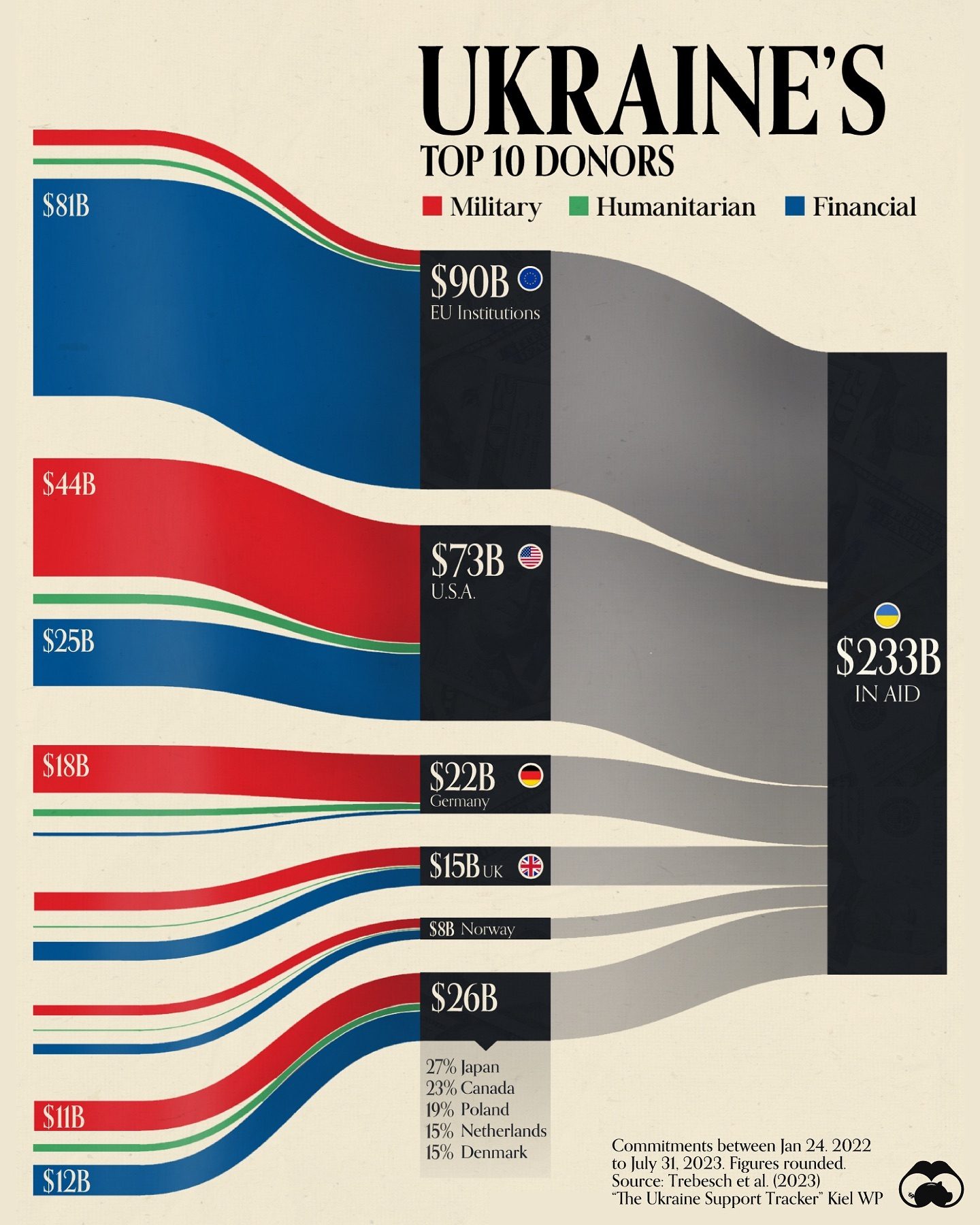
Since the Russian invasion in 2022, Ukraine has received over $230 billion in aid. This substantial support has been crucial for the country's ongoing efforts to address the impacts of the conflict. The aid comes from various sources, with the European Union (EU) institutions and the United States (U.S.) together accounting for almost 70% of the total.
Context / Why this Matters
Understanding the distribution of aid to Ukraine is essential for grasping the global response to the conflict and the specific areas where support has been most concentrated. The aid includes military, humanitarian, and financial assistance, each playing a critical role in Ukraine's resilience and recovery.
Main Discussion
Key Donors and Their Contributions
The top donors to Ukraine between January 24, 2022, and July 31, 2023, include several international actors. The data, visualized in a comprehensive infographic, highlights the significant financial contributions made by these countries and institutions.
EU Institutions and the U.S.
EU institutions and the U.S. have been the most substantial contributors, providing approximately $90 billion and $81 billion respectively. This represents a combined 70% of the total aid, underscoring the pivotal role these entities have played in supporting Ukraine.
Other Major Contributors
Beyond the EU and the U.S., other countries have also made significant contributions:
-
Germany: $44 billion
-
UK: $26 billion
-
Japan: $22 billion (27% of their total aid)
-
Canada: $25 billion (23% of their total aid)
-
Norway: $18 billion
-
Denmark: $15 billion (15% of their total aid)
Varieties of Aid
The aid comes in various forms, including military support, humanitarian assistance, and financial aid. This diverse range of support is essential for addressing the multifaceted challenges Ukraine faces.
Data Source and Methodology
The data for this visualization comes from the "Ukraine Support Tracker" by Trebesch et al. (2023), published by the Kiel Institute. This tracker provides a comprehensive overview of the commitments made by different countries and institutions, offering a detailed look at the financial support Ukraine has received.
Practical Tips
For those interested in visualizing data or understanding global aid distributions, several key points can be useful:
- Accurate Data Collection: Ensure that the data used for visualizations is from reliable sources. In this case, the Ukraine Support Tracker provides a credible dataset.
- Clear Visual Representation: Use clear and concise visuals, such as stacked bar charts, to represent complex data. This helps in understanding the distribution and contributions of different entities.
- Contextual Information: Include contextual information, such as the timeframe and the types of aid, to provide a comprehensive understanding of the data.
- Updating Data Regularly: Aid commitments can change over time. Regularly updating the data ensures that the visualizations remain accurate and relevant.
Important Takeaways
- Significant Contributions: The EU and the U.S. have been the largest donors, with substantial contributions from Germany and the UK as well.
- Diverse Aid Types: The aid includes military, humanitarian, and financial support, each critical for different aspects of Ukraine's needs.
- Transparency and Accuracy: The data used for visualizing aid contributions must be accurate and from reliable sources to maintain credibility.
Conclusion
The aid received by Ukraine since the Russian invasion in 2022 highlights the global community's commitment to supporting the country during this challenging period. The contributions from the EU, the U.S., and other major donors have been instrumental in Ukraine's efforts to address the impacts of the conflict. Understanding these contributions and the types of aid provided can offer valuable insights into the global response to the crisis and the specific needs Ukraine faces.
Watch the Reel
Questions readers ask
Who are the top donors to Ukraine since the 2022 invasion?
The European Union and the United States are the leading donors, contributing almost 70% of the total aid. Other significant donors include Germany, the UK, Canada, and Japan.
What are the main types of aid provided to Ukraine?
Aid to Ukraine is primarily distributed across three categories: military assistance, humanitarian support, and financial aid. Military assistance includes weaponry and defense equipment, humanitarian aid covers essential supplies and services for civilians, and financial aid helps stabilize the Ukrainian economy.
How has the aid been distributed across different sectors in Ukraine?
Aid distribution varies, with a significant portion directed towards military support to help Ukraine defend against the invasion. Humanitarian aid ensures that civilians receive essential supplies, while financial assistance supports Ukraine's economic stability and recovery efforts.
What role has the European Union played in supporting Ukraine?
The European Union, along with its member states, has been a major contributor to Ukraine's aid. The EU has provided extensive financial assistance, humanitarian support, and military aid, reflecting its commitment to Ukraine's sovereignty and security.
Why is it important to track aid to Ukraine?
Tracking aid to Ukraine helps monitor the global response to the conflict and ensures transparency in how resources are allocated. It also helps identify areas where additional support may be needed, allowing for more effective coordination among international donors.
How can individuals and organizations follow updates on aid to Ukraine?
Individuals and organizations can follow updates on aid to Ukraine through various sources, including government announcements, international news outlets, and dedicated aid tracker websites which provide real-time data on contributions and distribution.
What specific contributions have Germany and the UK made to Ukraine's aid efforts?
Germany and the UK have made significant contributions to Ukraine's aid efforts. Germany has provided substantial military support, including advanced weaponry and training, while the UK has offered a mix of military, humanitarian, and financial aid, helping Ukraine maintain its defense capabilities and support its civilian population.
Recent articles
Fresh deep dives from the latest Reels we unpacked.




Comments
Be the first to comment.