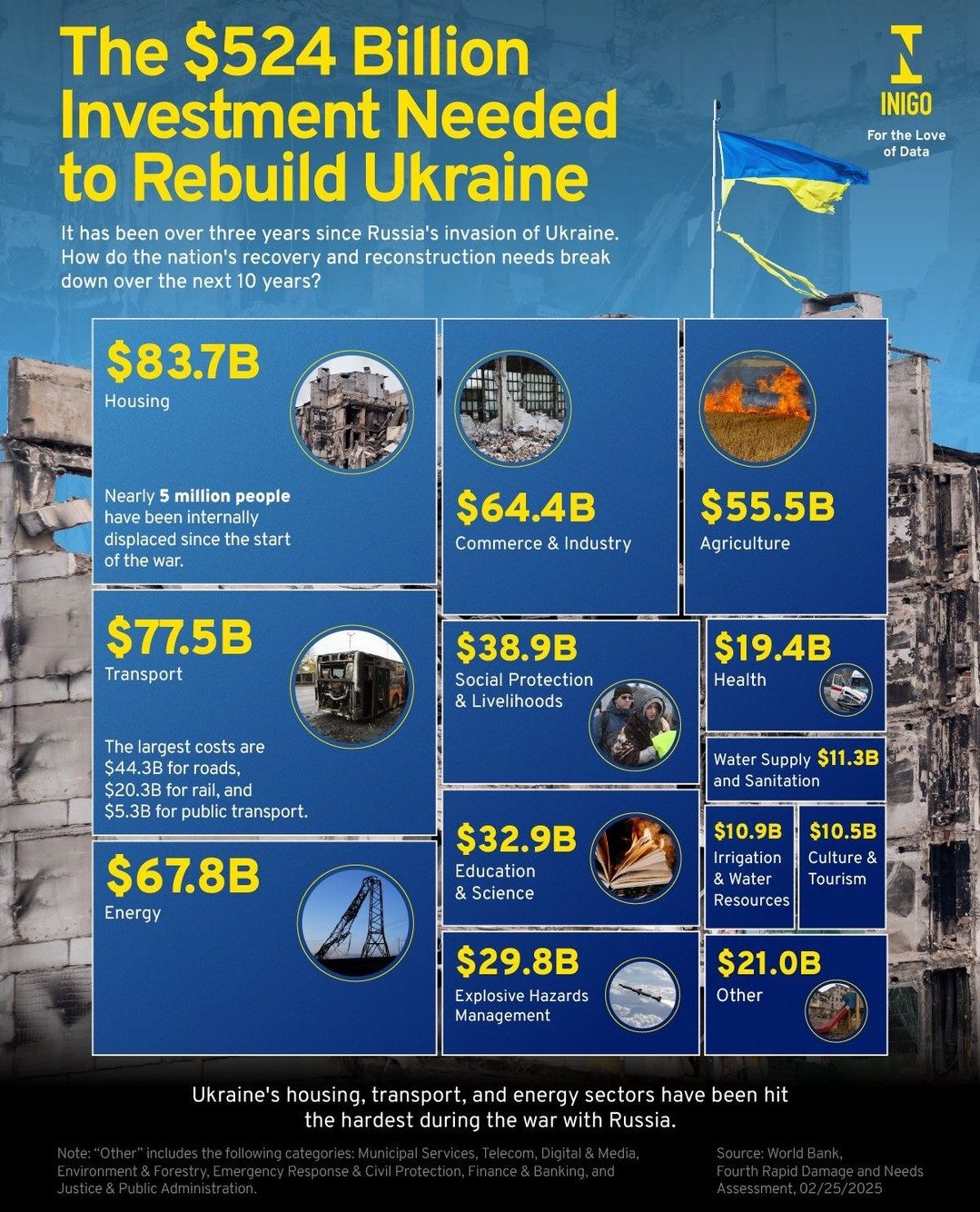
Ukraine's rebuilding and recovery process after the Russia-Ukraine war represents one of the most significant infrastructure and economic challenges of the decade. The country faces an estimated $524 billion in investment needs over the next ten years to address the widespread damage caused by the conflict. This investment is crucial for rebuilding Ukraine's housing, transport, and energy sectors, which have been hit the hardest, accounting for approximately $229 billion of the total reconstruction needs.
Why this matters
The sheer scale of the investment required to rebuild Ukraine underscores the profound impact of the conflict on the country's infrastructure and economy. The reconstruction will involve not just rebuilding physical structures, but also restoring the social fabric and economic viability of Ukraine. Understanding the specifics of these needs provides critical insights into the geopolitical and global risks, as well as the opportunities for international cooperation and investment.
Breakdown of the Investment Needs
Housing Sector
The housing sector has been one of the most severely affected, with an estimated $83.7 billion needed for reconstruction and recovery. This includes not only the rebuilding of residential buildings but also the infrastructure supporting these homes, such as water supply and sanitation. Nearly 5 million people have been displaced since the start of the war, highlighting the urgent need for stable housing solutions.
Transport Sector
The transport sector requires approximately $77.5 billion, with specific allocations for roads ($44.3 billion), rail ($20.3 billion), and public transport ($5.3 billion). This investment is critical for restoring connectivity, facilitating trade, and enabling the movement of people and goods. Effective transport infrastructure is essential for economic recovery and growth.
Energy Sector
The energy sector, with a needed investment of $67.8 billion, is pivotal for Ukraine's economic and social recovery. This includes investments in various energy sub-sectors, such as electricity, heating, and renewable energy. The energy sector’s reconstruction is not just about powering homes and businesses; it is also about ensuring energy security and reducing reliance on external energy sources.
Other Critical Sectors
While housing, transport, and energy sectors form the bulk of the immediate needs, other sectors also require significant investment:
- Commerce and Industry: $64.4 billion is needed to revive Ukraine’s industrial base and commercial activities, which are essential for economic recovery and job creation.
- Agriculture and Social Protection: $55.5 billion and $38.9 billion are allocated to agriculture and social protection and livelihoods, respectively. These sectors are vital for ensuring food security and supporting the livelihoods of displaced people and vulnerable populations.
- Health and Education: Health and education are pivotal for long-term recovery, with $19.4 billion and $32.9 billion allocated for these sectors, respectively. This investment aims to rebuild healthcare infrastructure and educational facilities, ensuring access to essential services for the population.
- Culture and Tourism: Culture and tourism, though often overlooked in immediate post-conflict scenarios, are critical for the cultural and economic recovery of the country. An estimated $10.5 billion is needed to revitalize these sectors.
- Explosive Hazards Management: An estimated $29.8 billion is required for explosive hazards management, which includes the demining of affected areas and ensuring the safety of the population. This is a crucial step in making the country habitable and safe for reconstruction efforts.
Practical Tips for Investors and Policymakers
Investing in Ukraine's reconstruction is not just about financial contributions but also about strategic planning and collaboration. Here are some practical tips for investors and policymakers:
- Collaborative Efforts: Engage with local governments, NGOs, and international organizations to ensure that investments are aligned with the most pressing needs and community priorities.
- Long-term Planning: Consider long-term sustainability and resilience in your investment plans. This includes investing in renewable energy, resilient infrastructure, and sustainable development practices.
- Risk Assessment: Conduct thorough risk assessments, including geopolitical and economic risks, to ensure that investments are well-protected and yield the desired outcomes.
- Community Engagement: Involve local communities in the planning and implementation phases to ensure that reconstruction efforts are inclusive and meet the needs of all affected populations.
Takeaways
Immediate Needs
The immediate needs for Ukraine's rebuilding and recovery are substantial, with the housing, transport, and energy sectors requiring the most urgent attention. The estimated $524 billion investment over the next decade will be pivotal in addressing these needs and restoring the country's infrastructure and economic viability.
Long-term Investment
While immediate reconstruction is critical, long-term investment in sustainable development, renewable energy, and resilient infrastructure is essential for Ukraine's long-term recovery and growth. This includes not just rebuilding what was lost but also enhancing the country's ability to withstand future shocks.
Strategic Planning
Strategic planning and collaboration with local and international stakeholders are crucial for effective and sustainable reconstruction. Engaging with communities, conducting thorough risk assessments, and ensuring long-term sustainability are essential for successful investment.
Conclusion
The rebuilding of Ukraine is a monumental task that requires the combined efforts of international investors, policymakers, and local stakeholders. Understanding the specific needs and strategic planning is crucial for effective reconstruction and long-term sustainability. The estimated $524 billion investment over the next decade is a significant step towards restoring Ukraine's infrastructure, economy, and social fabric. This process will not only benefit Ukraine but also contribute to global peace and stability.
Watch the Reel
Questions readers ask
What are the key sectors targeted for rebuilding in Ukraine?
The primary sectors targeted for rebuilding in Ukraine are housing, transport, and energy. These sectors have incurred approximately $229 billion of the total $524 billion in reconstruction needs, making them crucial for Ukraine's recovery and economic stability following the war.
How long is the rebuilding process expected to take?
The rebuilding process in Ukraine is anticipated to span a decade. This timeframe allows for the comprehensive restoration of infrastructure and the revitalization of the country's social and economic fabric, which have been severely affected by the conflict.
What is the estimated cost of rebuilding Ukraine's infrastructure?
The estimated cost of rebuilding Ukraine's infrastructure is $524 billion over the next ten years. This substantial investment is necessary to address the widespread damage caused by the war and to stimulate economic growth in the country.
Why is rebuilding Ukraine's social fabric important?
Rebuilding Ukraine's social fabric is vital for the country's long-term recovery and stability. It involves addressing the impact of the conflict on communities, restoring social services, and fostering a sense of unity and resilience among Ukrainian citizens.
What role does international investment play in Ukraine's reconstruction?
International investment is crucial for Ukraine's reconstruction. Given the scale of the damage, Ukraine will rely on significant financial support from global partners to fund the rebuilding efforts across housing, transport, and energy sectors.
How will rebuilding Ukraine's infrastructure impact its economic stability?
Rebuilding Ukraine's infrastructure will have a direct positive impact on its economic stability. By restoring essential services, creating jobs, and stimulating economic activity, the rebuilding process will help Ukraine's economy recover and grow, fostering a more secure and prosperous future.
What steps are being taken to assess the war damage in Ukraine?
Ukraine is conducting comprehensive assessments to evaluate the extent of war damage across various sectors. These assessments involve detailed evaluations of infrastructure, housing, and other critical areas to determine the specific needs and costs for reconstruction, ensuring a targeted approach to rebuilding efforts.
Related deep dives
Similar reads based on topic and creator.

Recent articles
Fresh deep dives from the latest Reels we unpacked.




Comments
Be the first to comment.