Real Estate Bubble Risk: An In-Depth Look at Global Cities
Housing bubbles are a complex phenomenon, particularly when markets heat up and prices surge. The debate often centers on whether the market is overvalued due to speculation or simply experiencing strong demand. One clear warning sign is when property prices significantly outpace local incomes and rents. Additionally, imbalances in the broader economy, such as excessive construction and lending, can signal a bubble in the making.
Context: Why this matters
Understanding bubble risk is crucial for both investors and homebuyers. Identifying potential bubbles can help individuals make informed decisions about where to invest or purchase property. It also allows policymakers to implement measures to stabilize the market and mitigate risks. The UBS Global Real Estate Bubble Index provides a comprehensive assessment of the risks in major global cities, offering valuable insights into the health of the real estate market.
The index categorizes cities into three groups:
- Fair-Valued: Cities where prices align with economic fundamentals, such as income and rent levels.
- Overvalued: Cities where prices are higher than justified by economic indicators, but not yet at bubble levels.
- Bubble Risk: Cities where prices are significantly higher than warranted by economic conditions, indicating a high risk of a bubble.
Main Discussion
The UBS Global Real Estate Bubble Index
The UBS Global Real Estate Bubble Index is a powerful tool for assessing real estate market conditions. It takes into account various factors, including income levels, rent prices, mortgage rates, and construction activity. By analyzing these indicators, the index provides a clear picture of which cities are at risk of a housing bubble.
Key Findings
High-Risk Cities
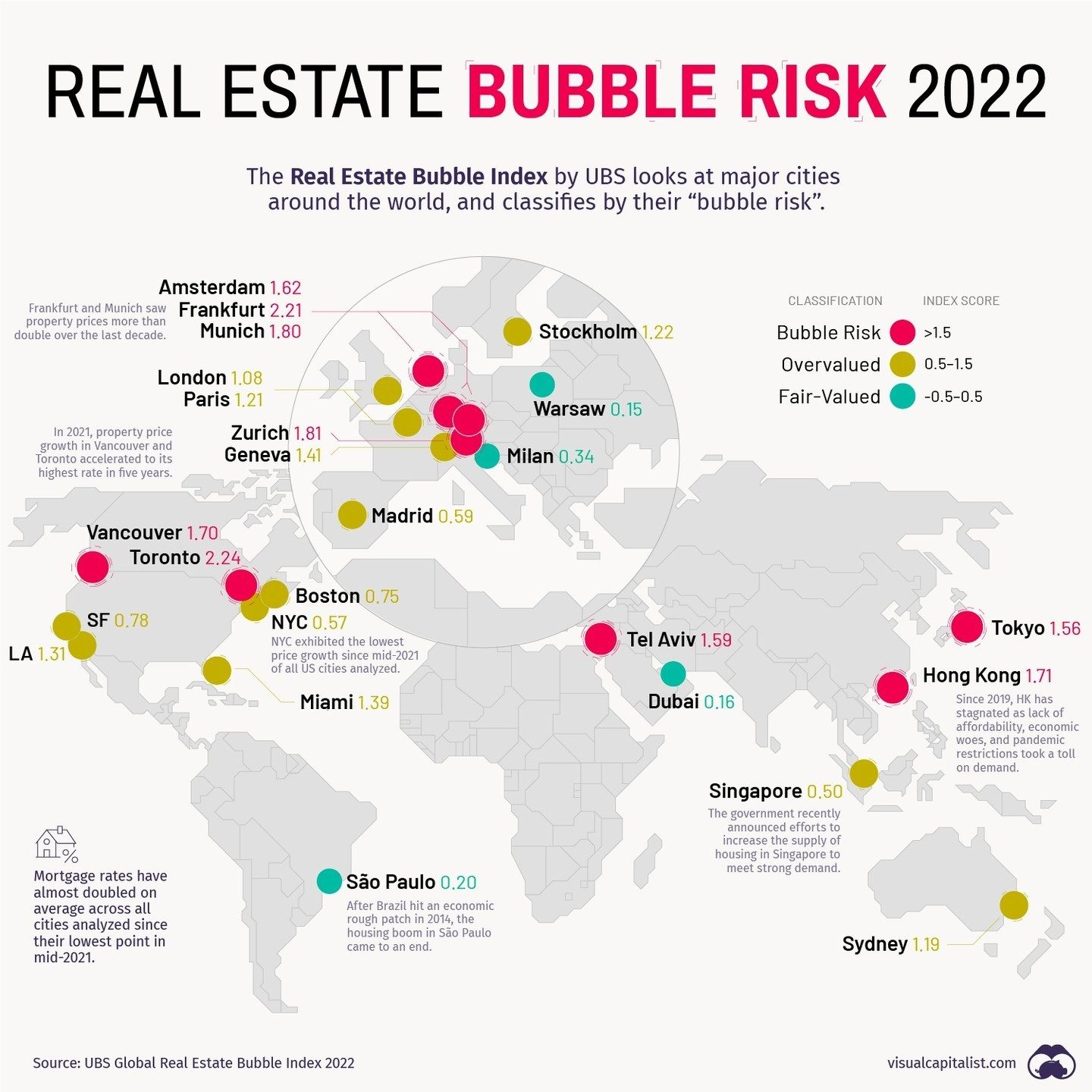
Frankfurt and Toronto top the list with the highest index scores, indicating a significant risk of a bubble. Frankfurt's index score is 2.21, while Toronto's is 2.24. Both cities are experiencing rapid price increases that are not fully supported by economic fundamentals. Amsterdam and Munich also fall into the high-risk category, with scores of 1.62 and 1.80, respectively.
Overvalued Cities
Several cities are classified as overvalued, meaning prices are higher than justified by economic indicators, but not yet at bubble levels. Examples include Vancouver (1.70), Hong Kong (1.71), and Tel Aviv (1.59). These cities are experiencing strong demand, but there are concerns about sustainability.
Fair-Valued Cities
Cities classified as fair-valued have prices that align with economic fundamentals. Examples include Warsaw (0.15), Dubai (0.16), and Singapore (0.50). These cities are less likely to experience a significant drop in prices, making them relatively stable investment options.
Economic Factors Influencing Bubble Risk
Several economic factors contribute to bubble risk. One of the most significant is mortgage rates. Since mid-2021, mortgage rates have almost doubled on average across all cities. This increase can make buying a home more expensive and may lead to a slowdown in demand, potentially stabilizing prices. However, in cities with high bubble risk, the impact of rising mortgage rates may not be sufficient to offset the existing imbalances.
Cities in Detail
Frankfurt
Frankfurt's high index score of 2.21 indicates a significant risk of a bubble. The city has seen rapid price increases, driven by strong demand and limited supply. The local economy, while robust, may not fully support the current price levels, raising concerns about sustainability.
Toronto
Toronto's index score of 2.24 places it at the top of the high-risk category. The city has experienced a significant influx of buyers, pushing prices to unsustainable levels. Rising mortgage rates may slow down demand, but the existing imbalances could still pose a risk.
Vancouver
Vancouver's overvalued status, with an index score of 1.70, suggests that prices are higher than justified by economic conditions. The city has long been a hotspot for real estate investment, but the recent price increases have raised concerns about affordability and sustainability.
Practical Tips
For Investors
Investors should approach high-risk cities with caution. Conduct thorough research, including an analysis of local economic indicators and market trends. Diversifying investments across different cities and property types can also help mitigate risks.
For Homebuyers
Homebuyers should carefully consider their financial situation and the potential for price corrections in high-risk areas. It may be wise to look for opportunities in fair-valued cities, where prices are more likely to remain stable.
Important Takeaways
Understanding bubble risk is essential for making informed real estate decisions. The UBS Global Real Estate Bubble Index provides valuable insights into market conditions, helping investors and homebuyers navigate the complexities of the global real estate landscape.
Conclusion
The risk of a real estate bubble is a critical consideration for anyone involved in the market. By understanding the factors contributing to bubble risk and using tools like the UBS Global Real Estate Bubble Index, individuals can make more informed decisions. Whether you're an investor, a homebuyer, or a policymaker, staying informed about market conditions and potential risks is key to navigating the ever-changing real estate landscape.
Watch the Reel
Questions readers ask
Which cities are considered the most at-risk for a real estate bubble in 2022, according to UBS?
In 2022, Frankfurt and Toronto were identified as the cities with the highest risk of a housing bubble, topping the UBS Global Real Estate Bubble Index. These cities showed significant signs of overheating, with property prices outpacing local incomes and rents.
How does the UBS Global Real Estate Bubble Index categorize cities?
The UBS index categorizes cities into three groups: Fair-Valued, Overvalued, and Bubble Risk. This categorization is based on various factors including local income, rent prices, and construction activity. Cities in the Bubble Risk category are those with the highest risk of experiencing a housing bubble.
What are some warning signs of a real estate bubble?
Key warning signs of a real estate bubble include property prices significantly outpacing local incomes and rents, excessive construction activity, and imbalances in the broader economy, such as lax lending standards. These factors can indicate an overheated market that is at risk of a bubble.
Why is it important to understand real estate bubble risk?
Understanding real estate bubble risk is vital for both investors and homebuyers, as it helps them make informed decisions about where to invest or purchase property. By identifying potential bubbles, individuals can mitigate risks and avoid financial losses. Additionally, it enables policymakers to implement measures to stabilize the market and mitigate broader economic impacts.
What factors contribute to a city being categorized as "overvalued" in the UBS index?
Cities are categorized as "Overvalued" based on factors such as local income levels, rent prices, and construction activity. These factors help determine if property prices are significantly higher than what can be justified by local economic conditions, indicating a potential overvaluation of the real estate market.
How can policymakers use the UBS Global Real Estate Bubble Index to stabilize the market?
The UBS index provides valuable insights into the health of global real estate markets. Policymakers can use this information to implement measures such as adjusting lending standards, regulating construction activity, or introducing policies that cool down overheated markets, thereby helping to stabilize the real estate market and prevent potential bubbles from bursting.
What is the significance of the 2022 UBS Global Real Estate Bubble Index?
The 2022 UBS Global Real Estate Bubble Index provides a snapshot of the global housing market, highlighting cities at risk of a bubble. This information is valuable for investors, homebuyers, and policymakers, as it helps them navigate the complexities of the real estate market by providing clear indicators of where the market may be overheating.
Recent articles
Fresh deep dives from the latest Reels we unpacked.




Comments
Be the first to comment.