The UAE's Vehicle Trade: A Look into Booming Automotive Export and Import
The United Arab Emirates (UAE) has emerged as a significant player in the global vehicle trade, with Dubai's port of Jebel Ali serving as a critical hub for automotive logistics. The latest data from the Bank for International Settlements (BACI) reveals an impressive growth trajectory for the UAE's vehicle import and export activities, with several key countries driving this expansion.
Context / Why this Matters
The UAE's strategic location and robust infrastructure have positioned it as a pivotal hub for global automotive trade. The country's vehicle trade has seen substantial growth, making it a notable player in the international market. Understanding the dynamics of this trade is crucial for stakeholders in the automotive industry, including manufacturers, logistics providers, and policymakers.
Main Discussion
The Role of Dubai’s Port of Jebel Ali
Dubai's port of Jebel Ali is a linchpin in the UAE's automotive trade success. Its strategic location and advanced infrastructure make it an ideal transit point for vehicle imports and exports. The port's efficiency and capacity have attracted major automotive players, facilitating the smooth flow of vehicles between the UAE and its trading partners.
Key Import and Export Partners
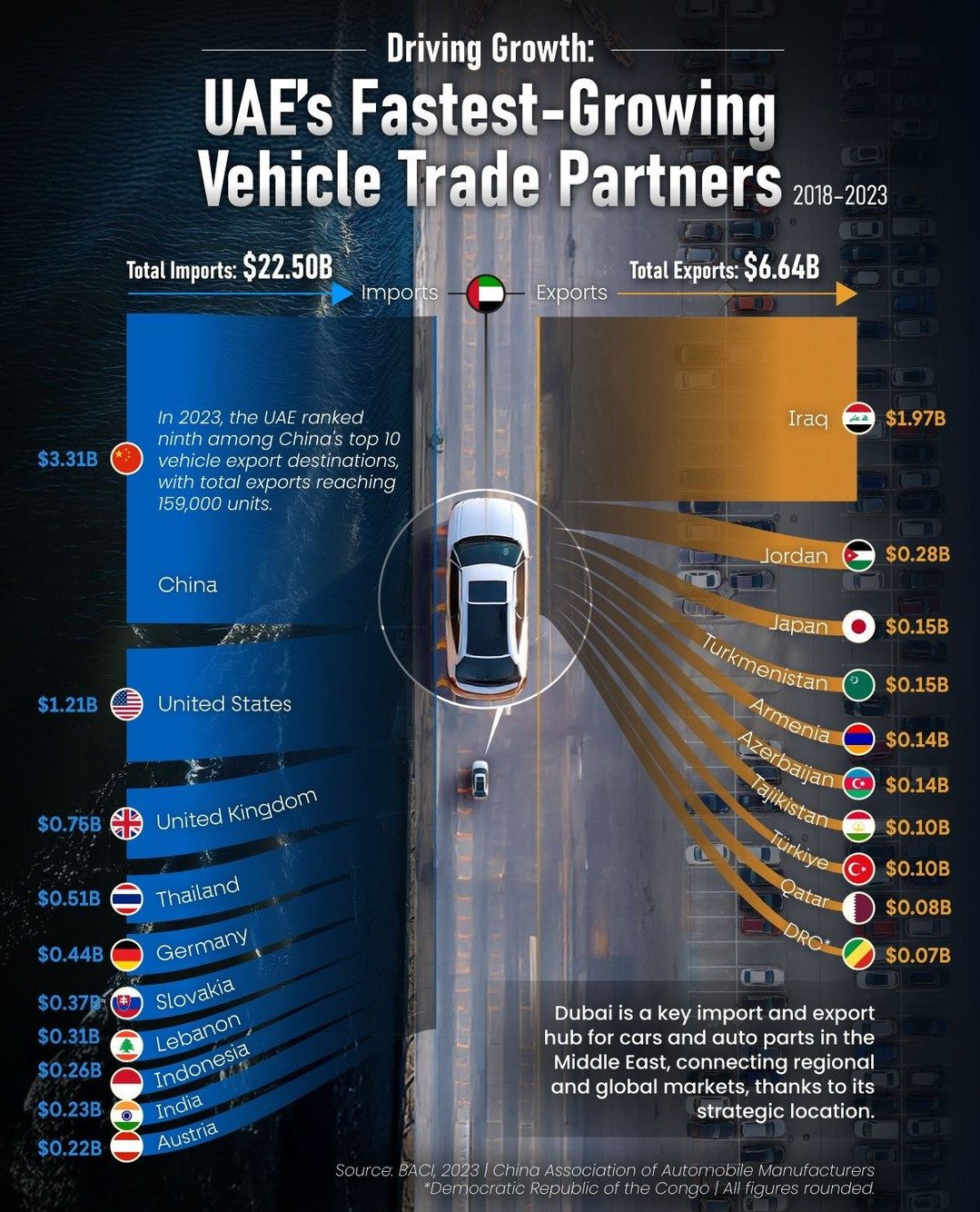
The UAE's vehicle trade involves a diverse range of countries, with China, the United States, and the United Kingdom being some of the most significant partners. In 2023, the UAE ranked ninth among China's top 10 vehicle export destinations, with exports reaching 159,000 units. This highlights the UAE's growing importance as a market for Chinese automotive exports. Additionally, the UAE imports vehicles from countries like the United States, United Kingdom, and Japan, showcasing its role as a global automotive hub.
In 2023, the UAE's total vehicle imports reached $22.50 billion, while exports totaled $6.64 billion. This substantial trade volume underscores the country's influence in the global automotive market. Key import partners include the United States, United Kingdom, and Japan, while significant export destinations include countries like China and the Democratic Republic of the Congo.
Emerging Markets and Strategic Alliances
The UAE's vehicle trade extends beyond traditional markets, with emerging economies like Tajikistan, Turkmenistan, and Lebanon also playing crucial roles. These countries represent new opportunities for the UAE's automotive industry, driven by strategic alliances and growing demand for vehicles in these regions.
The UAE's partnerships with countries like India, Thailand, and Germany further diversify its trade portfolio. These countries are not only significant trading partners but also potential markets for the UAE's automotive exports. The UAE's ability to foster strong trade relationships with a variety of countries reflects its strategic approach to global trade.
Dubai as a Strategic Hub
Dubai's strategic location and advanced logistics infrastructure make it a key import and export hub for cars and auto parts in the Middle East and global markets. The city's free zones, such as the Jebel Ali Free Zone, offer tax incentives and streamlined customs procedures, making it an attractive destination for automotive trade. The UAE's commitment to developing its logistics capabilities has further enhanced its status as a global automotive trade hub.
Practical Tips
For businesses looking to engage in the UAE's vehicle trade, several practical tips can help maximize opportunities:
-
Leverage Dubai's Infrastructure: Utilize Dubai's advanced logistics infrastructure, including the port of Jebel Ali, to streamline the import and export of vehicles.
-
Explore Emerging Markets: Identify and explore emerging markets in the Middle East and other regions to diversify trade partnerships.
-
Build Strategic Alliances: Form strategic alliances with key trading partners to strengthen supply chains and enhance market access.
-
Understand Regulatory Framework: Stay informed about the UAE's regulatory framework for automotive trade, including customs procedures and tax incentives.
-
Engage with Local Partners: Collaborate with local partners, such as DP World and Jebel Ali Free Zone, to navigate the market and optimize trade operations.
Important Takeaways
The UAE's vehicle trade is a dynamic and growing sector, driven by strategic alliances, emerging markets, and advanced logistics infrastructure. The country's partnerships with key countries like China, the United States, and the United Kingdom highlight its significance in the global automotive market. Dubai's strategic location and advanced logistics capabilities further enhance its role as a key hub for global automotive trade.
Conclusion
The UAE's vehicle trade represents a thriving sector with immense potential for growth. With Dubai's port of Jebel Ali serving as a strategic hub, the country's trade activities are poised to continue expanding. By leveraging its strengths and exploring new opportunities, the UAE is well-positioned to maintain its influence in the global automotive market.
Watch the Reel
Questions readers ask
Why is the UAE considered a pivotal hub for global vehicle trade?
The UAE's strategic location and robust infrastructure, particularly the port of Jebel Ali in Dubai, make it an ideal hub for global vehicle trade. This positioning facilitates significant import and export activities, connecting key international partners and driving growth in the automotive sector.
Which countries are the main partners of the UAE in vehicle trade?
The UAE has established strong trade relationships with several countries, with China, the United States, and the United Kingdom being among the most notable. These partnerships contribute significantly to the growth of the UAE's vehicle import and export activities.
How has the UAE's vehicle trade grown over recent years?
According to the Bank for International Settlements (BACI), the UAE's vehicle trade has shown impressive growth. From 2018 to 2023, the country has seen a substantial increase in both imports and exports, reflecting its increasing importance in the global automotive market.
What role does the port of Jebel Ali play in the UAE's vehicle trade?
The port of Jebel Ali in Dubai is a critical hub for automotive logistics. Its strategic location and efficient infrastructure enable it to handle a large volume of vehicle imports and exports, making it a linchpin in the UAE's global vehicle trade operations.
What are some of the fastest growing vehicle trade markets for the UAE?
The UAE's vehicle trade with countries like China has seen notable growth. This expansion is driven by strategic partnerships and the UAE's ability to leverage its infrastructure to facilitate robust import and export activities.
How does the UAE's vehicle trade infrastructure support its global role?
The UAE's vehicle trade infrastructure is designed to support the efficient flow of goods. This includes modern ports, advanced logistics systems, and strategic highways, all of which enable the UAE to effectively manage the high volume of vehicle imports and exports.
What are the key statistics for the UAE's vehicle trade in 2023?
As of 2023, the UAE's vehicle trade statistics show a significant increase in both import and export activities. This growth is a testament to the country's rising importance in the global vehicle trade network, driven by its strategic location, infrastructure, and partnerships.
Related deep dives
Similar reads based on topic and creator.

Recent articles
Fresh deep dives from the latest Reels we unpacked.




Comments
Be the first to comment.