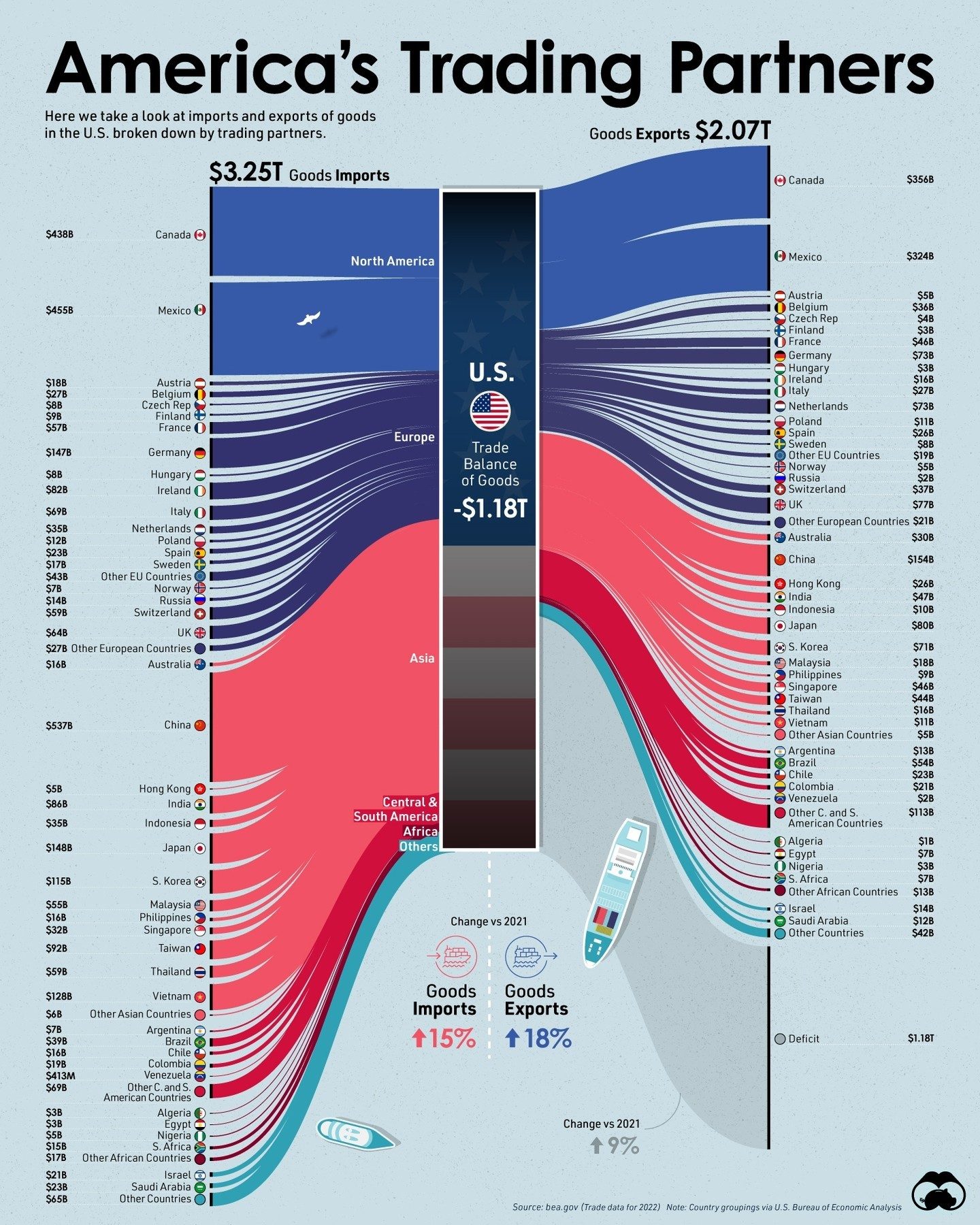
America's Trading Partners
The United States stands as the world’s biggest importer of goods, playing a pivotal role in global trade. With over 200 countries, regions, and territories engaged in trade relations, the U.S. has a vast and complex network of trading partners. This article will dive into the key players in U.S. trade, highlighting the value of exports and imports, and breaking down the significant trading partners.
Why Understanding U.S. Trade Matters
Understanding U.S. trade dynamics is crucial for several reasons. It impacts the economy, job markets, and consumer goods supply. The U.S.'s position as the world’s largest goods importer makes it a powerhouse in global trade. This status comes with significant influence and responsibility, affecting international relations and economic policies. Trade data helps businesses make informed decisions and governments formulate effective policies.
Key Trading Partners
North America
Mexico
Mexico is a critical trading partner for the U.S., ranking high in both exports and imports. Goods exchanged include automobiles, electronics, and agricultural products. The close geographic proximity and the United States-Mexico-Canada Agreement (USMCA) facilitate smooth trade. Mexico is a major exporter of goods like vehicles, auto parts, and machinery to the U.S.
Canada
Canada consistently ranks as one of the top trading partners for the U.S. The high value of goods traded between the two countries underscores their strong economic ties. Key exports from the U.S. to Canada include vehicles, machinery, and electrical equipment. Imported goods from Canada to the U.S. include vehicles, mineral fuels, oils, and wood pulp.
Europe
European Countries
The European Union collectively is a significant trading partner for the U.S. Countries like Germany, France, and the UK are major players in this region. Goods exchanged include machinery, vehicles, and chemicals. The U.S. imports a variety of goods from Europe, including luxury vehicles, pharmaceuticals, and consumer electronics.
Asia
Asia
While specific countries aren’t mentioned, Asia as a region is pivotal for U.S. trade. Goods traded with Asian countries include electronics, machinery, and textiles. The U.S. imports a significant amount of consumer goods and electronics from Asia. The region's role in global supply chains makes it a critical partner for the U.S.
Practical Tips for Understanding Trade Data
1. Utilize Trade Statistics
Getting a handle on U.S. trade dynamics starts with understanding trade statistics. Websites like the U.S. Census Bureau and the International Trade Administration provide detailed data on exports and imports. These resources can help you identify trends, track changes in trade relations, and understand the economic impact of trade policies.
2. Follow Trade Agreements
Trade agreements shape the landscape of international trade. Familiarize yourself with key agreements such as the USMCA, the United States–European Union Trade and Technology Council, and the U.S.-Japan Trade and Investment Partnership. These agreements set the rules for trade, influence tariffs, and promote fair competition.
3. Monitor Policy Changes
Trade policies can fluctuate based on political and economic conditions. Stay updated on policy changes by following relevant government agencies and industry reports. Policy shifts can impact trade flows, tariffs, and market access, making it crucial to stay informed.
4. Analyze Industry-Specific Data
Different industries have unique trade dynamics. Dive into industry-specific data to understand the nuances of trade in sectors like automotive, electronics, and agriculture. This detailed analysis can provide insights into competitive advantages, market trends, and regulatory environments.
Important Takeaways
- The U.S. is the world’s largest importer of goods, with a complex network of trade relations.
- Mexico and Canada are key trading partners in North America, with high values of goods exchanged.
- Europe, particularly countries like Germany, France, and the UK, is a significant trading partner.
- Asia, though not specified, is crucial for U.S. trade, particularly in electronics and consumer goods.
- Utilizing trade statistics, following trade agreements, monitoring policy changes, and analyzing industry-specific data are practical steps to understand U.S. trade dynamics.
Conclusion
The United States' role as the world’s biggest goods importer highlights its influence in global trade. Understanding the key trading partners, the value of goods exchanged, and the dynamics of trade agreements is essential for businesses and policymakers. By staying informed and utilizing available resources, one can navigate the complexities of U.S. trade and make strategic decisions that leverage these global relationships.
Watch the Reel
Questions readers ask
Who are the top U.S. trading partners?
The top U.S. trading partners include Mexico, Canada, and several European countries. These nations are crucial for both imports and exports, significantly impacting the U.S. economy through bilateral trade agreements and economic cooperation.
How does the U.S. rank in global goods imports?
The U.S. is the world's largest importer of goods, which underscores its significant role in the global economy. This position highlights the U.S.'s considerable influence in international trade, affecting job markets and the availability of goods for consumers.
What is the significance of U.S. trade relationships with Mexico and Canada?
U.S. trade with both Mexico and Canada is substantial. These countries are among the top export partners for the U.S., facilitating a continuous flow of goods and services that support job growth and economic stability in all three nations. Trade statistics indicate robust commercial ties.
What are the key U.S. trading partners in Europe?
Key U.S. trading partners in Europe include countries like Germany, the United Kingdom, and France. These relationships are crucial for the U.S. trade partnerships, with significant volumes of imports and exports contributing to mutual economic benefits, including access to diverse markets and resources.
How do U.S. trade values impact the global market?
U.S. trade values have a profound impact on the global market. As the largest importer of goods, the U.S. sets trends in international trade. Fluctuations in U.S. trade values can affect global supply chains, influence pricing strategies, and drive economic policies in other countries.
How can businesses and governments leverage U.S. international trade statistics?
Businesses and governments can leverage U.S. international trade statistics to make informed decisions. These statistics provide insights into market trends, helping businesses identify opportunities for growth and governments to develop policies that foster international cooperation and economic stability.
What are the primary benefits of understanding U.S. trade partnerships?
Understanding U.S. trade partnerships offers several benefits, including insights into global market trends, enhanced opportunities for international cooperation, and the ability to navigate complex trade agreements. This knowledge can drive strategic decision-making for businesses and shape effective policies for governments.
Related deep dives
Similar reads based on topic and creator.


Recent articles
Fresh deep dives from the latest Reels we unpacked.




Comments
Be the first to comment.