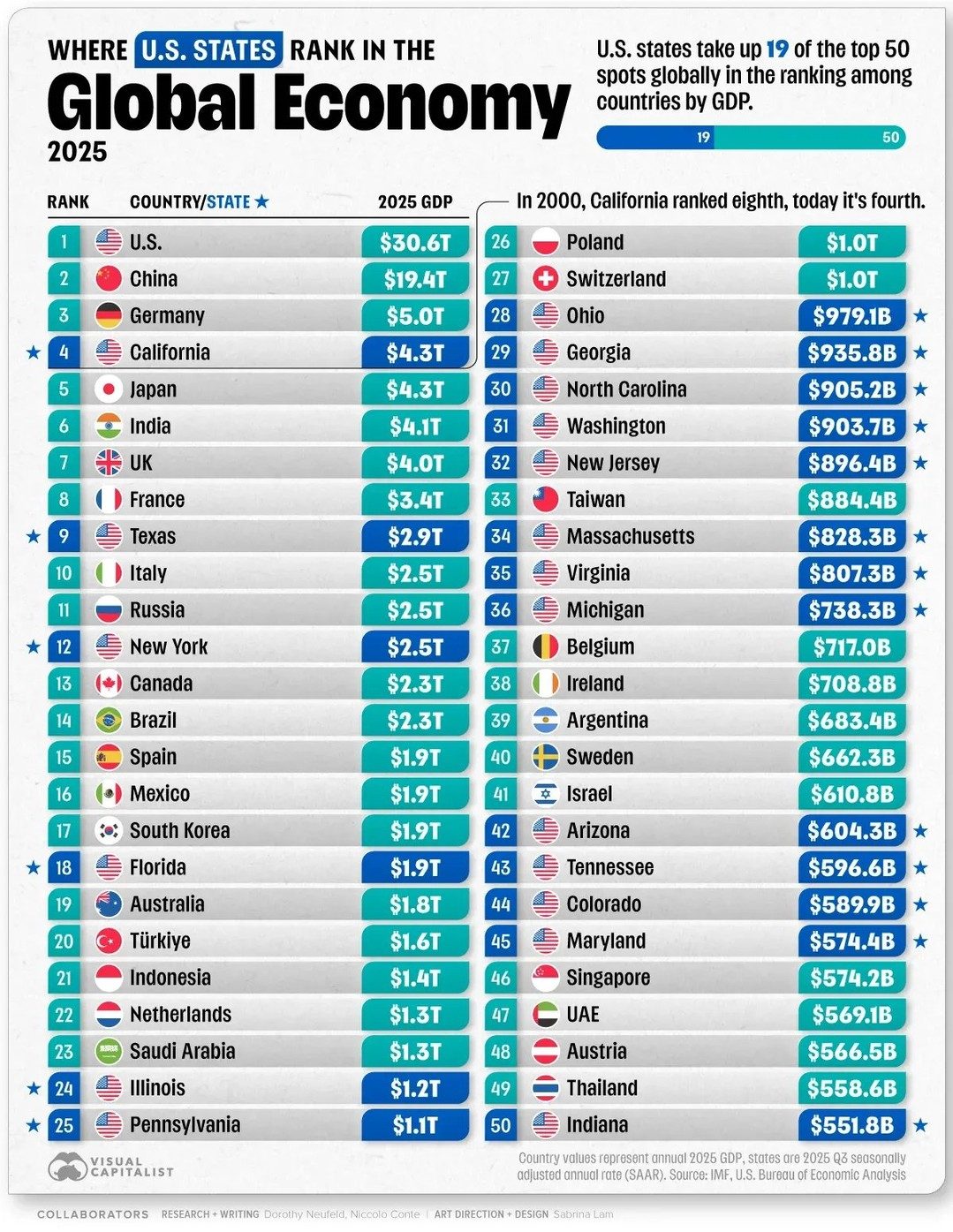
Global Economy Ranking: How U.S. States Compare to Countries
The economic landscapes of the United States and the world are vast and complex. In 2025, the U.S. GDP is projected to be $30.6 trillion, making it the world's top economy. China and Germany closely follow, with GDPs of $19.4 trillion and $5.0 trillion, respectively. Intuitively, countries with massive populations like China dominate the global economy. However, it’s surprising that several U.S. states individually rank among the world’s 50 largest economies.
Context / Why This Matters
Understanding the economic ranking of U.S. states in a global context is essential for several reasons. It provides a comparative analysis of economic power, highlights key industries, and indicates economic resilience. By looking at economic indicators, businesses, policymakers, and investors can identify potential markets, assess risks, and make informed decisions.
Main Discussion
The Economic Powerhouses: California, Texas, and Florida
Three states stand out in the ranking:
-
California: At $4.30 trillion, California would be the world's fourth-largest economy, surpassing Japan and India. California's economy is diverse, with key industries including technology, entertainment, and agriculture. Silicon Valley alone is a global innovation hub, and Hollywood fuels the entertainment industry worldwide.
-
Texas: With a GDP of $2.94 trillion, Texas ranks higher than Italy and Russia. Texas is a leader in energy, aerospace, and technology sectors, particularly in Houston and Dallas.
-
Florida: Florida’s economy, at $1.9 trillion, surpasses Australia’s. Florida is a major tourist destination, with significant contributions from hospitality, international trade, and aerospace.
The Economic Impact of Other U.S. States
Beyond the top three, several other U.S. states also rank high on the global economic stage:
-
New York: With a GDP of $2.5 trillion, New York is a global financial center and home to Wall Street, the heart of the world's financial markets. Its economy is also bolstered by industries like media, fashion, and tourism.
-
Washington: Washington State has a GDP of $903.7 billion, driven by industries like aerospace (home to Boeing), technology, and agriculture.
-
Ohio: Ohio’s GDP of $979.1 billion is supported by sectors such as manufacturing, healthcare, and education.
-
Georgia, New Jersey, and North Carolina: These states are also among the top 30 global economies, with GDPs ranging from $905.2 billion to $979.1 billion. These states benefit from diverse economies, including manufacturing, finance, and technology.
The Economic Evolution of U.S. States
Looking at how rankings have changed over the years provides valuable insights. For instance, in 2000, California ranked eighth globally. Today, it ranks fourth. This significant jump reflects the growth of key industries like technology and entertainment. Similarly, states like Texas and Florida have also seen substantial economic growth, driven by their diverse economies.
The Importance of GDP in Economic Comparisons
GDP (Gross Domestic Product) is a crucial economic indicator. It measures the total value of goods and services produced within a region or country in a given period. Comparing GDPs provides a snapshot of economic power and helps in understanding the relative economic strength of different regions.
Practical Tips
To better understand and leverage this information, consider the following tips:
For Businesses
-
Market Expansion: Consider the economic strength of a region when expanding your business. States with high GDP typically have more disposable income and a larger consumer base.
-
Supply Chain Management: Understand the economic landscape to manage your supply chain more effectively. For example, states with strong manufacturing sectors can provide reliable and affordable production options.
For Investors
- Diversify Your Portfolio: Invest in different states and sectors to diversify your portfolio and mitigate risks.
- Identify Growth Opportunities: Look for growth potential in states with strong economic indicators and key industry sectors.
For Policymakers
- Economic Development Policies: Craft policies that support key industries and foster economic growth. This could include tax incentives, infrastructure development, and education initiatives.
- Collaboration and Partnerships: Foster collaboration between states and other countries to leverage global economic opportunities.
Important Takeaways
Economic Powerhouses
The U.S. states ranking among the world's top 50 economies are economic powerhouses. States like California, Texas, and Florida exemplify this economic might with diverse and robust industries.
Economic Growth and Evolution
States’ economic rankings have evolved significantly over the years, reflecting industry growth and investment in key sectors. This evolution highlights the dynamic nature of economic power.
Comparative Analysis
Comparing U.S. states to global economies provides a unique perspective on economic strength and resilience. It helps identify key industries, economic risks, and potential opportunities.
Conclusion
The economic rankings of U.S. states compared to countries offer a fascinating and valuable perspective on global economic power. States like California, Texas, and Florida stand out as significant economic players, while others like New York and Ohio also contribute significantly.
Understanding these rankings can help businesses, investors, and policymakers make informed decisions. By analyzing economic indicators and trends, stakeholders can identify opportunities, manage risks, and drive economic growth.
Watch the Reel
Questions readers ask
Which U.S. states are expected to be among the world's 50 largest economies by 2025?
By 2025, several U.S. states will rank among the world's 50 largest economies, with California, Texas, and Florida leading the way. The diverse industries within these states contribute significantly to their global economic significance.
How does the U.S. economy compare to the world's largest economies in 2025?
The U.S. is projected to have the world's top economy by 2025, with a GDP of $30.6 trillion. This positions the U.S. above China, which is expected to have a GDP of $19.4 trillion, and Germany, with a GDP of $5.0 trillion.
What makes California's economy stand out among U.S. states in 2025?
California's economy is driven by a variety of industries, including technology, entertainment, and agriculture. Its GDP in 2025 is expected to be significant, placing it among the world's largest economies.
How does Texas's economy compare to other states and countries by 2025?
Texas's economy is bolstered by sectors like energy, aerospace, and technology. With a projected substantial GDP in 2025, the state will rank highly among global economies and outcompete many smaller countries.
Why is understanding the economic ranking of U.S. states globally important?
Understanding how U.S. states compare to global economies offers insights into economic power, key industries, and resilience. This knowledge can inform policy decisions, investment strategies, and international trade negotiations.
Which industry in Florida is a major part of its 2025 economy?
Florida's economy is significantly influenced by its tourism industry, which attracts visitors from around the world. Additionally, sectors like aerospace and international trade contribute to its economic standing.
How does the U.S. economy's expected growth in 2025 impact the ranking of its states?
The projected $30.6 trillion GDP for the U.S. in 2025 means that several of its states will have economies comparable to those of entire countries. This growth underscores the strength and diversity of the U.S. economy and its individual states.
Related deep dives
Similar reads based on topic and creator.

Recent articles
Fresh deep dives from the latest Reels we unpacked.




Comments
Be the first to comment.