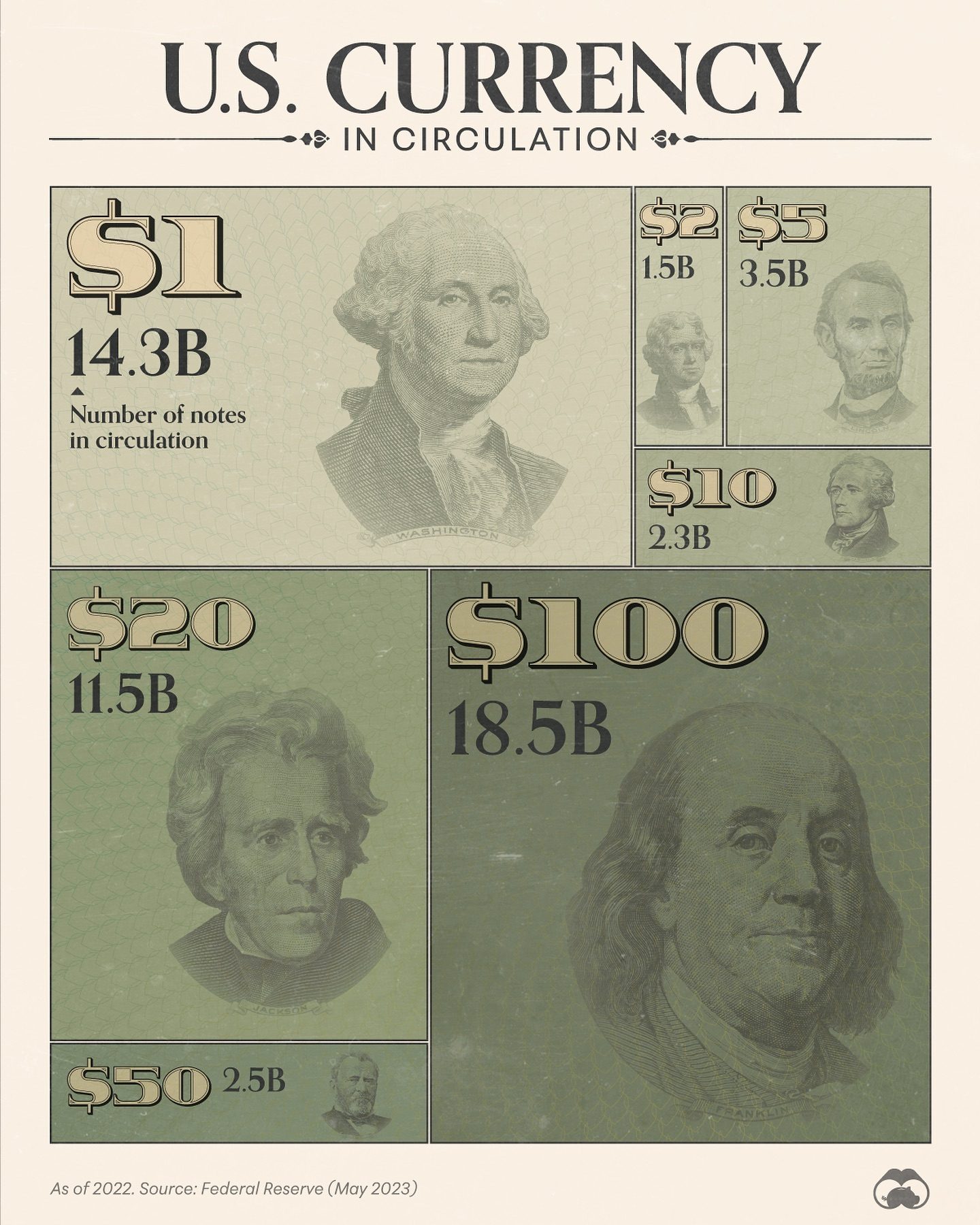
U.S. Currency in Circulation
Curiosity about the abundance of U.S. currency in circulation is common, and the figures are indeed noteworthy. Each year, the U.S. Federal Reserve places an order for U.S. currency with the Treasury Department’s Bureau of Engraving and Printing (BEP). This process results in the printing of billions of notes across various denominations, ranging from $1 to $100 bills. Let's delve into the latest data to understand the distribution and significance of these denominations.
Why This Matters
The amount of currency in circulation is a crucial indicator of economic activity and monetary policy. It reflects consumer spending habits, economic growth, and the Federal Reserve's efforts to manage inflation and stabilize the economy. Understanding the distribution of different denominations can provide insights into how money is used and circulated within the economy.
Key Denominations and Their Circulation
$1 Bills
As of December 31, 2022, there were approximately 14.3 billion $1 bills in circulation. This denomination is the most commonly used for everyday transactions, making up a significant portion of the total currency in circulation. The $1 bill features a portrait of George Washington, the first U.S. President.
$2 Bills
While less common, there were still 1.5 billion $2 bills in circulation. The $2 bill features a portrait of Thomas Jefferson, the third U.S. President. These bills are often used for smaller transactions and are sometimes sought after by collectors.
$5 Bills
Approximately 3.5 billion $5 bills were in circulation. The $5 bill features a portrait of Abraham Lincoln, the 16th U.S. President. This denomination is frequently used for small purchases and is a staple in many wallets.
$10 Bills
There were around 2.3 billion $10 bills in circulation. The $10 bill features a portrait of Alexander Hamilton, the first U.S. Secretary of the Treasury. This denomination is often used for larger transactions and is a common choice for cash payments.
$20 Bills
The $20 bill is one of the most widely used denominations, with approximately 11.5 billion notes in circulation. The $20 bill features a portrait of Andrew Jackson, the seventh U.S. President. This bill is used for a variety of transactions, from everyday purchases to larger payments.
$50 Bills
There were about 2.5 billion $50 bills in circulation. The $50 bill features a portrait of Ulysses S. Grant, the 18th U.S. President. This denomination is less common in daily transactions but is often used for larger payments and savings.
$100 Bills
The $100 bill is the highest denomination in common circulation, with approximately 18.5 billion notes in circulation. The $100 bill features a portrait of Benjamin Franklin, one of the Founding Fathers of the United States. This bill is often used for significant transactions and is a popular choice for savings and investments.
Production and Distribution
The Bureau of Engraving and Printing (BEP) is responsible for the production of U.S. currency. Each year, the BEP prints billions of notes to meet the demand for various denominations. The Federal Reserve, which oversees monetary policy, determines the amount of currency to be printed based on economic indicators and public demand.
The Printing Process
The printing process involves several steps, including the design, engraving, and printing of the notes. The BEP uses advanced security features to prevent counterfeiting, such as watermarks, security threads, and microprinting. The notes are then distributed to the Federal Reserve banks and commercial banks, which in turn distribute them to the public.
Security Features
U.S. currency notes are designed with numerous security features to prevent counterfeiting. These features include watermarks, security threads, and microprinting. Modern notes also include color-shifting ink, which changes color when viewed from different angles. These security features help ensure the authenticity of the currency and protect against fraud.
Practical Tips
Understanding the circulation of U.S. currency can be useful in various scenarios. Here are some practical tips to keep in mind:
Managing Cash Transactions
When managing cash transactions, it's helpful to know the most commonly used denominations. For example, $1, $5, $10, and $20 bills are frequently used for everyday purchases, while $50 and $100 bills are more commonly used for larger transactions and savings. Keeping a mix of denominations can make transactions more convenient and efficient.
Recognizing Counterfeit Bills
Being familiar with the security features of U.S. currency can help you recognize counterfeit bills. Always check for watermarks, security threads, and microprinting. Modern notes also include color-shifting ink, which changes color when viewed from different angles. If you suspect a bill is counterfeit, do not accept it and notify the authorities.
Currency Exchange
When traveling abroad, it's important to exchange your currency for the local currency. Understanding the circulation of U.S. currency can help you make informed decisions about how much to exchange and which denominations to carry. Carrying a mix of denominations can make transactions more convenient and efficient.
Important Takeaways
The Significance of Denominations
Each denomination of U.S. currency serves a specific purpose and is used for different types of transactions. Understanding the distribution and significance of these denominations can provide valuable insights into economic activity and monetary policy.
Economic Indicators
The amount of currency in circulation is a crucial indicator of economic activity and monetary policy. It reflects consumer spending habits, economic growth, and the Federal Reserve's efforts to manage inflation and stabilize the economy.
Security and Authenticity
U.S. currency notes are designed with numerous security features to prevent counterfeiting. Being familiar with these features can help you recognize counterfeit bills and protect against fraud. Always check for watermarks, security threads, and microprinting, and notify the authorities if you suspect a bill is counterfeit.
Conclusion
The circulation of U.S. currency is a complex and multifaceted topic that involves various denominations and production processes. Understanding the distribution and significance of these denominations can provide valuable insights into economic activity and monetary policy. By being familiar with the security features of U.S. currency, you can protect against fraud and ensure the authenticity of the notes you use and accept. The circulation of U.S. currency is a crucial indicator of economic activity and monetary policy, and understanding its distribution and significance can help you make informed decisions about cash transactions and currency exchange.
Watch the Reel
Questions readers ask
How many $1 and $2 bills were in circulation in the U.S. in 2022?
As of 2022, there were over 21 billion $1 and $2 bills in circulation. This significant number reflects their widespread use in everyday transactions across the country.
Which agency is responsible for printing U.S. currency?
The U.S. Treasury Department’s Bureau of Engraving and Printing (BEP) is tasked with printing U.S. currency. The Federal Reserve places an annual order with the BEP for the production of billions of notes in various denominations.
What is the significance of the $100 bill in U.S. currency circulation?
The $100 bill plays a crucial role in U.S. currency circulation as it represents a substantial portion of the total currency value in circulation. Despite being used less frequently in everyday transactions, it is often held for savings and large transactions, making it an important component of the monetary system.
How does the distribution of U.S. currency denominations reflect economic activity?
The distribution of U.S. currency denominations provides insights into consumer spending habits and economic trends. For instance, a higher circulation of lower denominations like $1 and $2 bills indicates frequent use in daily transactions, while larger denominations suggest savings and big-ticket purchases.
Why does the Federal Reserve monitor the currency in circulation?
The Federal Reserve monitors the currency in circulation to assess economic health, manage inflation, and implement monetary policies. By tracking the volume and distribution of currency notes, the Federal Reserve can make informed decisions to stabilize the economy and support growth.
What are the most common denominations of U.S. currency in circulation?
The most common denominations in U.S. currency circulation are the $1, $2, $5, $10, $20, $50, and $100 bills. These denominations cover a wide range of transactions, from small everyday purchases to larger financial exchanges.
How does the U.S. Federal Reserve influence the amount of currency in circulation?
The Federal Reserve influences the amount of currency in circulation through its monetary policies, which include setting interest rates and managing the money supply. By controlling the supply of currency, the Federal Reserve aims to maintain economic stability and support overall economic growth.
Recent articles
Fresh deep dives from the latest Reels we unpacked.




Comments
Be the first to comment.