Trade Advantage Analysis Under Trump's Policies
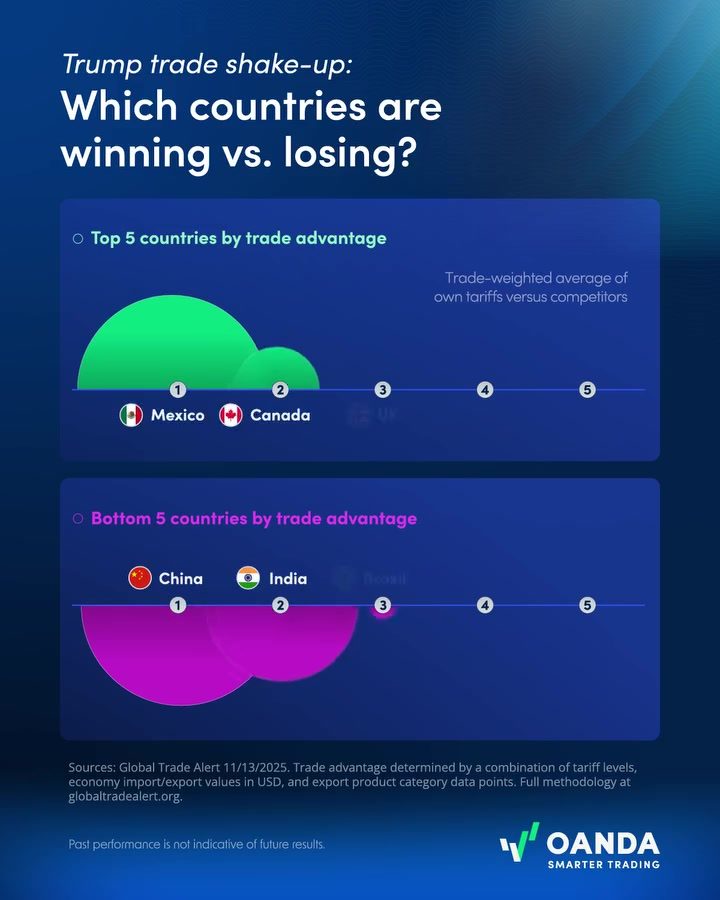
The shift in U.S. trade rules under the Trump administration has significantly reshaped the global trade landscape, with countries like Mexico and Canada gaining a competitive edge while others struggle to keep up. This analysis, in partnership with OANDA, delves into how Trump’s trade policies are influencing export competitiveness worldwide.
Context / Why This Matters
Understanding the impact of Trump's trade policies is crucial for businesses and economies worldwide. These policies have altered tariff structures, affecting import and export values and product categories. By examining the trade-weighted average of tariffs, we can identify which countries are benefiting and which are falling behind. This knowledge is vital for strategic planning and staying ahead in the global market.
Main Discussion
The Trump Trade Shake-Up
The Trump administration implemented several significant trade policies, including tariff increases on various goods and the renegotiation of trade agreements like NAFTA (now USMCA). These changes have had a profound impact on global trade dynamics. Countries have had to adapt quickly to these shifts, leading to a reshuffling of trade advantages.
Top Performing Countries
Mexico
Mexico tops the list with a trade advantage of 17.4%. The country has benefited significantly from the USMCA, which provides greater market access and stability for Mexican exports to the U.S. Mexico’s diverse export portfolio, including automotive parts, electronics, and agricultural products, has helped it maintain a competitive edge.
China
China follows closely with a 6.1% trade advantage. Despite ongoing trade tensions, China's robust manufacturing sector and extensive global supply chains have enabled it to weather the storm. The country's focus on technological advancements and infrastructure development continues to drive its export competitiveness.
India
India secures the third spot with a 5.1% trade advantage. The country's IT and pharmaceutical sectors have been pivotal in maintaining its export competitiveness. India has also benefited from diversifying its export markets, reducing its reliance on any single country.
Switzerland
Switzerland’s trade advantage stands at 3.6%, driven by its strong pharmaceutical and financial sectors. The country’s high-quality products and reliable legal framework have made it a favored export destination for many businesses.
South Korea
Rounding out the top five is South Korea with a 2.8% trade advantage. The country’s advanced manufacturing capabilities, particularly in electronics and automotive sectors, have been instrumental in maintaining its competitive edge.
Struggling Economies
Brazil
Brazil faces a significant trade disadvantage of -19.4%. The country's reliance on commodity exports, such as soybeans and iron ore, has made it vulnerable to global price fluctuations. Additionally, political instability and economic challenges have hampered Brazil's export competitiveness.
Switzerland
Switzerland, despite its strong sectors, faces a trade disadvantage of -16.6%. This is likely due to its high labor costs and stringent regulations, which can make it less competitive in certain markets.
South Korea
South Korea is also listed as having a -14.6% trade disadvantage. While the country has strong manufacturing capabilities, it faces intense competition from other Asian economies and the ongoing trade tensions with the U.S. have also impacted its export competitiveness.
India
India’s trade disadvantage is -6.9%. Despite its strengths in IT and pharmaceuticals, India struggles with infrastructure challenges and bureaucratic hurdles, which can hinder its export competitiveness.
Brazil
Brazil's trade disadvantage of -5.5% highlights its dependence on commodity exports and the need for diversification. The country's economic and political instability further complicates its efforts to improve export competitiveness.
Practical Tips
For countries looking to enhance their trade competitiveness, several strategies can be effective:
Diversify Export Markets
Relying on a single market can be risky. Diversifying export markets can help mitigate the impact of trade policies and global economic fluctuations.
Invest in Technology and Infrastructure
Technological advancements and robust infrastructure are key to maintaining a competitive edge. Investing in these areas can improve productivity and efficiency, making exports more attractive to global markets.
Foster Strong Trade Agreements
Strong trade agreements can provide stability and market access. Countries should work on negotiating favorable trade deals that can benefit their export sectors.
Encourage Innovation
Innovation is crucial for staying ahead in the global market. Countries should invest in research and development to create high-value products that can compete on the global stage.
Important Takeaways
The Trump trade policies have significantly altered the global trade landscape, benefiting some countries while posing challenges for others. Understanding these shifts is essential for businesses and economies to strategize effectively. Countries that focus on diversification, technological advancements, and strong trade agreements are likely to thrive in this evolving landscape. For those facing disadvantages, addressing infrastructure challenges and fostering innovation will be critical to improving their competitiveness.
Conclusion
The analysis underscores the importance of adapting to changing trade policies. As the global trade dynamics continue to evolve, countries must remain agile and proactive in their strategies. By focusing on diversification, innovation, and strong trade agreements, nations can enhance their export competitiveness and secure their place in the global market.
Watch the Reel
Questions readers ask
Which countries have seen the most significant advantages due to Trump's trade policies?
Countries like Mexico and Canada have gained notable advantages. Mexico, in particular, has benefited from the renegotiation of trade agreements, while Canada has seen a shift in its export competitiveness due to changes in tariff structures.
How have Trump's tariff changes impacted global export competitiveness?
Trump's tariff changes have reshuffled global export competitiveness. Some countries have seen their exports become more competitive, while others face higher barriers to entry in U.S. markets, making strategic planning essential for businesses worldwide.
What is the significance of the trade-weighted average of tariffs in understanding Trump's trade policies?
The trade-weighted average of tariffs helps identify which countries are benefiting and which are falling behind under Trump's trade policies. By examining this metric, businesses and economies can gain insights into how their exports are being affected.
Which countries have emerged as top exporters under Trump's trade policies?
Countries like Mexico, China and Canada have emerged at the top of the list of exporters. These countries have strategically adapted to the changes in U.S. trade policies, allowing them to increase their export competitiveness.
How have changes in U.S. trade agreements impacted bottom exporting countries?
Bottom exporting countries have faced significant challenges due to changes in U.S. trade agreements. Increased tariffs and altered trade rules have made it more difficult for these countries to compete in the global market, leading to a decline in their export values and competitiveness.
What role does strategic planning play for businesses navigating Trump's trade policies?
Strategic planning is crucial for businesses to navigate the shifting landscape of global trade under Trump's policies. By understanding the impact of tariff changes and renegotiated trade agreements, businesses can make informed decisions to maintain or improve their competitiveness in the global market.
How have Trump's trade policies influenced the export competitiveness of China?
Trump's trade policies have had a significant impact on China's export competitiveness. Despite facing increased tariffs, China has managed to maintain and even increase its exports to other markets, demonstrating its adaptability and resilience in the face of trade policy changes.
Recent articles
Fresh deep dives from the latest Reels we unpacked.




Comments
Be the first to comment.