Trade Tariff Analysis: Who Wins and Who Loses from Trump's Policies?
Understanding the impact of tariffs on global trade is complex, but one key aspect is how these policies affect countries relative to their competitors. When examining the tariffs imposed by the Trump administration, it becomes clear that the impact varies significantly from one nation to another. This analysis is based on a visualization created in partnership with the Hinrich Foundation, which provides insights into which countries are losing the most, and the least, from these tariffs.
Why This Matters
Trade tariffs are a powerful tool in international trade policy, used to protect domestic industries or punish unfair trade practices. Yet, their effects are not uniform. For instance, while one country might lose significant market share due to higher tariffs, another might gain an advantage by offering cheaper alternatives. This disparity can reshape global trade dynamics, influencing everything from economic growth to job markets. Understanding these shifts helps businesses, policymakers, and consumers navigate the global economy more effectively.
Main Discussion
The Impact of Trump's Tariffs
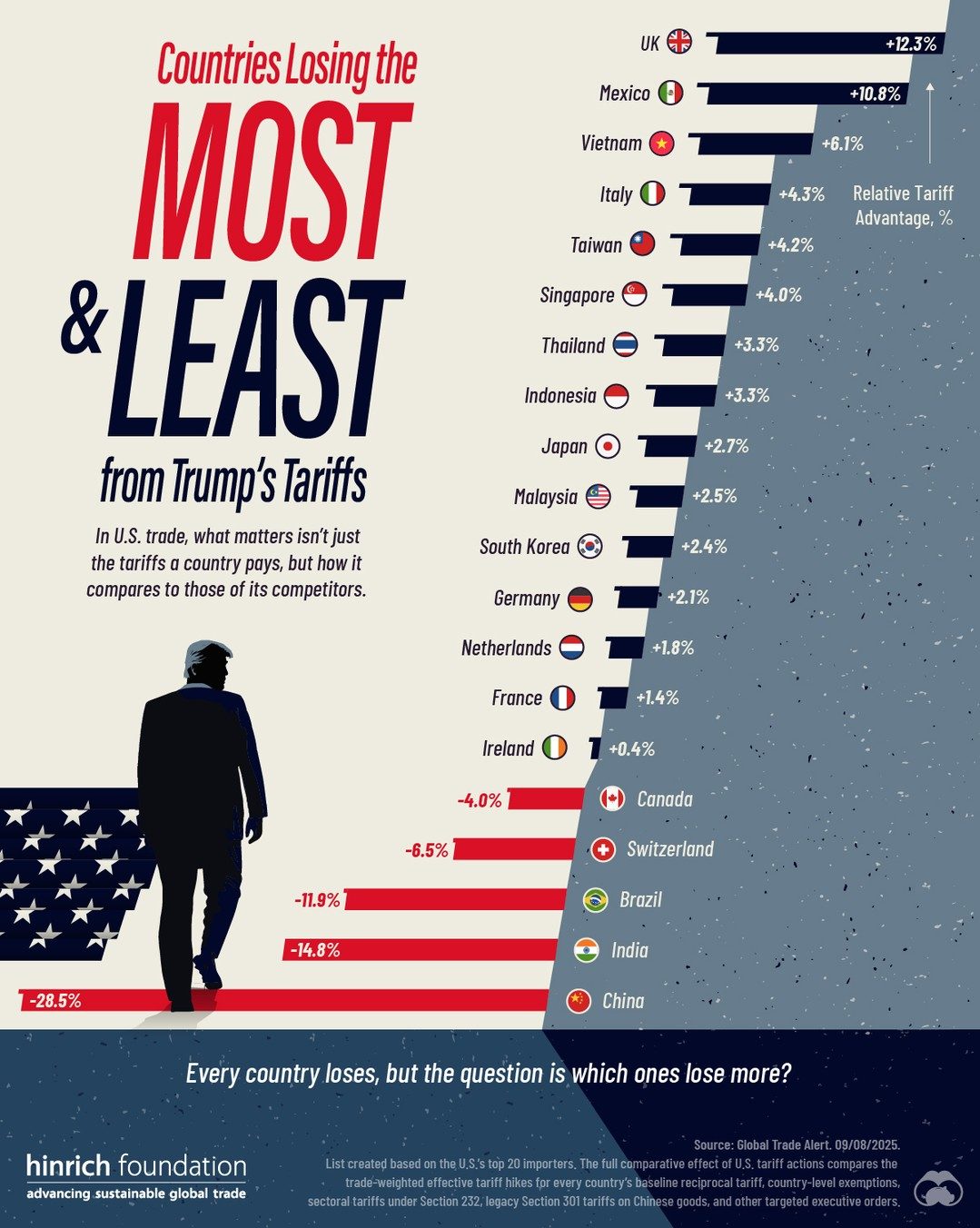
The infographic highlights how different countries are impacted by the tariffs imposed during the Trump administration. Countries like China face significant disadvantages, while others, such as the UK, benefit from a more favorable tariff landscape. This variation in impact underscores the importance of considering relative tariff advantages and disadvantages in trade policy.
Countries Losing the Most
China
China is among the countries hardest hit by Trump's tariffs, experiencing a -21.6% disadvantage. This significant drop can be attributed to the extensive trade relationship between the U.S. and China, as well as the broad range of goods and services subject to increased tariffs. The policies aimed to reduce the U.S. trade deficit with China, which has been a point of contention in recent years.
Other Impacted Nations
Other countries facing substantial losses include Brazil, Japan, and India, with tariff disadvantages ranging from -4.0% to -21.6%. These nations, like China, have extensive and diverse trade relationships with the U.S. The imposition of tariffs on key exports has significantly disrupted their market access and revenue streams.
Countries Losing the Least
While many nations are negatively impacted, some have managed to navigate the tariff landscape more successfully. These countries often have a more diversified export base or have negotiated favorable trade agreements with the U.S. or other major economies.
UK
The UK stands out with a +12.3% advantage, indicating that it has managed to maintain or even increase its market access in the U.S. This is partly due to the UK's strong trade relationships and its ability to pivot towards exports that are less affected by the tariffs.
Other Advantaged Nations
Other countries, such as Vietnam, Mexico, and Italy, also benefit from relatively low tariff disadvantages. Vietnam, for example, has seen a +6.1% advantage, suggesting that its export strategies and product offerings have been resilient to the tariff policies. These nations often have specific industries or products that are less affected by tariffs, allowing them to continue thriving in the U.S. market.
Relative Advantages: The Role of Competition
The infographic highlights the concept of relative tariff advantages and disadvantages. For example, while China experiences a significant disadvantage, other nations like the UK and Vietnam have managed to turn the situation to their advantage. This disparity underscores the importance of competitive dynamics in international trade.
UK vs. China
The stark contrast between the UK's +12.3% advantage and China's -21.6% disadvantage illustrates how tariff policies can tilt the competitive landscape in favor of certain countries. The UK's ability to maintain and even expand its market share in the U.S. reflects its strategic trade policies and the resilience of its export industries.
Vietnam vs. Brazil
Vietnam's +6.1% advantage compared to Brazil's -4.0% disadvantage shows how different export strategies and industry focus can influence a country's performance in the face of tariffs. Vietnam's focus on labor-intensive industries and its ability to pivot towards non-tariffed products have helped it mitigate the negative impacts.
Singapore vs. Malaysia
Singapore's +4.2% advantage versus Malaysia's +1.8% advantage reflects the strategic differences in their trade policies. Singapore's advanced industries and diverse export base have allowed it to navigate the tariff landscape more effectively, while Malaysia's focus on specific sectors has limited its ability to adapt.
Visualizing the Data
The visualization includes a clear ranking system that represents the relative tariff advantage or disadvantage for each nation. This ranking is based on data sourced from Global Trade Alert, a comprehensive database that tracks changes in global trade policies. The data is up-to-date as of 08/08/2025, providing a reliable snapshot of the current trade landscape.
Practical Tips
For Businesses
Businesses operating in the global market need to stay informed about changing tariff policies. This knowledge can help them adapt their strategies to minimize the impact of increased tariffs. For instance, diversifying product offerings and exploring alternative markets can mitigate risks.
Diversify Your Supply Chain
Relying on a single supplier or market can be risky in a volatile tariff environment. Diversifying your supply chain can help you maintain stability and reduce costs. This could involve sourcing materials from multiple countries or investing in local production facilities.
Adapt Product Offerings
Products that are less affected by tariffs can provide a competitive edge. Businesses should consider pivoting towards these items to maintain market share and profitability. Regularly reviewing and updating your product portfolio can help you stay resilient in a changing trade landscape.
For Policymakers
Policymakers play a crucial role in shaping trade policies. They must consider the relative advantages and disadvantages that different countries gain from tariffs. This can involve negotiating favorable trade agreements or implementing support measures for affected industries.
Support Affected Industries
Policymakers can provide targeted support to industries that face significant disadvantages from tariffs. This could include financial assistance, tax incentives, or regulatory reforms. Supporting these industries can help them adapt to changing market conditions and maintain competitiveness.
Negotiate Trade Agreements
Favorable trade agreements can help countries mitigate the negative impacts of tariffs. Policymakers should prioritize negotiating agreements that provide market access and reduce tariff burdens. These agreements can also include provisions to support local industries and workers.
For Consumers
Consumers can also be affected by changes in tariff policies, as they may experience price increases or shifts in product availability. Staying informed about trade developments can help consumers make better purchasing decisions.
Stay Informed
Consumers should stay informed about changes in tariff policies and their potential impact on product prices and availability. This knowledge can help you make better purchasing decisions and support local industries.
Support Local Businesses
Supporting local businesses can help mitigate the negative impacts of tariffs on local economies. By buying locally produced goods, consumers can contribute to the resilience of their communities and reduce reliance on imported products.
Important Takeaways
Impact on Trade Dynamics
The tariff policies of the Trump administration have had a profound impact on global trade dynamics. Some countries, like the UK and Vietnam, have managed to turn the situation to their advantage, while others, such as China and Brazil, face significant disadvantages.
Strategic Adaptation
Countries that have successfully navigated the tariff landscape are those that have adapted their export strategies and product offerings. This involves diversifying export bases, focusing on non-tariffed products, and negotiating favorable trade agreements.
Competitive Landscape
The competitive landscape in global trade is constantly evolving. Countries must stay informed and adapt their strategies to maintain and enhance their market positions. This requires a strategic approach to trade policy, export diversification, and market adaptation.
Conclusion
Understanding how Trump's tariffs have impacted different countries is crucial for businesses, policymakers, and consumers. The relative advantages and disadvantages that countries experience can significantly influence the global trade landscape. By staying informed and adapting their strategies, countries can mitigate the negative impacts of tariffs and maintain their competitiveness in the global market.
Watch the Reel
Questions readers ask
How did Trump's tariffs primarily affect global trade dynamics?
Trump's tariffs reshaped global trade by imposing significant costs on certain countries, particularly those heavily reliant on exports to the US. This policy shift led to trade rerouting, with some countries facing increased competition and others finding new opportunities.
Which countries were most impacted by Trump's tariffs?
Countries like China were significantly impacted due to their large export volume to the US. The tariffs led to substantial financial losses and forced many Chinese manufacturers to seek alternative markets or adjust their supply chains.
Did any countries benefit from Trump's tariffs?
Yes, countries like the UK experienced benefits from Trump's tariffs. The UK saw an increase in competitive advantages, as US tariffs on Chinese goods led to a shift in trade flows, increasing the UK’s exports to the US.
How did Trump's tariff policies influence international trade relations?
Trump's tariffs sparked a series of retaliatory measures from affected countries, leading to trade wars. These conflicts altered global trade routes and partnerships, prompting nations to reassess their trade agreements and dependencies.
How did the tariffs affect the competitiveness of US industries?
The tariffs aimed to protect and boost US industries by reducing foreign competition. However, the effectiveness of this strategy varied, with some domestic industries thriving while others faced higher input costs due to retaliatory tariffs from other countries.
Why is it important to analyze the impact of tariffs on a country-by-country basis?
Analyzing the impact of tariffs on a country-by-country basis is important because it reveals the varying effects of these policies. Some countries may experience significant benefits, while others face severe disadvantages, making it crucial for policymakers to consider these nuances in trade negotiations.
Recent articles
Fresh deep dives from the latest Reels we unpacked.




Comments
Be the first to comment.