Minimum Wage Comparison: State-by-State Breakdown
The District of Columbia leads the nation with the highest minimum wage at $17 per hour. Meanwhile, the federal minimum wage has remained stagnant at $7.25 for the past 15 years. This disparity highlights a significant gap between federal standards and the rates implemented by individual states. This article will delve into the states with the highest minimum wages, particularly focusing on the minimum cash wage for tipped employees.
Why This Matters
Understanding the variations in minimum wage across states is crucial for both employers and employees. It impacts the cost of living, economic stability, and the overall financial health of individuals and families. For tipped employees, the minimum cash wage can significantly affect their total earnings. Despite the federal minimum wage of $12.00, state mandates often dictate higher standards.
State-by-State Comparison
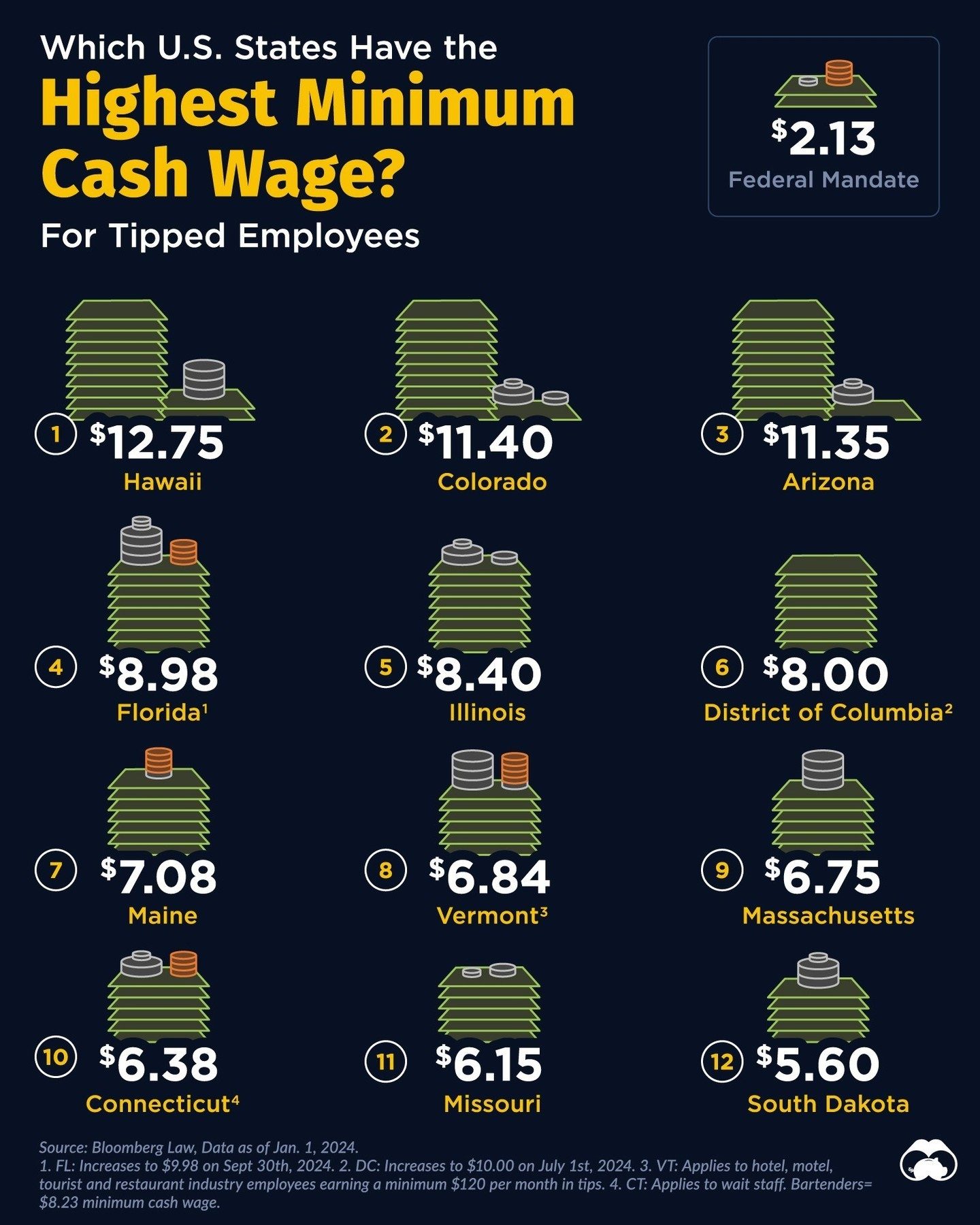
Let's explore the states with the highest minimum cash wages for tipped employees, based on data from Bloomberg Law as of January 1, 2024.
Top States with High Minimum Cash Wages
Highest Minimum Cash Wage
Hawaii tops the list with a minimum cash wage of $12.75. This is significantly higher than the federal mandate and ensures that tipped employees in Hawaii earn a more substantial base wage.
Close Seconds
Colorado and Arizona follow closely, with minimum cash wages of $11.40 and $11.35, respectively. These states have implemented higher wage standards to support their workforce better.
Mid-Range Leaders
Several other states also stand out for their relatively high minimum cash wages:
- Florida: Currently at $8.98, with an increase to $9.98 scheduled for September 30, 2024.
- Vermont: At $8.40, with specific applications to hotel, motel, tourist, and restaurant industry employees earning $120 per month in tips.
- District of Columbia: Currently at $8.00, with a planned increase to $10.00 on July 1, 2024.
- Maine: At $7.08.
- Massachusetts: At $6.84.
Lower End but Still Notable
Connecticut, Missouri, and South Dakota have minimum cash wages of $6.75, $6.38, and $6.15, respectively. While these are lower than those in the top-tier states, they still reflect a commitment to fair wages for tipped employees.
Specific Industry Applications
It's important to note that some states have specific industry applications for their minimum cash wages:
- Vermont: The minimum cash wage of $8.40 applies to certain industries, ensuring that employees in these sectors earn a fair base wage.
- Connecticut: The $6.75 minimum cash wage for wait staff ensures that they receive a reasonable base pay, with bartenders earning a minimum cash wage of $8.23.
These specifics highlight the nuanced approach some states take to ensure fair wages across different industries.
Practical Tips for Employees and Employers
For Employees
Understanding your state's minimum wage laws is essential for ensuring you receive fair compensation. Here are some practical tips:
- Know Your Rights: Familiarize yourself with your state's minimum wage laws and any specific industry applications.
- Track Your Tips: Keep a record of your tips to ensure you are being paid correctly.
- Seek Clarification: If you have questions about your wages, don't hesitate to ask your employer or consult local labor laws.
For Employers
Employers must stay informed about state-specific wage laws to ensure compliance and fairness. Here are some tips:
- Stay Updated: Keep up with any changes in minimum wage laws and adjustments for tipped employees.
- Review Industry-Specific Rules: Be aware of any industry-specific applications and ensure your payroll reflects these rules.
- Communicate Clearly: Make sure your employees understand their wage rates and any changes that may occur.
Important Takeaways
- Variation Across States: Minimum wages for tipped employees vary significantly by state, with some states offering much higher base wages than the federal mandate.
- Industry-Specific Rules: Some states have specific rules for certain industries, ensuring fair wages for employees in those sectors.
- Upcoming Changes: Be prepared for scheduled wage increases in several states, which can impact both employees and employers.
Conclusion
The minimum wage landscape in the U.S. is diverse and constantly evolving. States like Hawaii, Colorado, and Arizona lead the way with high minimum cash wages for tipped employees, while others have specific rules to ensure fair compensation across different industries. Whether you're an employee seeking fair pay or an employer aiming for compliance, staying informed about these variations is crucial. By understanding and adapting to these wage standards, both employees and employers can navigate the complexities of minimum wage laws more effectively.
Watch the Reel
Questions readers ask
What is the current minimum cash wage for tipped employees in Hawaii?
As of the latest data, Hawaii offers the highest minimum cash wage for tipped employees in the U.S. at $12.75 per hour. This is significantly higher than the federal minimum wage and ensures that tipped workers in Hawaii receive a substantial base pay regardless of tips they earn.
How does Colorado's minimum cash wage for tipped employees compare to other states?
Colorado's minimum cash wage for tipped employees is $11.40 per hour, making it one of the highest in the country. This rate is notably higher than the federal minimum wage of $7.25, providing tipped employees in Colorado with a more substantial base income.
What is the minimum cash wage for tipped employees in Arizona in 2024?
In 2024, Arizona's minimum cash wage for tipped employees is $11.35 per hour. This rate reflects Arizona's commitment to providing tipped workers with a higher base wage compared to the federal standard, ensuring better financial stability for these employees.
Why is it important to know the minimum wage laws by state for tipped employees?
Understanding minimum wage laws by state for tipped employees is important because it helps employers ensure they are compliant with local regulations and provides employees with a clear expectation of their earnings. Knowing these laws also helps tipped employees compare their wages across different states and advocate for fair compensation.
How does the District of Columbia's minimum wage compare to other states and the federal minimum wage?
The District of Columbia has the highest minimum wage in the nation at $17 per hour. This is significantly higher than the federal minimum wage of $7.25 and many other states, reflecting D.C.'s commitment to providing a higher standard of living for its residents, including tipped employees.
What are the current minimum cash wages for tipped employees in states with the highest minimum wage?
The states with the highest minimum cash wages for tipped employees are Hawaii, Colorado, and Arizona. Hawaii tops the list with a minimum cash wage of $12.75 per hour, followed by Colorado at $11.40, and Arizona at $11.35. These rates are all higher than the federal minimum wage of $7.25, providing tipped employees with a more stable and higher base income.
Related deep dives
Similar reads based on topic and creator.


Recent articles
Fresh deep dives from the latest Reels we unpacked.




Comments
Be the first to comment.