U.S. Debt Buyers
The United States debt market is a complex and dynamic landscape, with various countries and financial entities playing significant roles. From June 2024 to June 2025, a notable shift occurred in the major buyers of U.S. Treasury holdings, with stablecoin issuers emerging as a significant player. This article delves into the roles of stablecoin issuers such as Tether and Circle, and compares them to traditional major buyers like Japan and Singapore.
Why This Matters
Understanding the dynamics of U.S. debt buyers is crucial for several reasons. The U.S. Treasury market is one of the largest and most influential financial markets globally. The purchases and sales of U.S. debt by foreign entities can significantly impact interest rates, currency exchange rates, and overall economic stability. This analysis sheds light on the evolving landscape of U.S. debt buyers, highlighting the increasing role of stablecoin issuers.
Comparison of Major Buyers
Key Players in U.S. Debt
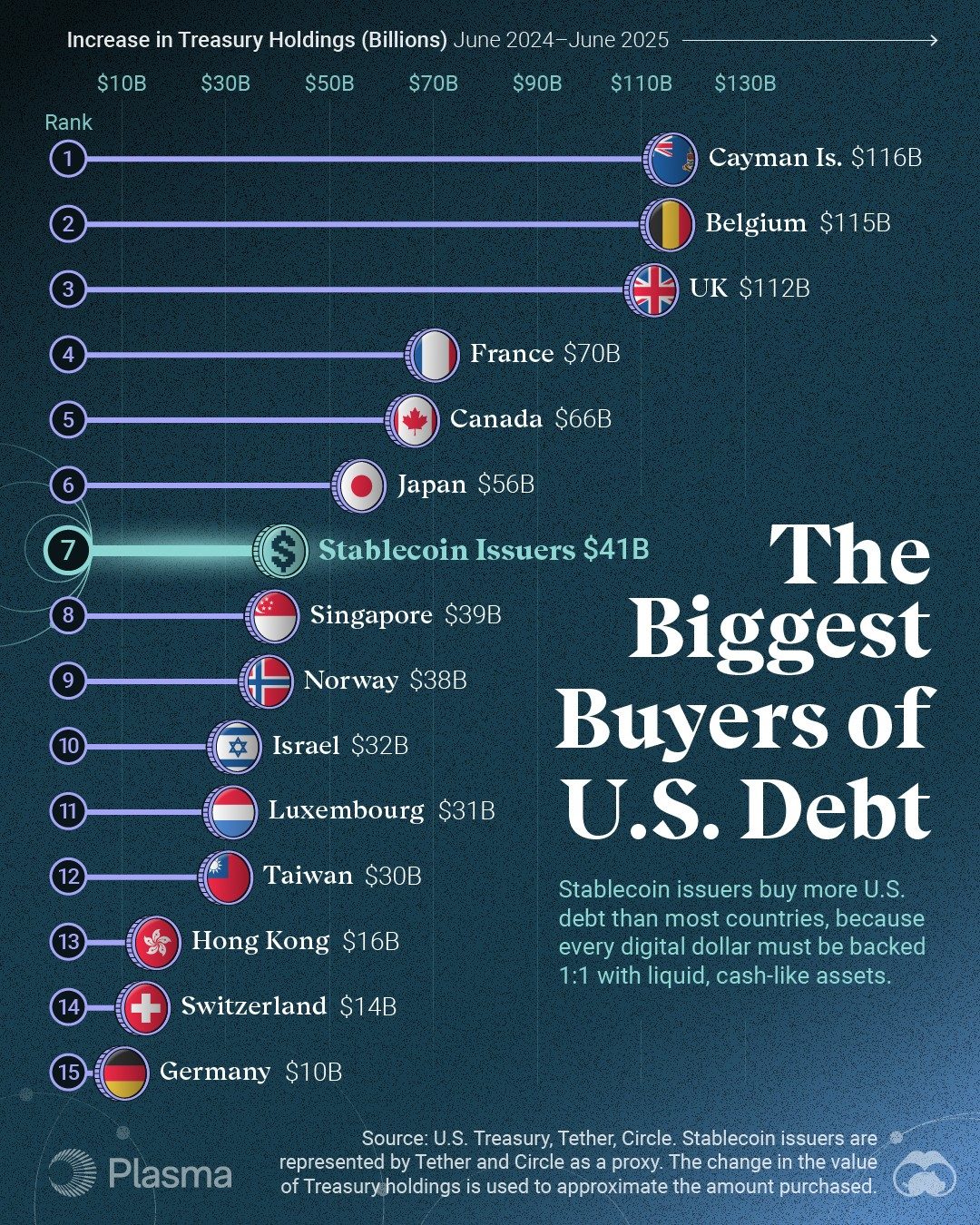
From June 2024 to June 2025, the Cayman Islands, Singapore, and Belgium were the top buyers of U.S. Treasury holdings. The Cayman Islands led with an increase of $116 billion, followed closely by Singapore and Belgium, each with $115 billion. The United Kingdom held $112 billion, France $70 billion, and Canada $66 billion. Japan, traditionally a major buyer, came in with $56 billion.
The Role of Stablecoin Issuers
Stablecoin issuers, represented by Tether and Circle, collectively purchased $39 billion in U.S. Treasury holdings, placing them on par with Hong Kong. This significant amount reflects the growing financial muscle and strategic importance of stablecoins in the global financial system. Their role as a buyer of U.S. Treasuries is a testament to their growing influence and the trust placed in them by investors.
Other notable buyers included Norway with $38 billion, Israel with $32 billion, Luxembourg with $31 billion, and Taiwan with $30 billion. Hong Kong, appearing twice in the infographic with different amounts ($39 billion and $16 billion), highlights potential discrepancies or significant transactions during the period. Switzerland and Germany rounded out the list with $14 billion and $10 billion, respectively.
The Rise of Stablecoin Issuers
What Are Stablecoins?
Stablecoins are a type of cryptocurrency designed to maintain a stable value, typically pegged to a reserve asset like the U.S. dollar. This stability makes them attractive for various financial transactions, including purchasing U.S. Treasury securities. Issuers like Tether and Circle are at the forefront of this market, providing liquidity and stability to the crypto ecosystem.
Why Stablecoin Issuers Are Buying U.S. Debt
The purchase of U.S. Treasury securities by stablecoin issuers can be attributed to several factors. Firstly, U.S. Treasuries are considered one of the safest and most liquid investments globally, making them an ideal reserve asset. Secondly, the stability and liquidity of stablecoins allow issuers to manage their reserves effectively. Lastly, the regulatory environment and financial infrastructure in the U.S. provide a stable and predictable market for these investments.
Practical Tips for Understanding This Market
For Investors
Investors looking to understand the U.S. debt market should closely monitor the activities of stablecoin issuers. As their influence grows, so does their impact on financial markets. Keeping an eye on regulatory developments and market trends related to stablecoins can provide valuable insights.
For Economists and Analysts
Economists and analysts should consider the role of stablecoins in their macroeconomic analyses. The increasing involvement of stablecoin issuers in the U.S. debt market highlights the need for a comprehensive understanding of the crypto-financial ecosystem. This knowledge can aid in predicting future market movements and economic trends.
For Policymakers
Policymakers need to address the regulatory implications of stablecoin issuers' growing role in the U.S. debt market. Clear and consistent regulations can ensure the stability and integrity of the financial system while fostering innovation in the crypto sector.
Important Takeaways
From June 2024 to June 2025, the landscape of U.S. debt buyers saw significant shifts, with stablecoin issuers emerging as a major player. Key points to remember include:
- The Cayman Islands, Singapore, and Belgium were the top buyers of U.S. Treasury holdings.
- Stablecoin issuers, represented by Tether and Circle, collectively purchased $39 billion in U.S. Treasury holdings.
- The role of stablecoins in the global financial system is increasing, making them a critical factor in understanding U.S. debt markets.
- Monitoring the activities of stablecoin issuers is essential for investors, economists, and policymakers.
Conclusion
The evolving dynamics of U.S. debt buyers, particularly the rise of stablecoin issuers, highlight the need for a nuanced understanding of the global financial landscape. As stablecoins gain prominence, their impact on financial markets will continue to grow. Whether you're an investor, economist, or policymaker, staying informed about these trends is essential for navigating the complex world of U.S. debt and the broader financial ecosystem. The next steps involve continued analysis and engagement with this dynamic market, ensuring that the financial system remains resilient and adaptable to new challenges and opportunities.
Watch the Reel
Questions readers ask
Who are the major stablecoin issuers that have become significant U.S. debt buyers?
The primary stablecoin issuers that have emerged as major U.S. debt buyers include Tether and Circle. These companies have significantly increased their holdings of U.S. Treasury securities, positioning themselves as key players in the debt market.
How have the roles of Japan and Singapore changed as U.S. debt buyers in the period from June 2024 to June 2025?
Japan and Singapore have traditionally been major U.S. debt buyers. However, from June 2024 to June 2025, their roles have shifted as stablecoin issuers have emerged as new significant buyers, changing the dynamic of the global debt market.
What is the significance of the shift in U.S. debt buyers from June 2024 to June 2025?
The shift indicates a changing landscape in global financial power, with stablecoin issuers becoming more influential. This change can impact interest rates, currency exchange rates, and overall market stability, making it a crucial development to monitor.
Why are stablecoin issuers increasing their U.S. debt holdings?
Stablecoin issuers like Tether and Circle are increasing their U.S. debt holdings as a strategy to diversify their reserves and ensure the stability of their stablecoins. By holding U.S. Treasury securities, they can mitigate risks associated with market volatility and maintain the value of their stablecoins.
What impact do stablecoin issuers have on the global debt market?
Stablecoin issuers, through their significant holdings of U.S. debt, can influence market liquidity and stability. Their actions can affect global financial markets, making them important players to watch in the evolving debt market landscape.
How do stablecoin issuers compare to traditional debt buyers like Japan and Singapore?
Traditional debt buyers like Japan and Singapore have long been key players in the U.S. debt market. However, the emergence of stablecoin issuers as major buyers adds a new dynamic, reflecting the growing influence of digital financial entities in global markets.
What are the potential implications of stablecoin issuers becoming major U.S. debt buyers?
The implications are multifaceted, including potential shifts in market dynamics, changes in interest rates, and impacts on global financial stability. As stablecoin issuers continue to grow in influence, their actions will be closely watched by financial analysts and policymakers.
Related deep dives
Similar reads based on topic and creator.


Recent articles
Fresh deep dives from the latest Reels we unpacked.




Comments
Be the first to comment.