Military Submarines: Global Comparison
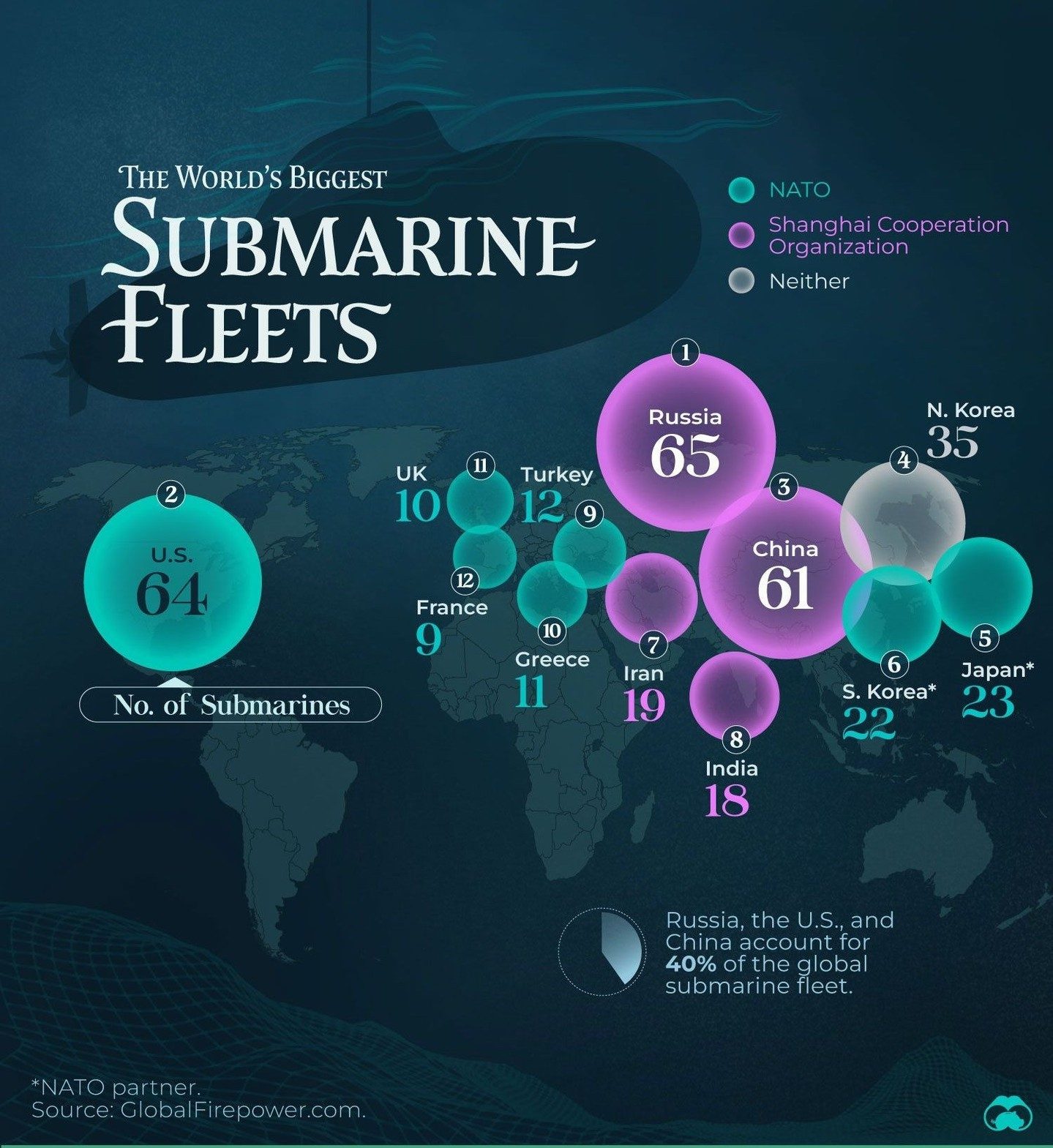
The global landscape of military submarine fleets is dominated by a few key players. As of July 2024, Russia, the U.S., and China collectively account for 40% of the world's submarines. This dominance is reflected in their substantial fleets: Russia leads with 65 submarines, closely followed by the U.S. with 64 and China with 61. This distribution highlights the strategic importance of submarines in modern naval warfare.
Context / Why this matters
Submarines play a critical role in naval operations due to their stealth and versatility. They can conduct a range of missions, from surveillance and reconnaissance to anti-ship and anti-submarine warfare. The number and capabilities of a country's submarine fleet can significantly influence its maritime strategy and global influence.
Main discussion
Top Submarine-Fleet Countries
Beyond the top three, several other countries maintain notable submarine fleets. Here’s a closer look at the top 12 countries by the number of military submarines:
-
Russia (65 submarines): Russia's extensive fleet underscores its commitment to maintaining a powerful naval presence. The country's submarines are deployed in various regions, including the Arctic, Black Sea, and Pacific Ocean.
-
United States (64 submarines): The U.S. Navy operates a diverse range of submarines, from nuclear-powered ballistic missile submarines (SSBNs) to attack submarines (SSNs). These vessels are essential for the U.S. Navy’s global reach and deterrence capabilities.
-
China (61 submarines): China's growing submarine fleet reflects its increasing naval ambitions. The country has been rapidly modernizing its fleet, focusing on both conventional and nuclear-powered submarines.
-
North Korea (35 submarines): Despite economic challenges, North Korea maintains a significant submarine fleet. These submarines are crucial for North Korea's defense strategy, particularly in the context of its coastal waters.
-
Japan (23 submarines): Japan's submarines are primarily diesel-electric, reflecting the country’s focus on coastal defense and anti-submarine warfare. Japan's submarines often work in conjunction with surface vessels and aircraft to maintain maritime security.
-
Iran (19 submarines): Iran's submarine fleet is relatively small but plays a vital role in its defense strategy. The country's submarines are primarily used for coastal defense and deterrence against potential naval threats.
-
India (18 submarines): India's submarine fleet includes both conventional and nuclear-powered submarines. These vessels are integral to India's naval strategy, particularly in the Indian Ocean region.
-
France (9 submarines): France's submarine fleet includes nuclear-powered attack submarines and ballistic missile submarines. These submarines are critical for France's nuclear deterrent and global naval operations.
-
Greece (11 submarines): Greece's submarines are mainly used for coastal defense and maritime patrols. The fleet includes both conventional and modernized submarines.
-
Turkey (11 submarines): Turkey's submarine fleet is designed to protect its maritime interests and contribute to NATO operations. The fleet includes a mix of conventional and modern submarines.
-
United Kingdom (12 submarines): The UK's submarine fleet is relatively small but highly capable. It includes nuclear-powered attack submarines and ballistic missile submarines, crucial for the UK's nuclear deterrent and global naval operations.
-
NATO Partners: Several NATO countries, including the UK, Turkey, and Greece, contribute to the alliance's submarine capabilities. These nations work together to enhance collective defense and maritime security.
Technological Advancements
The technological gap between the leading naval powers is significant. Admiral Samuel Paparo, commander of the U.S. Pacific Fleet, noted that U.S. submarine technology is 10-20 years ahead of China's. This technological edge allows the U.S. to maintain a high level of stealth, weaponry, and operational capabilities. The U.S. submarines are equipped with advanced sonar systems, quiet propulsion technologies, and long-range missiles, making them formidable assets in any naval conflict.
Strategic Implications
The distribution of submarine fleets has several strategic implications:
-
Global Power Dynamics: The concentration of submarines in Russia, the U.S., and China reflects their status as global naval powers. These countries use their submarines to project power and influence in key maritime regions.
-
Regional Security: Countries like Japan, India, and North Korea leverage their submarine fleets to secure their regional interests. For instance, Japan's submarines are crucial for maintaining maritime security in the Pacific, while India's submarines play a vital role in the Indian Ocean.
-
Alliance and Coalition Building: NATO countries, including the UK, Turkey, and Greece, collaborate to enhance their collective submarine capabilities. This cooperation is essential for maintaining maritime security and responding to potential threats.
Practical tips
While individual enthusiasts and hobbyists might find submarine comparisons intriguing, practical applications for this information are more relevant to naval strategists, military personnel, and policymakers. Here are some practical tips for those involved in naval strategy and defense:
Stay Informed
Keep up-to-date with the latest developments in submarine technology and fleet sizes. Regularly reviewing sources like GlobalFirepower.com can provide valuable insights into global naval capabilities and trends.
Engage in Strategic Planning
Leverage the data on submarine fleets to inform strategic planning. Understanding the capabilities and limitations of different countries' submarines can help in developing effective defense and deterrence strategies.
Invest in Modernization
Countries looking to enhance their naval capabilities should invest in modernizing their submarine fleets. This includes upgrading existing submarines and acquiring new, more advanced vessels. Technological advancements can significantly improve a country's maritime defense and offensive capabilities.
Foster International Cooperation
For countries with limited resources, fostering international cooperation can be a cost-effective way to enhance naval capabilities. Participating in alliances and coalitions, such as NATO, can provide access to advanced technologies and collective defense mechanisms.
Important takeaways
The global distribution of submarine fleets underscores the strategic importance of these vessels in modern naval warfare. Key takeaways include:
- Russia, the U.S., and China dominate the global submarine fleet, accounting for 40% of the total.
- Technological advancements play a crucial role in determining a country's naval capabilities.
- Submarine fleets are essential for both global power projection and regional security.
- International cooperation and modernization are key to enhancing naval capabilities.
Conclusion
The global submarine fleet reflects the strategic priorities and technological capabilities of various nations. Understanding the distribution and capabilities of these fleets is crucial for naval strategists, military personnel, and policymakers. By staying informed, investing in modernization, and fostering international cooperation, countries can enhance their maritime security and global influence. The dynamic nature of naval technology and strategy highlights the ongoing importance of submarines in modern warfare.
Watch the Reel
Questions readers ask
Which countries have the largest submarine fleets in the world?
As of July 2024, Russia, the U.S., and China have the largest submarine fleets. Russia leads with 65 submarines, followed by the U.S. with 64, and China with 61. These three nations collectively possess 40% of the world's submarines.
What makes submarines important in modern naval warfare?
Submarines are crucial in modern naval warfare due to their stealth and versatility. They can carry out various missions, including surveillance, reconnaissance, and both anti-ship and anti-submarine warfare, making them invaluable assets for navies worldwide.
How does the size of a country's submarine fleet impact its naval capabilities?
The size and capabilities of a country's submarine fleet can significantly influence its naval power. A larger fleet can enhance a nation's ability to control maritime territories, deter adversaries, and protect sea lanes, thereby bolstering overall naval strength.
What is the significance of the top submarine fleets being held by Russia, the US, and China?
The dominance of Russia, the U.S., and China in the global submarine fleet underscores their strategic interests and military prowess. It reflects their commitment to maintaining a strong naval presence and their ability to project power in various maritime regions.
How do NATO submarine fleets compare to those of Russia, the US, and China?
While specific numbers for NATO submarine fleets aren't detailed, it's important to note that the U.S. is a key member of NATO. Therefore, the U.S. submarines are part of the overall NATO submarine capabilities. Russia, the U.S., and China's fleets are the largest individually, but NATO's collective strength includes contributions from multiple member states.
What types of missions can submarines typically undertake?
Submarines are designed for a wide range of missions. These include covert surveillance of adversaries, gathering intelligence, deterring enemy actions, protecting friendly forces, and engaging in anti-submarine and anti-ship warfare, among other specialized tasks.
How does the distribution of the world's submarines reflect on global naval dynamics?
The distribution of the world's submarines, with a significant portion held by Russia, the U.S., and China, indicates a concentration of naval power in these nations. This distribution underscores their strategic influence and the importance of submarine warfare in maintaining global maritime security and stability.
Recent articles
Fresh deep dives from the latest Reels we unpacked.




Comments
Be the first to comment.