Stock Exchange Ranking
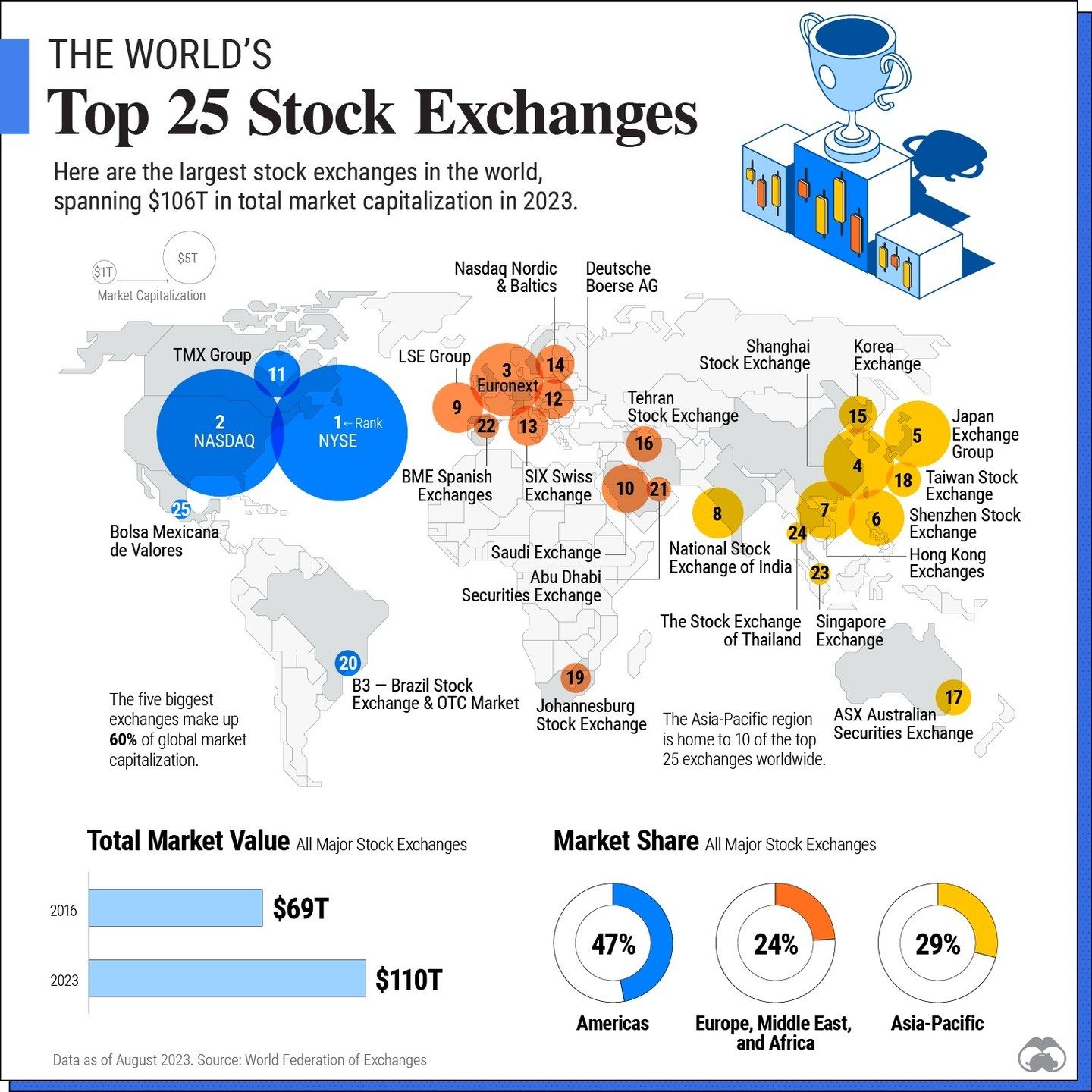
The world's financial landscape is vast and complex, with roughly 80 major stock exchanges collectively worth a staggering $110.2 trillion in value. The New York Stock Exchange (NYSE) and the Nasdaq dominate this landscape, commanding 42.4% of the global market capitalization. Understanding the rankings and dynamics of these exchanges provides valuable insights into the global economy and investment trends.
Why This Matters
The ranking of stock exchanges is more than just a list of numbers; it reflects the economic power and financial stability of different regions. The top exchanges influence global market trends, investment strategies, and economic policies. For investors, understanding these rankings can help identify potential opportunities and risks in different markets. For policymakers, it provides a benchmark for economic performance and regulatory frameworks.
Global Market Capitalization
Top 25 Stock Exchanges
At the top of the list are the NYSE and Nasdaq, followed by exchanges like the Shanghai Stock Exchange, Japan Exchange Group, and Hong Kong Securities Exchange. These exchanges collectively account for a significant portion of the global market capitalization, with the top five alone making up 60%. This concentration of market power underscores the influence of these exchanges on global financial trends.
Regional Market Share
The distribution of market capitalization across regions reveals some interesting trends. The Americas, with the NYSE and Nasdaq, hold a substantial 47% of the market share. Europe, the Middle East, and Africa (EMEA) account for 24%, while the Asia-Pacific region, home to some of the world's fastest-growing economies, holds 29%. This regional breakdown highlights the shifting dynamics in global finance, with emerging markets gaining ground.
U.S. Dominance and Emerging Economies
Despite the rapid growth of emerging economies, the U.S. continues to lead the capital markets by a wide margin. The NYSE and Nasdaq have a combined market capitalization of $50.2 trillion, demonstrating the enduring strength of the U.S. financial system. However, the rise of emerging economies, such as India surpassing the UK in 2023, indicates a potential shift in the global financial landscape. This trend underscores the importance of diversifying investment portfolios to include both established and emerging markets.
The Role of Emerging Markets
India's Rise
India's stock market, particularly the National Stock Exchange of India, has shown remarkable growth, surpassing traditional European markets like the UK. This growth is driven by factors such as economic liberalization, a burgeoning middle class, and a strong technology sector. Investors are increasingly looking at India as a high-potential market for future investments, given its robust economic fundamentals.
China and Asia-Pacific
China's Shanghai and Shenzhen Stock Exchanges are among the largest in the world, reflecting the country's economic might and rapid development. The Asia-Pacific region, including markets in Japan, Hong Kong, and Singapore, also plays a significant role, contributing 29% to the global market capitalization. These exchanges benefit from regional economic integration and technological advancements, positioning them as key players in the global financial system.
Market Dynamics and Trends
Technological Advancements
Technological advancements have significantly impacted the operations and efficiency of stock exchanges. High-frequency trading, algorithmic trading, and the use of blockchain technology have enhanced market liquidity and transparency. These innovations are reshaping the way financial transactions are conducted, making markets more accessible and efficient.
Regulatory Environment
The regulatory environment plays a crucial role in the functioning of stock exchanges. Effective regulation ensures market stability, investor protection, and transparency. Regulatory bodies like the Securities and Exchange Commission (SEC) in the U.S. and the Financial Conduct Authority (FCA) in the UK are instrumental in maintaining the integrity of their respective markets.
Global Integration
Global integration of financial markets has led to increased interdependencies and interconnectedness. This integration facilitates capital flows and investment opportunities across borders, but it also poses challenges related to systemic risks and financial contagion. Understanding these dynamics is essential for investors and policymakers to navigate the complex global financial landscape.
Practical Tips
Diversification
Investors should consider diversifying their portfolios to include a mix of established and emerging markets. This strategy can help mitigate risks and capitalize on growth opportunities in different regions.
Monitoring Market Trends
Keeping an eye on market trends and regulatory changes is crucial for making informed investment decisions. By staying updated on global financial news and developments, investors can better navigate the dynamic landscape of stock exchanges.
Leveraging Technology
Utilizing technological tools and platforms can enhance investment strategies. Tools for data analysis, algorithmic trading, and market simulation can provide valuable insights and improve decision-making.
Risk Management
Effective risk management is essential for navigating the complexities of global financial markets. Investors should employ strategies such as hedging, diversification, and stress testing to manage risks associated with market volatility and economic uncertainties.
Important Takeaways
The world's financial landscape is dominated by a few major stock exchanges, with the NYSE and Nasdaq leading the way. Emerging markets, particularly in Asia, are rapidly gaining ground, highlighting the importance of diversifying investment portfolios. Technological advancements and regulatory frameworks play crucial roles in shaping the efficiency and stability of financial markets. Staying informed about global trends and leveraging available tools can help investors make better decisions.
Conclusion
The rankings of the world's top stock exchanges provide a snapshot of the global financial landscape, reflecting economic power, technological advancements, and regulatory frameworks. By understanding these dynamics, investors and policymakers can better navigate the complexities of global markets. Whether you're a seasoned investor or just starting out, keeping an eye on these trends and developments can help you make more informed decisions and capitalize on opportunities in the ever-evolving world of finance.
Watch the Reel
Questions readers ask
What is the current market capitalization of the New York Stock Exchange (NYSE) and Nasdaq?
As of 2023, the NYSE and Nasdaq together command 42.4% of the global market capitalization. This significant share underscores their dominant position in the world's financial markets. While exact figures fluctuate, their combined market capitalization is a substantial portion of the total global stock market value of $110.2 trillion.
How many stock exchanges are considered major players in the global financial market?
There are approximately 80 major stock exchanges worldwide. These exchanges collectively represent a market capitalization of around $110.2 trillion, indicating their profound impact on global economic trends and investment strategies.
Why is understanding the ranking of top stock exchanges important for investors?
Knowing the ranking of top stock exchanges helps investors identify potential opportunities and risks. It provides insights into global economic performance, financial stability, and emerging investment trends, enabling more informed decision-making.
Which regions do the top stock exchanges represent, and what does this signify?
The top stock exchanges represent various regions, including the United States, Europe, Asia, and India. The presence of major exchanges in these regions signifies their economic power and influence on global market trends and policies.
What are some of the benefits of tracking the growth of stock exchanges like those in India?
Monitoring the growth of stock exchanges, such as those in India, offers insights into the economic development and financial health of emerging markets. This information can be crucial for investors looking to diversify their portfolios and capitalize on growth opportunities in these regions.
How do the top 25 stock exchanges influence global economic policies and investment strategies?
The top 25 stock exchanges influence global economic policies by setting benchmarks for market performance and stability. They also shape investment strategies by driving trends in asset allocation, risk management, and sector-specific investments.
What insights can be gained from the dominance of NYSE and Nasdaq in the global stock market?
The dominance of NYSE and Nasdaq highlights the strength of the U.S. economy and its influence on global financial markets. It also indicates that these exchanges are pivotal for understanding broader investment trends, technological innovations, and regulatory impacts on stock markets worldwide.
Recent articles
Fresh deep dives from the latest Reels we unpacked.




Comments
Be the first to comment.