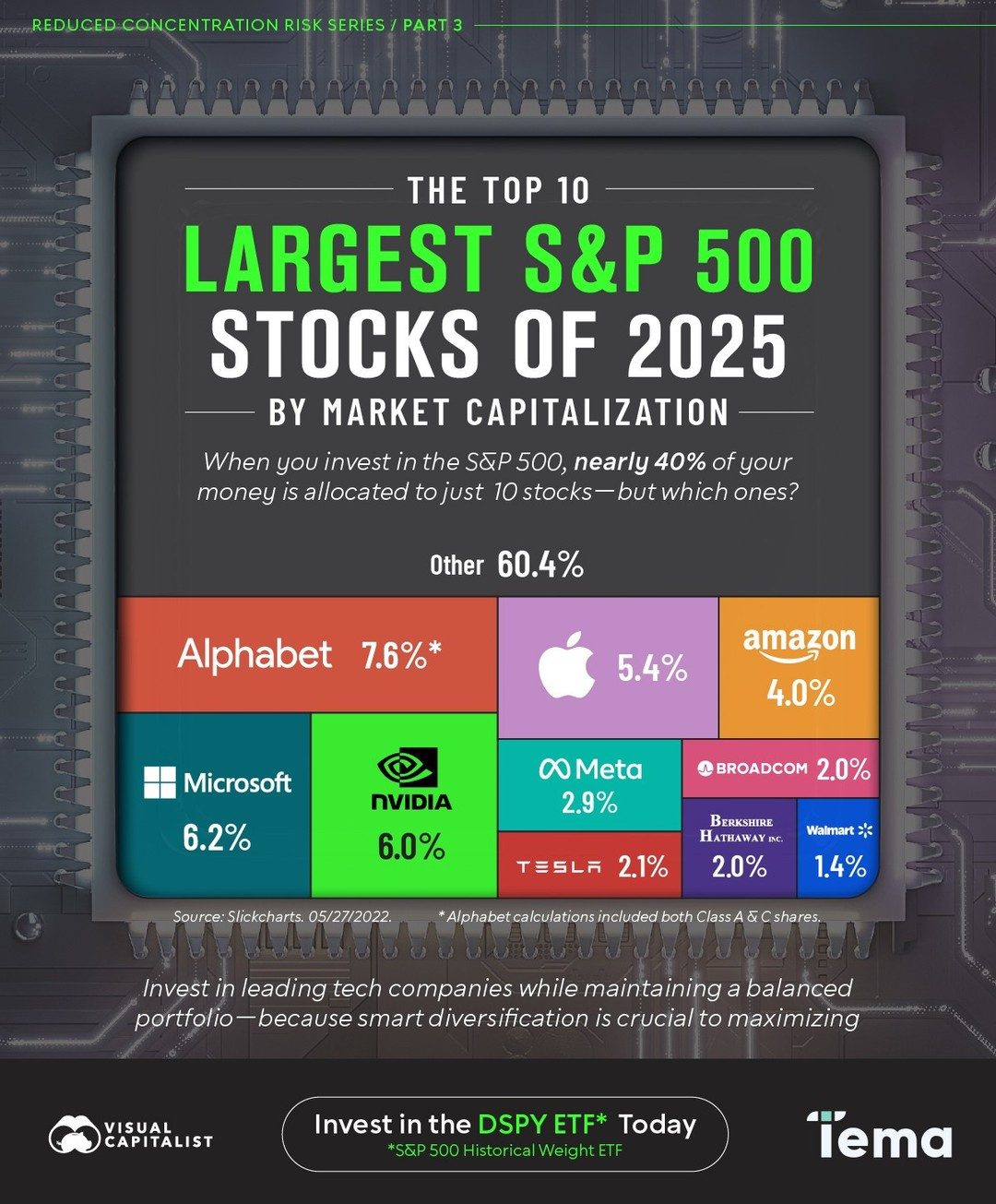
The Top 10 Largest S&P 500 Stocks of 2025 by Market Capitalization
The S&P 500, a widely followed index, is often seen as a benchmark for the U.S. equity market. However, a closer look reveals that nearly 40% of the index's total market capitalization is concentrated in just 10 companies. This concentration can significantly impact investment strategies, particularly in terms of risk and diversification. In 2025, the top 10 largest S&P 500 stocks by market capitalization are set to be Amazon, Alphabet, Microsoft, Nvidia, Meta, Tesla, Berkshire Hathaway, and Walmart.
Context / Why This Matters
Understanding the concentration of the S&P 500 is crucial for investors for several reasons. First, it highlights the potential risks associated with investing heavily in a few large-cap stocks. Second, it underscores the importance of diversification in managing risk. Third, it provides insights into the future of the tech sector, which dominates the top spots. By examining the top 10 stocks, investors can better understand the landscape and make more informed decisions.
Main Discussion
The Top 10 Stocks
The top 10 largest S&P 500 stocks in 2025 are expected to have significant market capitalizations. Alphabet leads the pack with a 7.64% weighting, followed closely by Microsoft at 6.19% and Nvidia at 5.96%. These three tech giants dominate the index, reflecting the growing importance of technology in the U.S. economy.
- Alphabet (7.64% Weight) — Known for its search engine and various other tech services, Alphabet's dominance in the S&P 500 underscores the company's market influence and potential for continued growth.
- Microsoft (6.19% Weight) — Microsoft's substantial weighting in the index reflects its diverse portfolio, including cloud computing, software, and hardware.
- Nvidia (5.96% Weight) — Nvidia's presence in the top three highlights the growing importance of semiconductor technology and graphics processing units (GPUs).
Additionally, Amazon, Meta, Tesla, Berkshire Hathaway, and Walmart round out the top 10. Amazon, with a 7.6% market capitalization, shows the growing influence of e-commerce and cloud services. Meta, with a 2.9% weighting, Tesla, with 2.1%, Berkshire Hathaway, with 2.0%, and Walmart, with 1.4%, also play significant roles in the index, each contributing to different sectors of the economy.
The Concentration of the S&P 500
The concentration of the S&P 500 in just a handful of stocks raises important questions about risk and diversification. When nearly 40% of the index is made up of just 10 companies, it means that a significant portion of an investor's portfolio could be exposed to the performance of these few stocks. This concentration can amplify both gains and losses, making it essential for investors to consider diversification strategies.
The Role of Diversification
Diversification is a critical aspect of managing risk in investment portfolios. By spreading investments across a broader range of stocks, investors can mitigate the impact of poor performance by any single company. This is particularly important in the context of the S&P 500, where the top 10 stocks account for nearly 40% of the index.
Investors can achieve diversification by allocating funds to various sectors and company sizes. For example, including small-cap and mid-cap stocks, along with large-cap stocks, can help balance risk and potential returns. Additionally, investing in sectors outside of technology, such as healthcare, consumer goods, and utilities, can further diversify a portfolio.
Rebalancing Risk
Rebalancing is another important strategy for managing risk in a concentrated market. It involves periodically adjusting the portfolio to maintain the desired asset allocation. For example, if the value of the top 10 S&P 500 stocks increases significantly, an investor might sell some shares to reduce exposure and reinvest in other areas of the market. This approach helps to ensure that the portfolio remains diversified and aligned with the investor's risk tolerance.
Our partner, TEMAETFs, explores new ways to rebalance risk, highlighting the importance of staying informed about market trends and adjusting investment strategies accordingly.
Practical Tips
When investing in the S&P 500, consider the following practical tips:
Diversification Strategies
- Sector Allocation: Ensure that your portfolio is well-diversified across various sectors. Avoid over-concentration in any single sector, especially technology.
- Asset Size: Include a mix of large-cap, mid-cap, and small-cap stocks to balance risk and potential returns.
- Geographical Diversification: Consider investing in international markets to further diversify your portfolio and reduce exposure to U.S.-specific risks.
Monitoring and Rebalancing
- Regular Reviews: Periodically review your portfolio to ensure it aligns with your investment goals and risk tolerance.
- Rebalancing: Make necessary adjustments to maintain your desired asset allocation. This can involve selling some shares of over-performing stocks and reinvesting in underperforming areas.
- Stay Informed: Keep up with market trends and economic indicators to make informed decisions about when to rebalance your portfolio.
Managing Concentration Risk
- Limit Exposure: Be cautious of the concentration of your investments in a few large-cap stocks. Consider setting a threshold for the maximum percentage of your portfolio that can be allocated to any single stock or sector.
- Risk Mitigation: Use strategies such as options and hedging to mitigate concentration risk and protect against potential losses.
Important Takeaways
The S&P 500's concentration in just a handful of stocks highlights the importance of diversification and risk management in investment strategies. By understanding the top 10 largest S&P 500 stocks and their market capitalizations, investors can make more informed decisions and better manage their portfolios. Diversification, monitoring, and rebalancing are key strategies for mitigating concentration risk and achieving long-term investment goals.
Conclusion
The S&P 500's concentration in a few large-cap stocks presents both opportunities and challenges for investors. By understanding the top 10 largest S&P 500 stocks in 2025 and implementing effective diversification and risk management strategies, investors can navigate the complexities of the market and achieve their financial goals. Staying informed about market trends and periodically reviewing and adjusting your portfolio are essential steps in managing concentration risk and building a resilient investment strategy.
Watch the Reel
Questions readers ask
What does the market capitalization concentration mean for investors in the S&P 500?
It means that a significant portion of the index's value is tied to just a few companies. This concentration can lead to increased volatility and risk, as the performance of these top stocks heavily influences the overall index. Investors should be aware that their portfolios may be more exposed to the fortunes of these large-cap stocks than they realize, which may necessitate adjustments in investment strategies.
Which sectors are primarily driving the concentration in the S&P 500 by 2025?
The tech sector is a major driver, with companies like Amazon, Alphabet, Microsoft, and Nvidia leading the pack. Other sectors, such as consumer discretionary and industrial, also contribute to the concentration, but to a lesser extent. The dominance of tech highlights the importance of these companies in the overall market landscape.
Why are Amazon, Alphabet, Microsoft, and Nvidia among the top stocks in the S&P 500 in 2025?
These companies are at the forefront of technological innovation and have demonstrated strong, consistent growth. Their market dominance is driven by their extensive product offerings, massive user bases, and strategic investments in emerging technologies. Additionally, their significant roles in the digital transformation of various industries contribute to their high market capitalization.
How does the top 10 list of S&P 500 stocks impact investment strategies?
The concentration of market capitalization in these 10 companies means that investors relying on the S&P 500 as a benchmark may find their portfolios heavily influenced by the performance of a few stocks. It's important for investors to assess their risk tolerance and consider diversification across various sectors and company sizes to mitigate potential risks associated with this concentration.
What is the significance of having Berkshire Hathaway and Walmart on the list?
Berkshire Hathaway and Walmart represent traditional sectors within the S&P 500 and provide a contrast to the tech-heavy concentration. Berkshire Hathaway, with its diverse holdings, and Walmart, a major player in the retail sector, add stability and broaden the market's representation. Their presence underscores the importance of considering a mix of traditional and innovative sectors in an investment strategy.
What does the future of the S&P 500 look like given this concentration?
The future of the S&P 500 will likely continue to be influenced by technological advancements and the performance of the top 10 companies. However, changes in market dynamics, regulatory environments, and economic conditions could also shape the future landscape. Investors should stay informed about these factors and be prepared to adapt their strategies to navigate potential shifts in the market.
How can visualizing the S&P 500 concentration help investors?
Visualizing the concentration of the S&P 500 allows investors to grasp the extent to which their investments are tied to a small number of stocks. This visualization can prompt investors to evaluate their portfolios for potential over-exposure to specific companies or sectors. It can also encourage a more balanced approach to investing, emphasizing the importance of diversification to manage risk effectively.
Related deep dives
Similar reads based on topic and creator.


Recent articles
Fresh deep dives from the latest Reels we unpacked.




Comments
Be the first to comment.