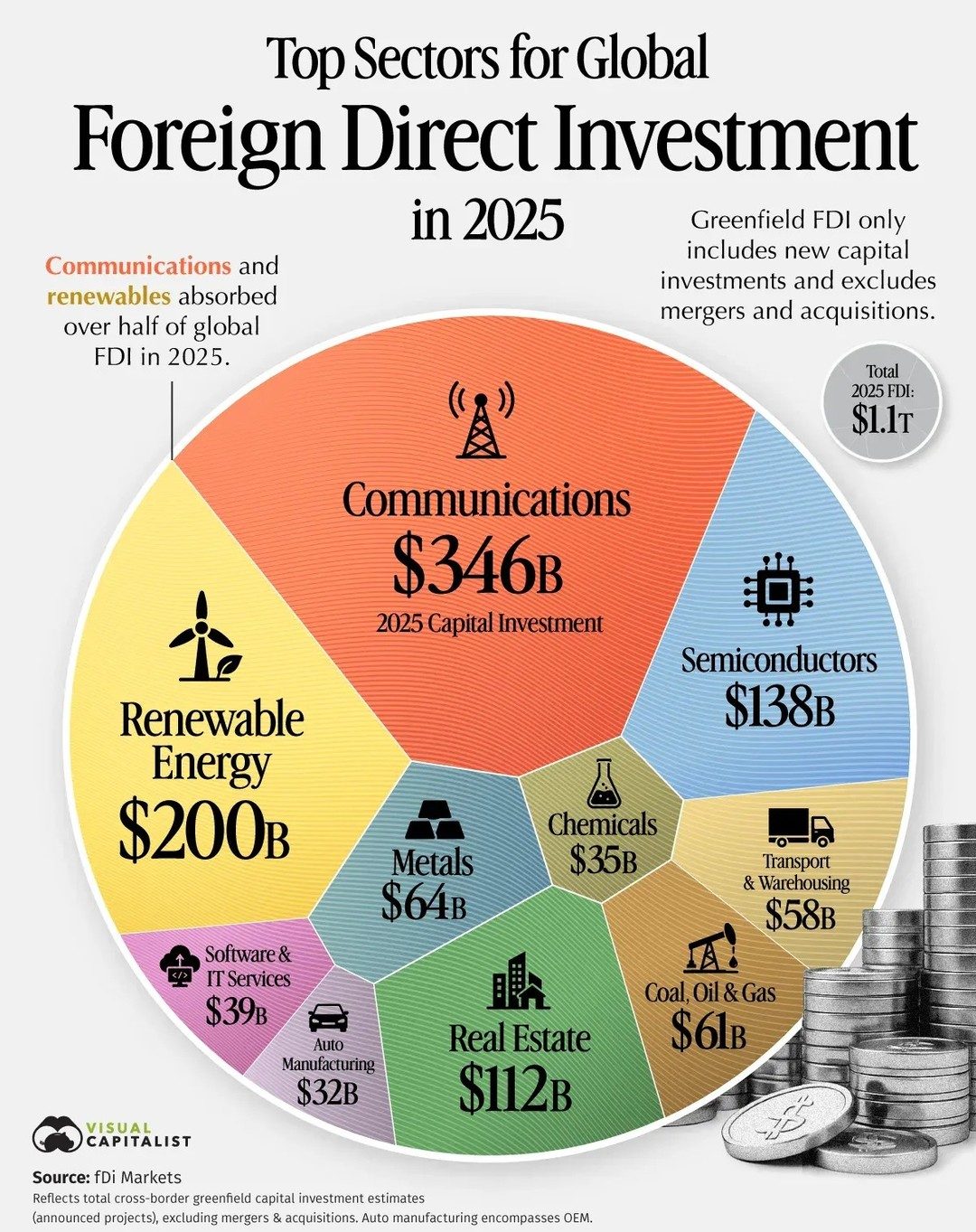
Global Foreign Direct Investment in 2025
In 2025, global greenfield investment is projected to reach nearly $1.1 trillion. This substantial capital inflow is being directed towards various sectors, each attracting significant foreign direct investment (FDI). The sector attracting the most attention is Communications, with a remarkable $346 billion in announced investment. This surge has pushed it ahead of Renewable Energy, which follows closely with $200 billion. Semiconductors, another critical sector, is expected to draw $138 billion, marking a record high.
Why This Matters
Understanding the distribution of FDI across different sectors is crucial for businesses, investors, and policymakers. It provides insights into global economic trends, identifies growth areas, and highlights the strategic importance of certain industries. This information can influence investment decisions, policy formulation, and strategic planning for both governments and corporations.
Top Sectors for Global FDI in 2025
Communications
Communications has overtaken renewable energy to become the leading sector for FDI, with $346 billion in announced investments. This surge can be attributed to the increasing demand for advanced communication infrastructure, driven by the growth of 5G networks, the Internet of Things (IoT), and cloud computing. The sector's growth is fueled by the need for enhanced connectivity, data management, and cybersecurity solutions.
Renewable Energy
Renewable energy remains a significant contender, attracting $200 billion in FDI. This sector's appeal lies in the global push towards sustainability and reducing carbon footprints. Investments in renewable energy are driven by technological advancements, government incentives, and increasing public awareness of environmental issues. The sector includes investments in solar, wind, hydro, and other renewable energy sources.
Semiconductors
Semiconductors have secured a record $138 billion in FDI, making it the third-largest sector. The semiconductor industry is critical for technological innovation and economic growth. Investments in this sector support the development of advanced chips, which are essential for various high-tech applications, including consumer electronics, automotive, and artificial intelligence. The semiconductor industry's growth is fueled by the increasing demand for data processing, storage, and computing power.
Software & IT Services
Software and IT services are crucial sectors for FDI, attracting $39 billion in investments. This sector encompasses a wide range of technologies, including enterprise software, cloud services, and cybersecurity solutions. The demand for digital transformation, automation, and data analytics drives investments in this sector. The global shift towards remote work and digitalization has further accelerated growth in software and IT services.
Metals
The metals sector is set to receive $64 billion in FDI, reflecting its importance in various industrial applications. Metals are essential for manufacturing, construction, and infrastructure development. Investments in this sector support the extraction, processing, and production of various metals, including steel, aluminum, and copper. The sector's growth is influenced by global infrastructure projects and the increasing demand for raw materials.
Transport & Warehousing
Transport and warehousing are critical for logistics and supply chain management, attracting $58 billion in FDI. This sector includes investments in transportation infrastructure, logistics services, and warehousing facilities. The growth in e-commerce and global trade drives investments in this sector, as companies strive to enhance efficiency, reduce costs, and improve delivery times.
Chemicals
The chemicals sector is expected to receive $35 billion in FDI, supporting various industrial applications. This sector encompasses a wide range of chemicals, including basic chemicals, specialty chemicals, and agrochemicals. Investments in the chemicals sector support the development of new products, process improvements, and sustainability initiatives. The sector's growth is driven by demand from various industries, including manufacturing, healthcare, and agriculture.
Real Estate
Real estate is a significant sector for FDI, attracting $112 billion in investments. This sector includes investments in residential, commercial, and industrial properties. The growth in real estate investments is driven by urbanization, population growth, and the demand for modern and sustainable properties. Investments in real estate support infrastructure development, economic growth, and job creation.
Coal, Oil & Gas
Coal, oil, and gas are traditional energy sources that continue to attract investment, despite the global shift towards renewable energy. The sector is expected to receive $6 billion in FDI, primarily focusing on exploration, production, and refining. Investments in this sector support energy security, economic development, and technological advancements in extraction and processing.
Practical Tips for Investors
Conduct Thorough Research
Before diving into any sector, conduct thorough research. Understand the market dynamics, regulatory environment, and competitive landscape. This will help you make informed investment decisions and identify growth opportunities.
Diversify Your Portfolio
Diversification is key to mitigating risks and maximizing returns. Consider investing in multiple sectors and geographies to spread your risk and capture opportunities from various sources.
Stay Updated on Market Trends
Global economic trends and technological advancements can significantly impact FDI flows. Stay updated on the latest trends, regulatory changes, and market developments to adapt your investment strategies accordingly.
Leverage Technology
Technology plays a crucial role in enhancing efficiency, reducing costs, and improving outcomes. Invest in sectors that leverage advanced technologies, such as renewable energy, semiconductors, and software and IT services.
Important Takeaways
The global FDI landscape in 2025 is characterized by substantial investments across various sectors. Communications, renewable energy, and semiconductors are leading the way, reflecting the growing importance of advanced technologies and sustainable practices.
Investors should focus on high-growth sectors, such as communications, semiconductors, and renewable energy, while also considering traditional sectors like real estate and metals. Diversification, thorough research, and staying updated on market trends are essential for making informed investment decisions and achieving long-term success.
Conclusion
The projected $1.1 trillion in global greenfield investment for 2025 underscores the potential for significant economic growth and innovation across various sectors. By understanding the top sectors for FDI and the factors driving investment, businesses, investors, and policymakers can capitalize on these opportunities and contribute to a prosperous global economy.
Watch the Reel
Questions readers ask
What is the significance of the Communications sector receiving $346 billion in FDI in 2025?
The Communications sector's significant FDI indicates a strong global interest in technologies such as 5G, IoT, and cloud computing. This highlights the sector's critical role in driving technological advancement and economic growth, making it a top priority for investors worldwide.
Why is the Renewable Energy sector attracting substantial FDI in 2025?
The Renewable Energy sector's $200 billion in FDI reflects the growing global emphasis on sustainable and environmentally friendly technologies. This investment trend underscores the sector's importance in combating climate change and meeting global energy demands.
What does the $138 billion FDI in the Semiconductor sector signify for the industry?
The $138 billion FDI in the Semiconductor sector indicates a strong demand for advanced semiconductor technologies, essential for various industries including communications, automotive, and consumer electronics. This investment is a response to the increasing importance of semiconductors in global economic development and technological innovation.
What are the implications of the Communications sector leading global FDI in 2025?
The Communications sector's lead in global FDI suggests a shift towards digital transformation and connectivity. This trend is driven by the need for faster, more reliable communication infrastructure, such as 5G networks, to support the growing demands of IoT and cloud computing technologies.
What are the key trends in global greenfield investment for 2025?
The projected $1.1 trillion in global greenfield investment for 2025 highlights a strong focus on emerging technologies and sustainable development. Key trends include significant investments in Communications, Renewable Energy, and Semiconductors, reflecting global priorities and strategic industry developments.
What is the importance of analyzing FDI trends across different sectors?
Analyzing FDI trends across sectors is essential for identifying growth opportunities and understanding global economic shifts. It helps businesses and investors make informed decisions, and policymakers develop strategies to attract investments that align with national priorities and foster economic growth.
Related deep dives
Similar reads based on topic and creator.


Recent articles
Fresh deep dives from the latest Reels we unpacked.




Comments
Be the first to comment.