Oil Production Statistics
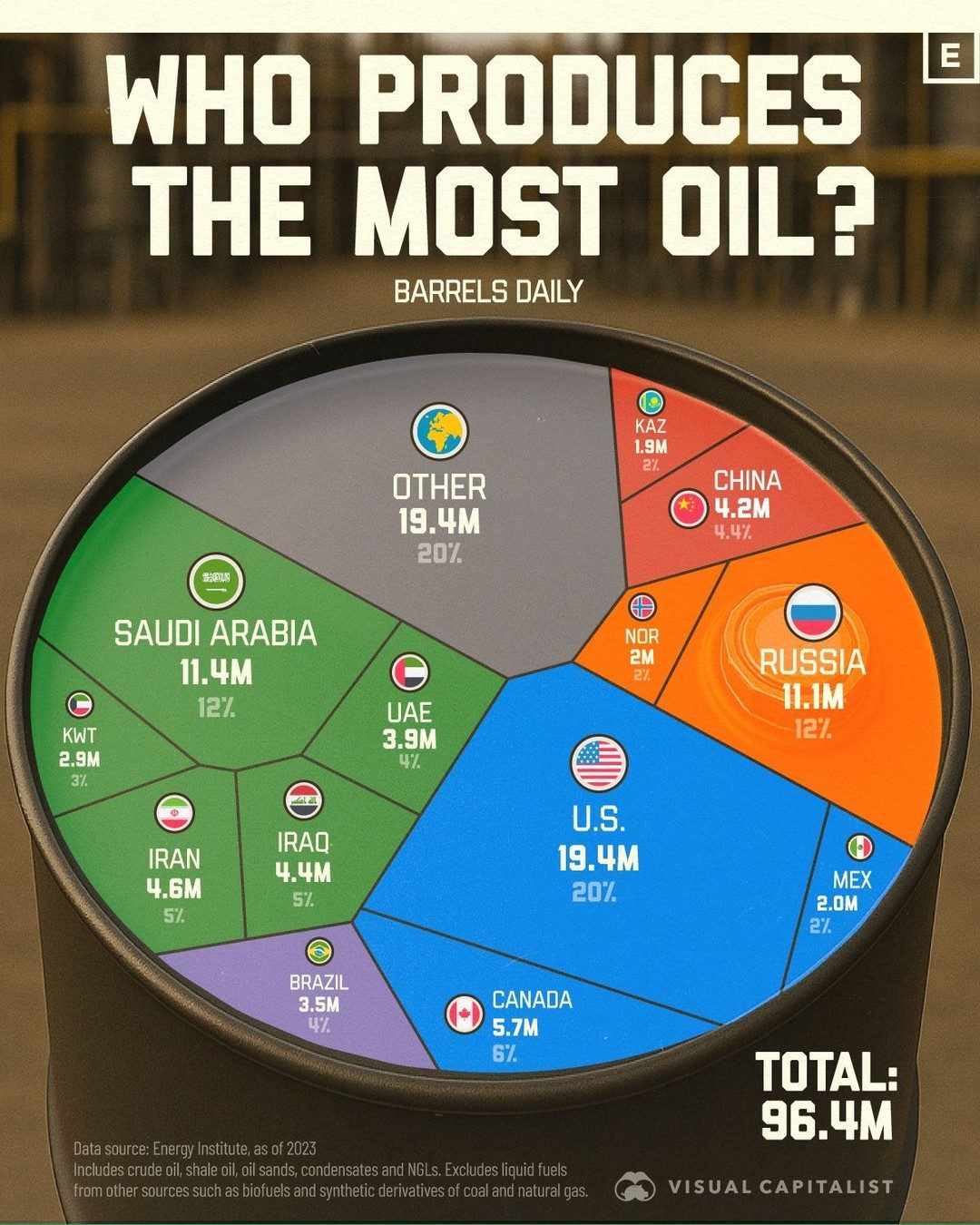
The United States (U.S.) leads global oil production, accounting for nearly one-fifth of the world’s daily output. The top five oil-producing countries—the U.S., Russia, Saudi Arabia, Canada, and Iraq—collectively generate over half of the world’s oil each day.
Context / Why this matters
Oil production is a critical component of the global energy landscape. The data highlights the dominance of a few key countries in meeting the world's energy demands. Understanding these statistics provides insights into energy security, economic influence, and geopolitical dynamics. The U.S. tops the list with 19.4 million barrels per day, followed by other major producers such as Saudi Arabia, Russia, and Canada.
Oil Production by Country
United States
The U.S. is the world's leading oil producer, contributing 19.4 million barrels per day. This significant output is driven by advancements in drilling technologies, particularly in the extraction of shale oil, which has led to a surge in domestic production. The U.S. has become a net exporter of oil, challenging traditional oil giants and reshaping global energy markets.
Saudi Arabia
Saudi Arabia produces 11.4 million barrels of oil daily, accounting for 12% of the world’s total output. The kingdom’s vast reserves and strategic investments in oil infrastructure have solidified its position as a key player in global oil markets. Saudi Arabia’s production capabilities are crucial for maintaining stability in oil prices and supply.
Russia
Russia follows closely with 11.1 million barrels per day, making it the second-largest producer. Russia’s significant oil reserves and state-owned energy companies like Rosneft and Gazprom have enabled it to maintain high production levels. Russia's role in global oil production is pivotal, especially in terms of supplying European markets.
Canada
Canada produces 4.2 million barrels of oil daily, primarily from oil sands. Oil sands production, though environmentally contentious, has significantly boosted Canada’s output, making it one of the world’s top producers. Canada’s oil industry is crucial for its economy and energy exports.
Iraq
Iraq contributes 4.4 million barrels per day, positioning itself as a significant producer in the Middle East. Despite political and security challenges, Iraq has worked to increase its oil production, leveraging its abundant reserves to support economic growth and reconstruction efforts.
Other Notable Producers
Beyond the top five, several other countries play substantial roles in global oil production:
- Kazakhstan (KAZ): 1.9 million barrels per day.
- Norway (NOR): 2 million barrels per day.
- United Arab Emirates (UAE): 3.9 million barrels per day.
- Brazil: 3.5 million barrels per day.
- Mexico (MEX): 1.9 million barrels per day.
These countries, along with others, contribute to the global oil supply, ensuring a diverse and robust energy market.
Types of Oil and Definitions
The total oil production figures include various types of oil, including:
- Crude oil: Natural petroleum extracted from the ground.
- Shale oil: Oil extracted from shale rock formations.
- Oil sands: Bituminous sands that contain heavy crude oil.
- Condensates: Light hydrocarbons that condense into liquid form.
- Natural Gas Liquids (NGLs): Liquids derived from natural gas processing.
These diverse sources of oil highlight the complexity and breadth of the global oil industry.
Practical tips
For Investors
Investing in oil involves understanding the production dynamics of key countries. Monitoring production data from the Energy Institute and other industry reports can provide valuable insights into market trends and potential investment opportunities. Diversifying investments across different oil types and regions can mitigate risks associated with supply and price volatility.
For Energy Consumers
Being informed about global oil production can help consumers make better decisions about energy usage. Understanding the environmental impact of different oil extraction methods and supporting sustainable energy initiatives can contribute to a more balanced and responsible energy landscape.
Important takeaways
The global oil production landscape is dominated by a few key countries, with the U.S. leading the way. Saudi Arabia, Russia, Canada, and Iraq are also significant contributors, each with its unique strengths and challenges. The types of oil produced vary widely, from crude oil to shale oil and oil sands, each with its own extraction methods and economic implications. The Energy Institute provides reliable data on oil production, making it a valuable resource for investors, consumers, and policymakers.
Conclusion
The data from the Energy Institute paints a clear picture of the global oil production landscape, with the U.S. at the forefront. Saudi Arabia, Russia, Canada, and Iraq play pivotal roles, contributing to over half of the world’s daily oil output. Understanding these dynamics is crucial for navigating the complex world of energy markets, investing in oil, and making informed decisions about energy consumption. The diversity of oil types and production methods underscores the importance of a balanced and responsible approach to global energy supply.
Watch the Reel
Questions readers ask
Which countries are the top oil producers globally and how much oil do they produce?
The top oil-producing countries are the United States, Saudi Arabia, and Russia. The United States produces 19.4 million barrels per day, while Saudi Arabia and Russia each produce over 11 million barrels per day.
What is the significance of understanding the top oil-producing countries?
Understanding the top oil-producing countries is crucial for analyzing global energy supply, economic influence, and geopolitical dynamics. These nations play a critical role in meeting the world's energy demands and their production levels can impact global energy security.
How much oil do the top five oil-producing countries produce collectively?
The top five oil-producing countries—the U.S., Russia, Saudi Arabia, Canada, and Iraq—collectively generate over half of the world’s oil each day. This highlights their significant role in the global energy landscape.
What is the current oil production of Saudi Arabia and why is it important?
Saudi Arabia produces over 11 million barrels of oil per day. Its production is important because it significantly influences global oil supply and prices, making it a key player in the world's energy market. Saudi Arabia’s oil production also has substantial economic and geopolitical implications.
How does the United States compare to other major oil producers like Russia and Canada?
The United States leads global oil production with 19.4 million barrels per day, significantly ahead of Russia and Canada. Russia produces over 11 million barrels per day, while Canada produces around 5.5 million barrels per day, underscoring the U.S.'s dominant position in world oil production.
What is the role of Iran and Iraq in global oil production?
Iraq is among the top oil-producing countries, contributing significantly to global oil supply with approximately 4.5 million barrels per day. Iran, while not in the top five, also plays a role with around 3.8 million barrels per day. Both countries are important for their contributions to the global oil market and their geopolitical influence in the Middle East.
Why is China's oil consumption relevant in the context of world oil production?
China's high consumption of oil, despite not being a top producer, is relevant because it significantly impacts global oil demand. China is the world’s largest importer of oil, with its consumption influencing global prices and the strategies of major oil-producing countries. Analyzing the production and consumption dynamics together provides a comprehensive view of the global oil supply chain.
Recent articles
Fresh deep dives from the latest Reels we unpacked.




Comments
Be the first to comment.