Oil Consumption by Country
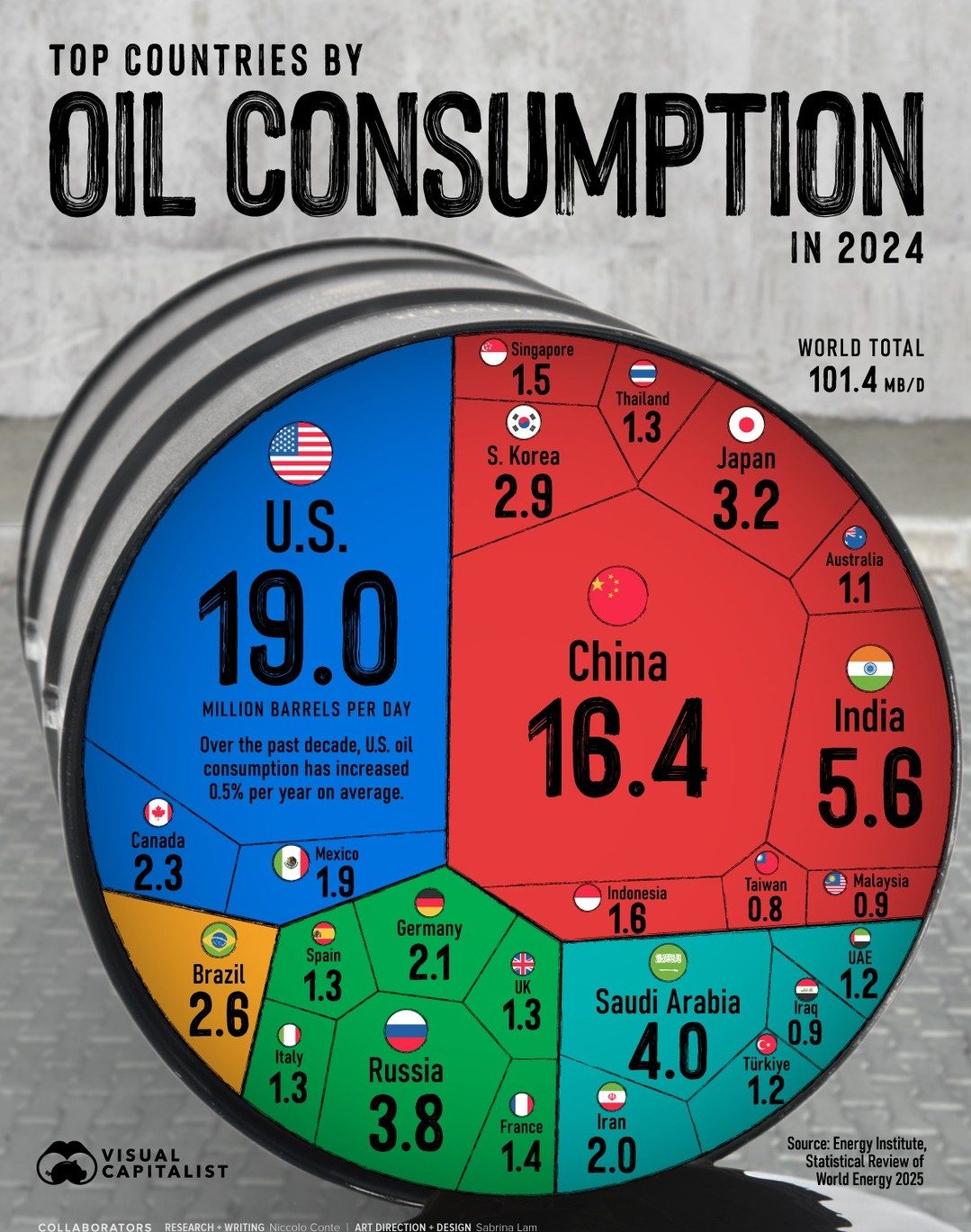
Oil is a cornerstone of the global economy, powering transportation, industry, and numerous other sectors. In 2024, the United States leads the world in oil consumption, followed closely by China. Together, the top 20 oil-consuming countries account for a significant portion of global demand. This article delves into the oil consumption patterns of these countries, using data from the Energy Institute.
Why This Matters
Understanding global oil consumption trends is crucial for various reasons. It helps in assessing energy security, predicting market fluctuations, and planning for future energy needs. Countries with high oil consumption often play pivotal roles in shaping global energy policies and influencing international relations. The data also highlights the importance of energy diversification and sustainability efforts to reduce dependence on fossil fuels.
Main Discussion
Top Oil Consumers
The United States consumes the most oil, with a daily intake of 19 million barrels. This high consumption is driven by a combination of factors, including a large population, extensive road networks, and a robust industrial sector. The U.S. is followed by China, which consumes 16.4 million barrels per day. China's rapid economic growth and industrialization have significantly increased its oil demand.
The top 10 oil-consuming countries account for 61% of global demand, while the top 20 countries account for 80%. This concentration underscores the influence these nations have on global oil markets. Other notable consumers include India, which consumes 5.6 million barrels per day, and Japan, which consumes 3.2 million barrels per day.
Regional Consumption Patterns
In Asia, countries like China, India, and Japan are significant oil consumers, driven by their industrial activities and large populations. China, in particular, has seen a sharp rise in oil consumption as it continues to urbanize and expand its manufacturing capabilities. India, with its growing economy, is also increasing its oil intake, while Japan, a major industrial power, remains a steady consumer.
In the Middle East, the UAE, Saudi Arabia, and Iran are among the top consumers, with Saudi Arabia consuming 4.0 million barrels per day. These countries have large economies and significant industrial sectors, contributing to their high oil demand.
Europe has several significant consumers, with countries like Germany, Russia, and the UK among the top 20. These nations have robust economies and significant industrial activities, leading to high oil consumption. Germany, for example, consumes 2.1 million barrels per day.
South America and Australia also have notable consumers, with Brazil and Australia consuming 2.6 and 1.1 million barrels per day, respectively. These countries have strong economies and significant industrial sectors, contributing to their oil consumption.
Emerging Trends
The data also highlights several emerging trends. For instance, there is a noticeable increase in oil consumption in developing countries, particularly in Asia and the Middle East. This trend is driven by economic growth, industrialization, and urbanization in these regions. As these countries develop, their demand for energy is expected to rise, further increasing global oil consumption.
In contrast, some countries are making efforts to reduce their dependence on oil. This is often driven by environmental concerns and a desire to move towards more sustainable energy sources. For example, countries in Europe are investing in renewable energy and energy-efficient technologies to reduce their oil consumption over time.
Factors Influencing Oil Consumption
Several factors influence oil consumption in different countries. Economic growth, industrial activities, and population growth are key drivers. For example, China's rapid economic growth has significantly increased its oil demand. Similarly, the large populations and extensive road networks in the United States contribute to its high oil consumption.
Technological advancements in energy efficiency and renewable energy also play a role. Countries investing in these areas may see a reduction in oil consumption over time. For example, the European Union has set targets to reduce greenhouse gas emissions, which includes efforts to decrease dependence on fossil fuels like oil.
Practical Tips
For individuals, there are several practical ways to reduce oil consumption and contribute to energy sustainability:
-
Energy-Efficient Vehicles: Consider switching to electric or hybrid vehicles, which consume less oil or none at all. These vehicles are increasingly affordable and offer long-term savings on fuel costs.
-
Public Transportation: Utilize public transportation whenever possible. This reduces the number of vehicles on the road and lowers overall oil consumption.
-
Efficient Home Appliances: Use energy-efficient home appliances and lighting. This not only reduces oil consumption but also lowers electricity bills.
-
Sustainable Lifestyle: Adopt sustainable practices such as carpooling, biking, and walking for short distances. These habits contribute to a significant reduction in oil use.
Important Takeaways
- The United States and China are the world's top oil consumers, followed by India, Japan, and several other countries.
- The top 20 oil-consuming countries account for 80% of global demand, highlighting their influence on global oil markets.
- Economic growth, industrial activities, and population growth are key drivers of oil consumption.
- Emerging trends show an increase in oil consumption in developing countries, while some countries are making efforts to reduce their dependence on oil.
Conclusion
Oil consumption patterns offer valuable insights into global energy trends and the economic landscape of various countries. The United States and China lead the way, while other significant consumers are spread across various regions. Understanding these trends is essential for planning energy policies, predicting market fluctuations, and promoting sustainable energy practices. As countries continue to develop and adopt new technologies, the global oil consumption landscape will undoubtedly evolve, shaping the future of energy and the environment.
Watch the Reel
Questions readers ask
Who are the largest oil consumers in 2024?
The United States and China are the top oil consumers in 2024, with other leading countries including India, Japan, and Russia. These nations collectively drive the majority of global oil demand.
How does the United States' oil consumption compare to other countries in 2024?
In 2024, the United States leads the world in oil consumption, making it the largest consumer globally. This high level of consumption significantly impacts global energy policies and market dynamics.
What factors influence the oil consumption patterns in 2024?
Several factors influence oil consumption patterns in 2024, including industrial growth, transportation needs, and economic development, particularly in rapidly developing countries.
Why is it important to track global oil consumption trends?
Tracking global oil consumption trends is crucial for predicting market fluctuations, assessing energy security, and planning future energy needs to ensure the stability of the global energy sector.
What role do the top 20 oil-consuming countries play in global energy policies?
The top 20 oil-consuming countries, such as the United States, China, and India, significantly influence global energy policies and international relations due to their high demand for oil, which affects supply and demand dynamics.
How does China's oil consumption impact global oil demand in 2024?
China's high oil consumption in 2024 is a major contributor to the overall global oil demand. China's industrial growth and infrastructure development drive its need for oil, making it the second-largest consumer after the United States.
Which sector consumes the most oil in the top oil-consuming countries?
The transportation sector is typically the largest consumer of oil in the top oil-consuming countries, followed by industry and manufacturing, which heavily relies on oil for fuel and production processes.
Related deep dives
Similar reads based on topic and creator.


Recent articles
Fresh deep dives from the latest Reels we unpacked.




Comments
Be the first to comment.