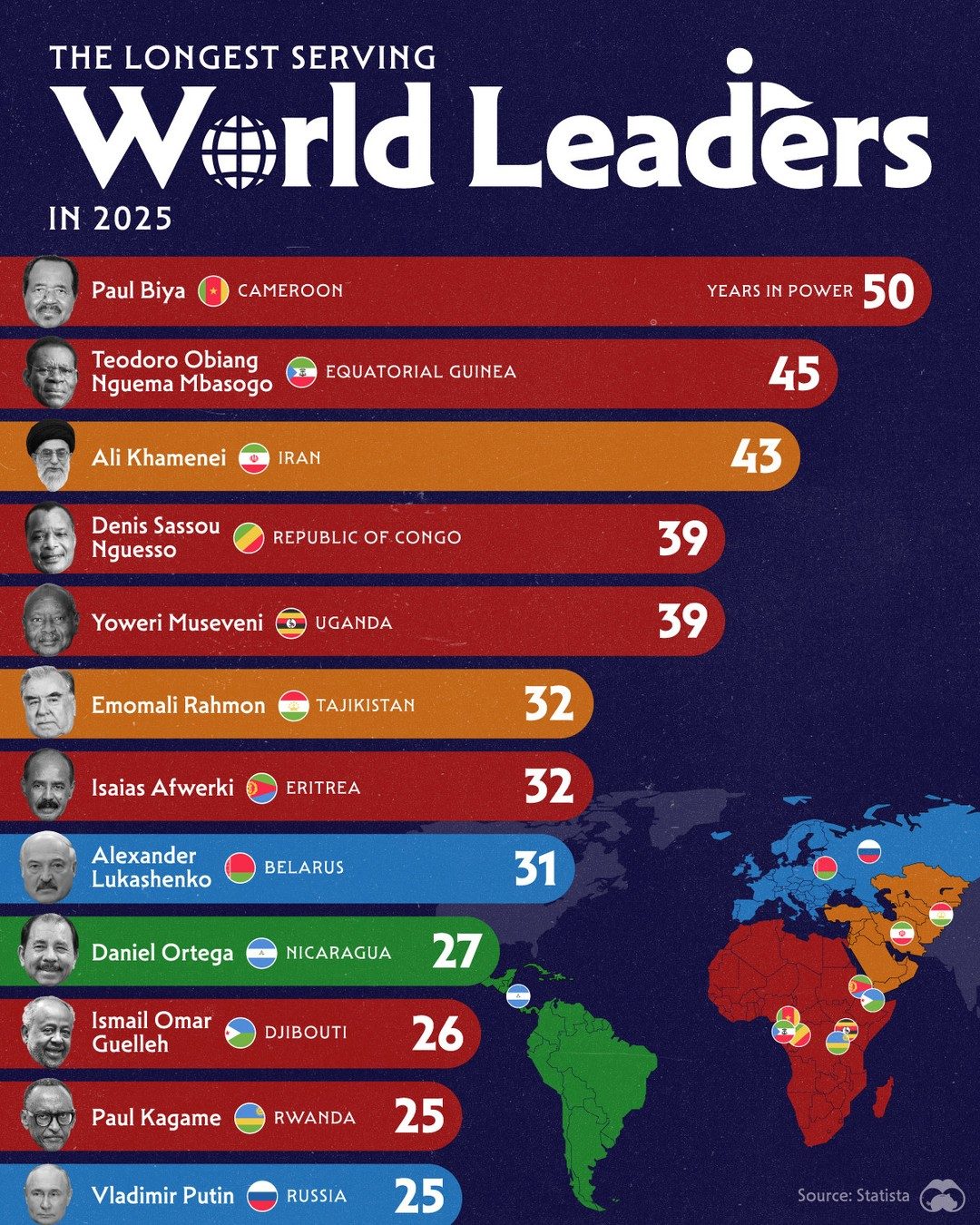
World Leaders’ Tenure in 2025: A Global Perspective
The tenure of world leaders often reflects the political stability and governance dynamics of their countries. By examining the longest-serving leaders as of 2025, we gain insights into the political landscapes of various nations. This data, compiled from Statista, sheds light on the longevity of leadership in different parts of the world.
Why This Matters
Understanding the tenure of world leaders is crucial for several reasons. It provides a snapshot of political continuity and change, highlights regions with stable governance, and reveals patterns of leadership longevity. Moreover, it helps in assessing the impact of long-term leadership on a nation's development, economy, and international relations.
The Longest-Serving Leaders in 2025
Paul Biya of Cameroon
Paul Biya of Cameroon tops the list with an impressive tenure of 50 years. Biya's longevity in office is a testament to his political acumen and the stability he has maintained in Cameroon. His rule has seen significant developments in infrastructure and economic growth, despite challenges such as corruption and political opposition.
Teodoro Obiang Nguema Mbasogo of Equatorial Guinea
Teodoro Obiang Nguema Mbasogo of Equatorial Guinea follows closely with 45 years in power. Obiang's rule has been characterized by a strong grip on power, with allegations of human rights abuses and corruption. His tenure has also seen the exploitation of the country's oil resources, which have contributed to economic growth but have also led to disparities in wealth distribution.
Ali Khamenei of Iran
Ali Khamenei of Iran has been in power for 43 years. As the Supreme Leader of Iran, Khamenei holds significant influence over the country's political, economic, and social landscapes. His tenure has been marked by Iran's complex relationships with Western nations, nuclear negotiations, and internal political dynamics.
Denis Sassou Nguesso of the Republic of Congo
Denis Sassou Nguesso of the Republic of Congo has been in power for 39 years. Sassou Nguesso's rule has seen periods of political instability and economic fluctuations. His tenure has also been marked by allegations of electoral fraud and human rights abuses, which have sparked international scrutiny and internal dissent.
Yoweri Museveni of Uganda
Yoweri Museveni of Uganda has also served for 39 years. Museveni's leadership has been characterized by efforts to modernize Uganda's economy and infrastructure. However, his tenure has also been fraught with controversies, including allegations of electoral fraud and human rights violations.
Emomali Rahmon of Tajikistan
Emomali Rahmon of Tajikistan has been in power for 32 years. Rahmon's rule has focused on economic development and maintaining political stability. His tenure has seen significant improvements in infrastructure and economic growth, but it has also been marked by allegations of corruption and human rights abuses.
Isaias Afwerki of Eritrea
Isaias Afwerki of Eritrea has held power for 32 years. Afwerki's rule has been characterized by a strong grip on power and a lack of political freedoms. Eritrea under Afwerki has faced criticism for human rights violations and a repressive regime, though some economic progress has been made.
Alexander Lukashenko of Belarus
Alexander Lukashenko of Belarus has been in power for 31 years. Lukashenko's leadership has been marked by his authoritarian style and suppression of political opposition. His tenure has seen periods of economic stagnation and international isolation, largely due to human rights abuses and electoral fraud.
Daniel Ortega of Nicaragua
Daniel Ortega of Nicaragua has been in power for 27 years. Ortega's rule has been characterized by a strong grip on power and allegations of electoral fraud. His tenure has seen significant economic and social changes, though they have been met with controversy and international criticism.
Ismail Omar Guelleh of Djibouti
Ismail Omar Guelleh of Djibouti has been in power for 26 years. Guelleh's leadership has focused on economic development and maintaining stability in a strategically important region. His tenure has seen significant improvements in infrastructure and economic growth, but it has also been marked by allegations of corruption and human rights abuses.
Paul Kagame of Rwanda
Paul Kagame of Rwanda has been in power for 25 years. Kagame's rule has been characterized by efforts to rebuild the country after the 1994 genocide and to promote economic development. His tenure has seen significant economic growth and social progress, though it has also been marked by allegations of human rights abuses and suppression of political opposition.
Vladimir Putin of Russia
Vladimir Putin of Russia has been in power for nearly 25 years. Putin's leadership has been marked by a strong grip on power and efforts to reassert Russia's influence on the global stage. His tenure has seen significant economic and military developments, though it has also been met with international criticism and allegations of electoral fraud and human rights abuses.
Practical Tips for Understanding Long-Tenured Leadership
To better comprehend the implications of long-tenured leadership, consider the following tips:
- Research Historical Context: Understanding the historical context in which a leader came to power can provide valuable insights into their governance style and political strategies.
- Analyze Economic Indicators: Economic growth and development often reflect the effectiveness of a leader's policies. Look at GDP growth, infrastructure development, and poverty reduction rates.
- Examine Political Stability: Long tenure can indicate political stability, but it can also signal a lack of democratic processes. Assess the frequency and fairness of elections, as well as the presence of political opposition.
- Consider Human Rights Records: A leader's tenure should be evaluated in the context of human rights. Look for international reports and watchdog organizations' assessments of a country's human rights situation.
- Study Foreign Policy: A leader's stance on international relations can greatly impact their country's standing on the global stage. Look at a country's alliances, trade agreements, and diplomatic relations.
Important Takeaways
The tenure of world leaders as of 2025 highlights several key points:
- Stability and Continuity: Long-tenured leaders often bring a sense of stability and continuity to their countries, which can be beneficial for long-term development.
- Challenges of Autocratic Rule: Many of the longest-serving leaders maintain power through autocratic means, which can lead to human rights abuses and lack of political freedoms.
- Regional Dynamics: The dominance of leaders in Africa and the Middle East suggests unique regional dynamics, including the prevalence of authoritarian regimes.
- Economic Progress: Long tenure can lead to significant economic progress, but it often comes with disparities in wealth distribution and corruption.
- International Relations: A leader's tenure can greatly impact their country's international relations, influencing trade, diplomacy, and geopolitical strategies.
Conclusion
Examining the tenure of world leaders as of 2025 provides a nuanced view of global politics. From Paul Biya of Cameroon to Vladimir Putin of Russia, these leaders have shaped their countries' trajectories in profound ways. While long tenure can bring stability and economic progress, it also comes with challenges such as autocratic control, human rights abuses, and political repression. By understanding these dynamics, we can gain a deeper appreciation for the complexities of global governance and the impact of leadership on national development.
Watch the Reel
Questions readers ask
Who are the top longest-serving world leaders in 2025?
As of 2025, some of the top longest-serving world leaders include Paul Biya of Cameroon, Teodoro Obiang Nguema Mbasogo of Equatorial Guinea, and Ali Khamenei of Iran. These leaders have held their positions for an extended period, offering unique perspectives on their countries' political landscapes.
How does the tenure of world leaders reflect on their countries' political stability?
The tenure of world leaders often serves as an indicator of political stability. Long-serving leaders like those in Cameroon, Equatorial Guinea, and Iran suggest a degree of continuity and established governance dynamics within their nations.
Why is it important to study the tenure of world leaders?
Studying the tenure of world leaders provides insights into political continuity and change, highlights regions with stable governance, and reveals patterns of leadership longevity. It also helps assess the impact of long-term leadership on a nation's development, economy, and international relations.
How long has Vladimir Putin been serving as the President of Russia in 2025?
Vladimir Putin has been serving as the President of Russia for a significant period. However, as of 2025, he is not among the top longest-serving leaders globally, but his tenure has been notable for its longevity and impact on Russian politics and international relations.
What can we learn from the governance dynamics of nations with long-serving presidents?
Nations with long-serving presidents, such as Cameroon, Equatorial Guinea, and Iran, offer insights into various governance dynamics. These include the balance between stability and potential stagnation, the influence of long-term leadership on policy continuity, and the public's adaptation to extended tenures.
Are there notable changes in the list of longest-serving world leaders from previous years to 2025?
While the list of longest-serving world leaders may include some familiar names, there are often shifts due to leadership changes or retirements. As of 2025, leaders like Paul Biya, Teodoro Obiang Nguema Mbasogo, and Ali Khamenei continue to stand out, but new names may appear based on recent political developments.
How does the tenure of world leaders impact international relations?
The tenure of world leaders significantly impacts international relations. Long-serving leaders often develop established relationships with other nations, shaping foreign policies and global alliances. This can lead to both stability and potential conflicts, depending on the leader's approach to international affairs.
Recent articles
Fresh deep dives from the latest Reels we unpacked.




Comments
Be the first to comment.