Union Membership Statistics
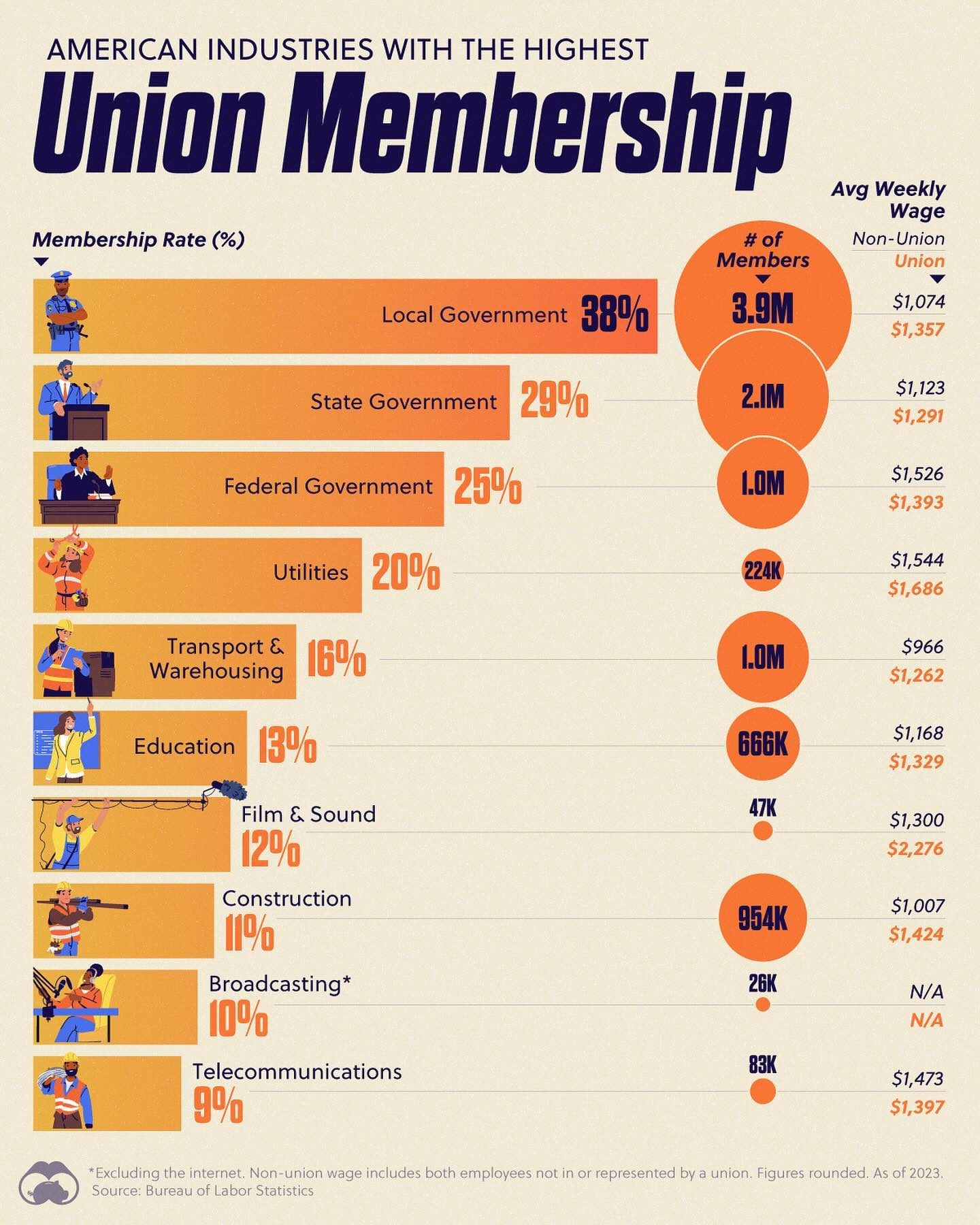
Union membership rates vary significantly across different industries in the United States. According to the Bureau of Labor Statistics (BLS) 2023 data, two out of five local government workers, including many police officers, are union members, making this the highest rate across all U.S. industries. In contrast, only 1% of professionals in fields like tech, law, and finance belong to unions.
Why This Matters
Understanding union membership rates and their impact on wages and working conditions is crucial for both employees and employers. Union membership can influence wage negotiations, benefits, and job security. Industries with higher union membership rates often see better compensation and working conditions, which can attract and retain skilled workers.
Union Membership by Industry
Local Government
Local government workers have the highest union membership rate at 38%, with approximately 3.9 million members. This high rate reflects the organized efforts of public sector workers to secure better wages, benefits, and working conditions. Union members in local government earn an average of $1,686 weekly, compared to non-union members who earn $1,291.
State Government
State government workers follow closely with a 29% union membership rate, totaling about 1.2 million members. The wage disparity is also evident here, with union members earning $1,526 per week compared to $1,357 for non-union members. This difference highlights the role of unions in negotiating higher compensation for public sector employees.
Federal Government
Federal government employees have a 25% union membership rate, with around 1.0 million members. However, the wage gap is less pronounced here, with union members earning $1,393 per week compared to $1,544 for non-union members. This suggests that federal government wages may be more standardized regardless of union affiliation.
Utilities
The utilities sector has a 20% union membership rate, with 224,000 members. Union members in this sector earn significantly more, with an average weekly wage of $1,329 compared to $966 for non-union members. This significant difference underscores the impact of union negotiations on wages in the utilities industry.
Transport and Warehousing
In transport and warehousing, 16% of workers are union members, totaling about 1.0 million. Union members earn $1,473 per week, while non-union members earn $1,262. This sector's high union density and wage differentials reflect the critical nature of the work and the need for organized labor to ensure fair compensation.
Education
Education has a 13% union membership rate, with 666,000 members. Union members earn $1,300 per week, compared to $1,168 for non-union members. The presence of unions in education helps ensure better working conditions and compensation for educators, which can improve the quality of education.
Film and Sound
The film and sound industry has a 12% union membership rate, with 47,000 members. This sector sees the largest wage gap, with union members earning $2,276 per week compared to $1,300 for non-union members. The high union membership rate and wage differential indicate the importance of unions in negotiating fair compensation in the entertainment industry.
Construction
Construction workers have an 11% union membership rate, with 954,000 members. Both union and non-union members earn $1,424 per week, indicating that union membership does not significantly affect wages in this sector. This could be due to standardized wage structures or other factors influencing compensation.
Broadcasting and Telecommunications
Broadcasting and telecommunications have the lowest union membership rates, at 10% and 8%, respectively, with 143,000 and 26,000 members, respectively. The data for non-union wages in broadcasting and telecommunications are not available. However, union members in broadcasting earn $1,397 per week, indicating that unions play a role in negotiating compensation in these sectors.
Impact of Union Membership on Wages
Union membership often translates to higher wages across various industries. For instance, local government, utilities, and film and sound sectors show significant wage gaps between union and non-union members. This disparity highlights the effectiveness of union negotiations in securing better compensation for their members. However, in some sectors like federal government and construction, the wage differential is less pronounced, suggesting that other factors may influence compensation.
Importance of Union Membership Rates
Union membership rates are a critical indicator of the labor dynamics within different industries. High union membership rates often correlate with better wages and working conditions, as seen in sectors like utilities and transport and warehousing. Conversely, lower union membership rates in sectors like tech, law, and finance may contribute to the lower wages and fewer benefits reported by workers in these fields.
Practical Tips
For workers considering union membership, it is essential to understand the potential benefits and trade-offs. Joining a union can provide better wages, benefits, and job security. However, it also involves paying union dues and adhering to the union's rules and regulations. Workers should research the union's track record in their industry, assess the potential impact on their career, and consider seeking advice from union representatives or legal experts before making a decision.
Research the Union
Before joining a union, research its history, leadership, and track record in negotiating fair wages and benefits. Look for unions with a strong reputation in your industry and a proven ability to advocate for workers' rights.
Understand the Benefits
Evaluate the specific benefits that union membership can offer, such as better wages, healthcare benefits, retirement plans, and job security. Consider how these benefits align with your personal and professional goals.
Weigh the Costs
Union membership often requires paying dues, which can be a financial burden for some workers. Ensure that the potential benefits outweigh the costs before deciding to join. Additionally, consider the time and effort required to actively participate in union activities, such as meetings and negotiations.
Important Takeaways
Union membership rates and their impact on wages and working conditions vary significantly across different industries. While higher union membership rates often correlate with better wages and benefits, the specific impact can vary. Workers considering union membership should carefully weigh the potential benefits and costs and research the union's track record in their industry.
Conclusion
Union membership plays a crucial role in shaping the labor landscape across various industries in the United States. The data from the Bureau of Labor Statistics (BLS) 2023 highlights the significant impact of union membership on wages and working conditions. Whether in local government, utilities, or the entertainment industry, union membership can offer better compensation and job security. However, the decision to join a union should be informed by thorough research and a clear understanding of the benefits and potential drawbacks.
Watch the Reel
Questions readers ask
Which industry has the highest union membership rate in 2023?
The local government industry has the highest union membership rate in 2023, with nearly 40% of its workers being union members. This includes professions like police officers, teachers, and other public service roles.
How does union membership affect wages in the utilities industry?
Union jobs in the utilities industry are likely to have a significant impact on wages because of their high union membership rate. These union members often have higher earnings and receive better benefits than their non-union counterparts.
What is the difference in union membership between state and federal government workers?
State government workers have a higher union membership rate (around 33%) than federal government workers (around 26%). This difference can lead to variations in wages and benefits, with state workers generally enjoying better compensation.
Which industry has the lowest union membership rate in 2023?
The tech, law, and finance sectors have the lowest union membership rates in 2023, with only 1% of professionals in these fields being union members. This can have a significant impact on the working conditions and wages of these employees.
How does union membership influence job stability in the transport industry?
Union membership in the transport industry can greatly enhance job stability. Unionized workers in this sector often have better job security, better wages, and more robust benefits packages compared to their non-union peers. This is due to the collective bargaining power of unions in negotiating better terms and conditions.
What are the benefits of working in unionized industries in 2023?
Working in unionized industries in 2023 can provide numerous benefits, including higher wages, better health and retirement benefits, and improved job security. These advantages are often the result of collective bargaining agreements that unions negotiate on behalf of their members.
Recent articles
Fresh deep dives from the latest Reels we unpacked.




Comments
Be the first to comment.