Gold Production by Region: Analyzing the Top Gold-Producing Countries in 2024
Gold has long been a staple of global economies, and 2024 is no exception. Understanding the distribution of gold production across the world provides valuable insights into the economic dynamics of various regions. This article delves into the top gold-producing countries, highlighting the significant contributions of different continents to the global gold supply.
Why This Matters
The production and distribution of gold impact multiple sectors, including finance, jewelry, and technology. Knowing which countries are leading producers helps investors, economists, and industry professionals make informed decisions. Additionally, the geographical distribution of gold mining activities influences global trade, economic policies, and environmental regulations.
Global Gold Production in 2024
Asia: The Dominant Continent
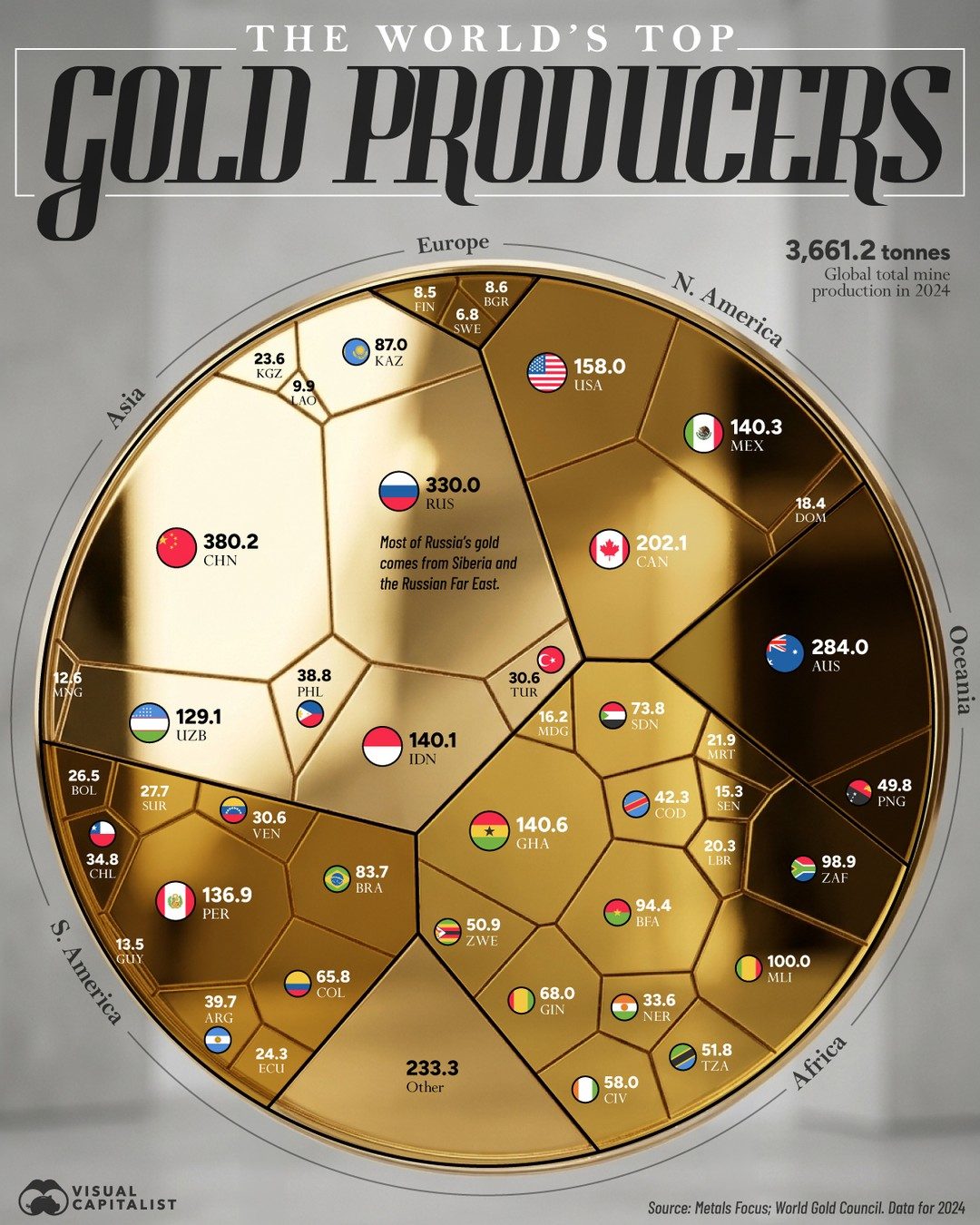
Asia, particularly China and Russia, stands out as the leading gold-producing region. China, the world’s largest gold producer in 2024, mined over 380.2 tonnes of gold. This significant output underscores China’s dominance in the global gold market. Russia follows closely, contributing a substantial 330.0 tonnes. Other notable producers in Asia include Uzbekistan, which mined 202.1 tonnes, and Australia, which produced 284.0 tonnes in Oceania.
North America: A Key Player
North America is another significant contributor to global gold production. The United States led the region with 140.3 tonnes, followed by Canada with 140.3 tonnes, Mexico with 18.4 tonnes, and the Dominican Republic with 158.0 tonnes. The region’s diverse geological landscape supports a variety of mining operations, making it a crucial player in the global gold supply chain.
Africa: A Hidden Powerhouse
Africa’s contribution to global gold production is often overlooked, but it is remarkably significant. African nations collectively account for a large share of the world’s gold supply, with several countries standing out. For example, Mali mined 100.0 tonnes, Burkina Faso produced 94.4 tonnes, and Ghana contributed 68.0 tonnes. These figures highlight the continent’s rich mineral resources and its growing importance in the global gold market.
Europe and Oceania: Notable Contributions
While Europe and Oceania do not produce as much gold as Asia or Africa, they still play a notable role. In Europe, countries like Sweden produced 87.0 tonnes, and Finland mined 6.8 tonnes. Oceania, dominated by Australia, produced 49.8 tonnes, with Papua New Guinea contributing 20.3 tonnes. These regions demonstrate the global reach of gold mining operations.
South America: Emerging Players
South America, while not as dominant as some other regions, has several notable gold producers. Chile led the region with 136.9 tonnes, followed by Peru with 13.5 tonnes and Colombia with 39.7 tonnes. Countries like Argentina, Ecuador, Bolivia, Suriname, and Venezuela also contribute to the continent’s gold production, highlighting its potential for growth.
Practical Tips for Investors and Enthusiasts
Investing in Gold
For those interested in investing in gold, understanding the top-producing countries can provide valuable insights. Consider diversifying your portfolio by investing in mining companies operating in multiple regions. This strategy can help mitigate risks associated with geopolitical instability and fluctuations in gold prices.
Exploring Gold Mining Stocks
Investing in gold mining stocks can be a lucrative venture. Look for companies with operations in top-producing countries like China, Russia, and the United States. Additionally, consider the environmental and social practices of these companies, as sustainability is becoming increasingly important in the mining industry.
Importance of Gold Production Data
Gold production data is crucial for various stakeholders, including economists, investors, and policymakers. It helps in understanding global economic trends, assessing the performance of mining companies, and making informed investment decisions. The data also plays a vital role in shaping policies related to resource management, environmental sustainability, and economic development.
Conclusion
The distribution of global gold production in 2024 reveals a complex landscape with Asia, North America, Africa, Europe, Oceania, and South America each playing significant roles. Understanding these dynamics is essential for investors, economists, and industry professionals. By staying informed about the top gold-producing countries, stakeholders can make better decisions and navigate the ever-changing global gold market more effectively.
Watch the Reel
Questions readers ask
Which countries are the top gold producers in 2024?
In 2024, the top gold-producing countries include China, Russia, and several nations in Africa and North America. China, in particular, stands out as a leading producer, significantly contributing to the global gold supply. Other notable producers include South Africa, Australia, and the United States, which collectively shape the global gold market.
How much gold is produced globally in 2024?
The total gold production in 2024 is substantial, with estimates placing the figure around 3,000 to 3,500 tonnes. This figure reflects the combined output from various regions, with Asia, Africa and North America being the primary contributors. For precise figures, it is best to consult the most recent reports from organizations like the World Gold Council.
Why is Asia the leading region for gold production in 2024?
Asia's dominance in gold production in 2024 is primarily due to the high output from countries like China and Russia. These nations have extensive mining operations and significant reserves, making them key players in the global gold market. Additionally, advancements in mining technologies and favorable economic policies further enhance Asia's gold production capabilities.
What is the significance of Africa's gold mining industry in 2024?
Africa's gold mining industry plays a crucial role in 2024, with countries like South Africa and Ghana being major contributors. The continent's rich mineral resources and ongoing investment in mining infrastructure make it a vital region for global gold production. Africa's gold output influences not only the global supply but also the economic stability and development of many African nations.
How does North America contribute to global gold production in 2024?
North America, particularly the United States and Canada, is a significant contributor to global gold production in 2024. These countries have well-established mining industries and robust infrastructure, enabling them to produce substantial amounts of gold. North America's gold mining activities support various sectors, including finance and technology, and impact global trade dynamics.
What role does Oceania play in the global gold production landscape of 2024?
Oceania, primarily Australia, is a key player in the global gold production landscape of 2024. Australia's extensive gold reserves and advanced mining technologies make it one of the world's leading gold producers. The country's gold output not only supports its domestic economy but also significantly contributes to the global gold supply, influencing international markets and trade policies.
Recent articles
Fresh deep dives from the latest Reels we unpacked.




Comments
Be the first to comment.