Financial Advisor Values
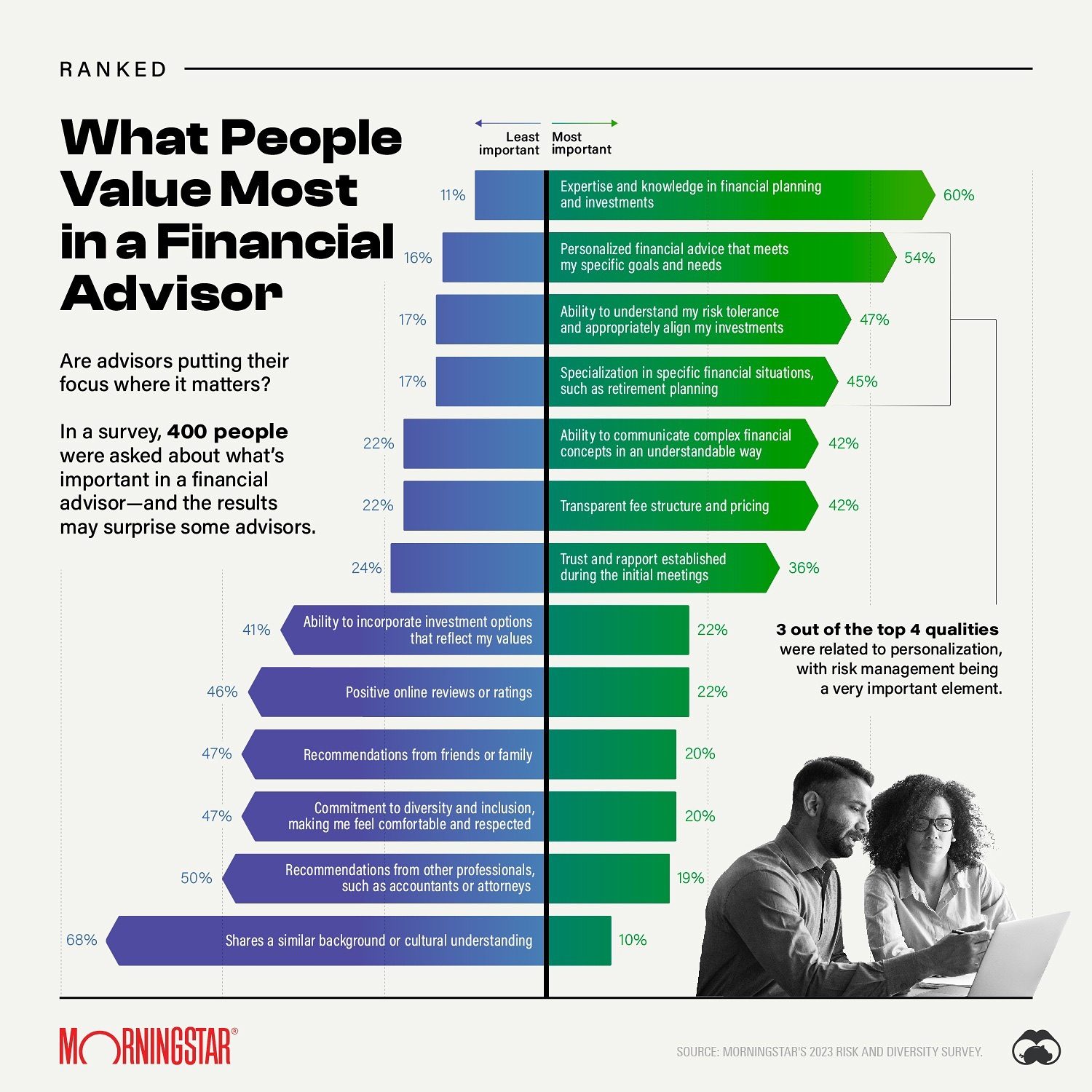
When choosing a financial advisor, investors often prioritize factors beyond just positive reviews and recommendations. Personalization and specific qualities play a significant role in decision-making. A recent survey by Morningstar conducted with 400 participants offers valuable insights into what people truly value in a financial advisor.
Why This Matters
Understanding what investors prioritize in a financial advisor is crucial for both consumers and professionals. For investors, knowing what qualities to look for can lead to more satisfying and effective financial management. For advisors, identifying these key qualities can help tailor services to better meet client needs, fostering stronger relationships and a competitive edge.
What People Value in a Financial Advisor
Expertise and Knowledge in Financial Planning
Expertise and knowledge in financial planning are arguably the most important qualities, with 60% of respondents citing this as a critical factor. This includes a deep understanding of various financial products, markets, and strategies. Financial advisors who can navigate complex financial landscapes with competence and experience are highly valued.
Personalized Financial Advice
Close behind is the ability to provide personalized financial advice that meets specific goals and needs. This quality was mentioned by 54% of the respondents. Personalization ensures that financial plans are tailored to individual circumstances, rather than applying a one-size-fits-all approach. This includes considering lifestyle, risk tolerance, and long-term goals.
Risk Tolerance and Investment Alignment
Personalization also extends to understanding an investor’s risk tolerance and aligning investments accordingly. This was highlighted by 47% of participants. Advisors who can manage risk appropriately and tailor investment strategies to individual risk profiles are seen as invaluable.
Financial Specialization
Specialization in specific financial situations, such as retirement planning, estate planning, or tax strategies, is another important factor. 45% of respondents emphasized the importance of advisors who have specialized expertise. This specialization ensures that investors receive advice that is finely tuned to their specific financial goals and challenges.
Transparency
Transparency in explaining financial concepts and fee structures is also highly valued. 42% of respondents highlighted the importance of advisors who can explain complex financial concepts clearly. Additionally, a transparent fee structure and pricing were important for 42% of participants. Transparency builds trust and ensures that clients fully understand the services and costs involved.
Trust and Rapport
Trust and rapport, established especially during the initial meetings, were also significant factors. 36% of respondents highlighted the importance of feeling comfortable and respected by their financial advisor. Building a strong relationship from the start can greatly influence an investor’s decision to stay with an advisor.
Inclusivity and Value Alignment
Commitment to personalization and inclusion, making clients feel comfortable and respected, was valued by 22% of participants. This includes incorporating investment options that reflect an individual’s values, which was also noted as important by 22% of respondents.
Recommendations and Background
While recommendations from friends, family, or other professionals are helpful, they are not the top considerations. Recommendations from friends or family were mentioned by 20% of respondents, and those from professionals, such as accountants or attorneys, by 19%. Shares a similar background or cultural understanding, while important, was the least cited factor at 10%.
Practical Tips
For Investors
- Assess Expertise: Verify the advisor's credentials and experience. Look for certifications like Certified Financial Planner (CFP) or Chartered Financial Analyst (CFA).
- Seek Personalization: Discuss your specific goals and needs during the initial meetings. A good advisor should tailor their advice to your unique situation.
- Evaluate Transparency: Ensure that the advisor explains financial concepts clearly and provides a transparent fee structure.
- Build Rapport: Pay attention to how comfortable you feel during initial meetings. A good rapport can lead to a more effective working relationship.
For Financial Advisors
- Demonstrate Expertise: Continuously update your knowledge and skills, and be prepared to showcase your expertise to potential clients.
- Personalize Your Approach: Tailor your advice to individual needs and circumstances. Personalized advice is one of the most valued qualities.
- Manage Risk: Develop a clear understanding of each client's risk tolerance and align investments accordingly.
- Communicate Clearly: Be transparent about fees and clearly explain financial concepts. Transparency builds trust and fosters long-term relationships.
- Build Trust: Focus on building a strong, respectful relationship from the start. Investors value trust and rapport highly.
Important Takeaways
The survey results underscore the importance of personalized, transparent, and expert financial advice. Investors value advisors who understand their specific needs, manage risk effectively, and build strong, trusting relationships. For financial advisors, tailoring services to individual client needs and maintaining transparency can greatly enhance their appeal and effectiveness.
Conclusion
Choosing a financial advisor is a critical decision that can significantly impact an investor's financial future. By focusing on personalization, expertise, transparency, and trust, investors can find advisors who best meet their needs. For financial advisors, understanding and prioritizing these qualities can lead to more successful and satisfying client relationships.
Watch the Reel
Questions readers ask
What key qualities do investors prioritize when selecting a financial advisor?
Investors highly value expertise in financial planning, personalized strategies, and an advisor's ability to match investments with their risk tolerance. These qualities were highlighted in a Morningstar survey, showing that investors seek advisors who can tailor their services to individual needs and provide a personalized approach to financial management.
How does personalized financial planning influence an investor's choice of a financial advisor?
Personalized financial planning is crucial because it ensures that the financial strategies are tailored to the investor's unique financial goals, risk tolerance, and life situation. This level of customization helps to build trust and confidence, making investors more likely to choose an advisor who offers personalized services.
Why is matching risk tolerance important in financial advising?
Matching risk tolerance is essential because it aligns the investment strategy with the investor's comfort level regarding market fluctuations. An advisor who accurately assesses and matches risk tolerance can help prevent emotional decision-making during volatile markets, leading to a more stable and satisfying investment experience.
What role does financial planning expertise play in an investor's decision to choose a financial advisor?
Financial planning expertise is a cornerstone of a successful advisor-client relationship. It demonstrates the advisor's competence in creating comprehensive financial plans that address various aspects of an investor's financial life, including retirement planning, tax strategies, and estate planning. This expertise reassures investors that their financial future is in capable hands.
How can financial advisors use the insights from the Morningstar survey to improve their services?
By understanding the key qualities valued by investors, financial advisors can enhance their services to better meet client needs. This includes developing deeper expertise in financial planning, offering more personalized strategies, and ensuring that investment portfolios align with each client's risk tolerance. These steps can help advisors build stronger relationships and attract more clients.
What specific traits do investors value most in a financial advisor, according to the Morningstar survey?
The Morningstar survey revealed that investors particularly value expertise in financial planning, the ability to create personalized strategies, and a keen understanding of risk tolerance. These traits indicate a holistic approach to financial management, making investors more confident in their choice of advisor.
How do personalized strategies help investors achieve their financial goals?
Personalized strategies are designed to address the specific needs and goals of each investor, ensuring that the financial plan is unique and effective. Through personalized strategies, investors can better navigate market complexities and make informed decisions that align with their long-term financial objectives, ultimately contributing to a more successful financial journey.
Recent articles
Fresh deep dives from the latest Reels we unpacked.




Comments
Be the first to comment.