Employee Embezzlement Schemes
Employee embezzlement is a significant financial threat to organizations of all sizes. It occurs when employees steal or misappropriate funds entrusted to them for personal gain. This illegal act can go undetected for long periods, leading to substantial financial losses. In this post, we delve into the largest employee embezzlement schemes reported from May 2025 to April 2026, highlighting the amounts embezzled by various organizations, including Detroit Riverfront Conservancy, Santa Cruz County, and Mars.
Context / Why this Matters
Employee embezzlement is a pervasive issue that can have devastating consequences for businesses. Understanding the scope and methods of these schemes is crucial for implementing effective preventative measures. By examining the largest cases, we can gain insights into the tactics used by embezzlers and the vulnerabilities that enable these crimes.
Main Discussion
The Top 10 Embezzlement Schemes
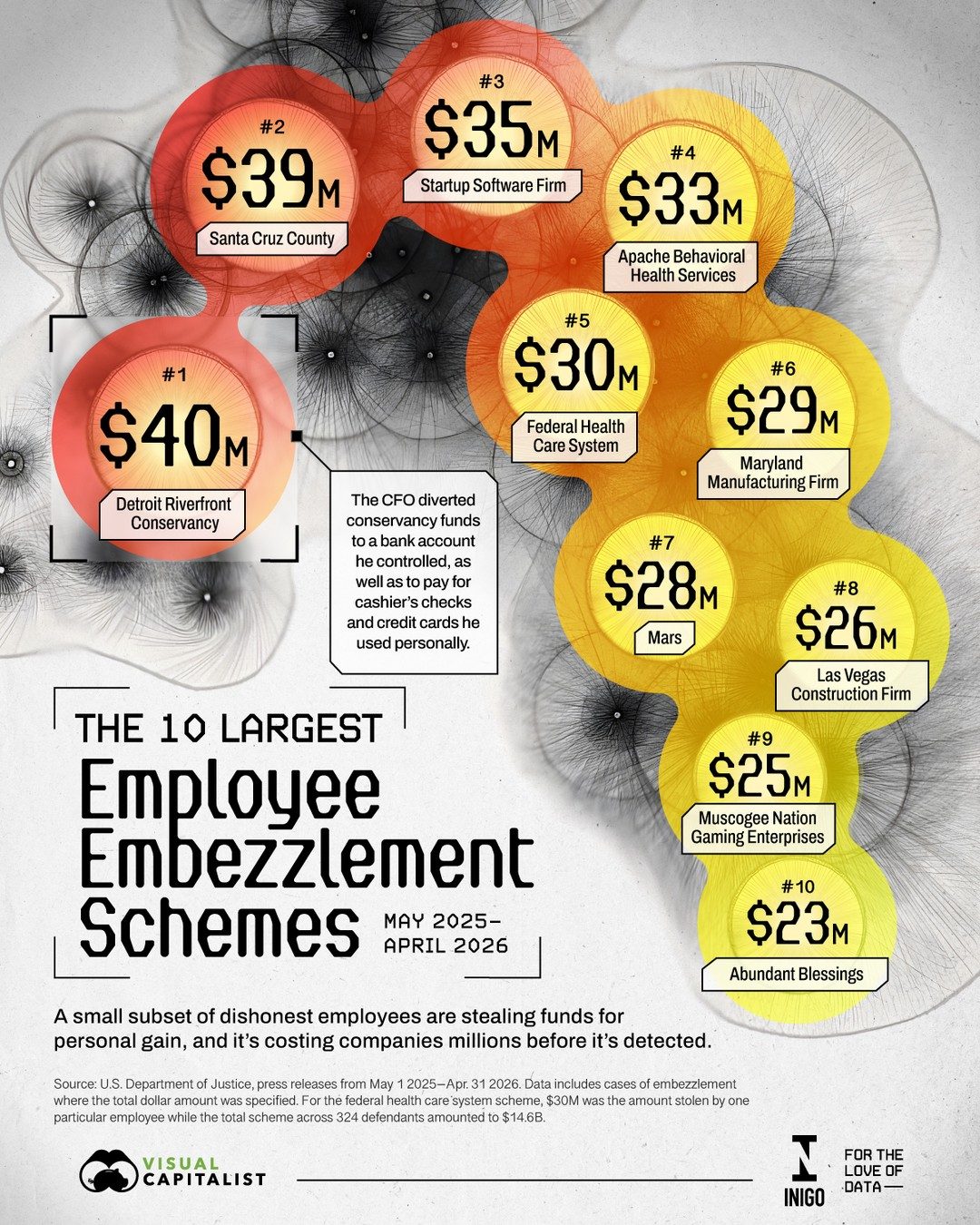
The infographic details the 10 largest employee embezzlement schemes from May 2025 to April 2026, showcasing the financial impact on various organizations. Here are the top schemes:
-
Detroit Riverfront Conservancy: A chief financial officer (CFO) diverted approximately $40 million from conservancy funds to a bank account he controlled and used for personal expenses, including cashier’s checks and credit cards.
-
Santa Cruz County: A scheme in Santa Cruz County resulted in the embezzlement of $39 million.
-
Startup Software Firm: The third-largest scheme involved a startup software firm with $35 million stolen.
-
Apache Behavioral Health Services: Approximately $33 million was embezzled from Apache Behavioral Health Services.
-
Federal Health Care System: $30 million was stolen in this scheme, while the total scheme involving 324 defendants amounted to $14.6 billion. The CFO diverted conservancy funds to a bank account he controlled, as well as to pay for cashier’s checks and credit cards he used personally.
-
Maryland Manufacturing Firm: A Maryland manufacturing firm faced an embezzlement of $29 million.
-
Mars: The global corporation Mars was targeted in an embezzlement scheme resulting in the loss of $28 million.
-
Las Vegas Construction Firm: A Las Vegas construction firm lost $26 million to embezzlement.
-
Muscogee Nation Gaming Enterprises: $25 million was embezzled from Muscogee Nation Gaming Enterprises.
-
Abundant Blessings: The final scheme in the top 10 list involved the embezzlement of $23 million from Abundant Blessings.
Methods of Embezzlement
Employee embezzlement schemes often involve intricate methods. The infographic highlights that a small subset of dishonest employees are stealing millions from companies for personal gain. Common tactics include:
- Fund Diversion: Funds are diverted to personal bank accounts controlled by the embezzler. -Diversion of conservancy funds to a bank account he controlled, as well as to pay for cashier’s checks and credit cards he used personally.
- Cashier’s Checks and Credit Cards: Embezzlers use cashier’s checks and credit cards for personal expenditures.
Financial Impact
The financial impact of embezzlement on companies can be catastrophic. It is not uncommon for these schemes to go undetected for years, allowing embezzlers to siphon off millions of dollars. The schemes listed in the infographic underscore the staggering amounts stolen, with the largest case involving $40 million. The cumulative financial loss across these top 10 schemes alone is in the hundreds of millions of dollars, demonstrating the significant monetary impact on organizations.
Practical Tips
To protect your organization from employee embezzlement, consider the following practical tips:
Implement Strong Internal Controls
- Segregation of Duties: Ensure that no single employee has control over all parts of any financial transaction. This reduces the risk of a single employee being able to embezzle funds without detection.
- Regular Audits: Conduct regular internal and external audits to identify and address any discrepancies in financial records. Regular audits can help detect embezzlement early, minimizing financial losses.
- Access Controls: Restrict access to financial systems and records to authorized personnel only. Implement strict access controls to prevent unauthorized access to sensitive financial information.
- Documentation: Maintain thorough documentation of all financial transactions and activities. Proper documentation can help trace the source of any discrepancies and identify potential fraud.
Employee Training and Awareness
- Training Programs: Conduct regular training programs to educate employees about the risks of embezzlement and the importance of ethical conduct. Training programs can help employees recognize the signs of embezzlement and understand the consequences of such actions.
Use Technology
- Fraud Detection Software: Implement fraud detection software to monitor financial transactions and identify any suspicious activities. Advanced analytics and machine learning algorithms can help detect patterns indicative of embezzlement.
- Real-Time Monitoring: Use real-time monitoring tools to track financial transactions and alert authorities of any unusual activities. Real-time monitoring can help prevent embezzlement by alerting organizations to potential issues as they occur.
Important Takeaways
- Detection is Critical: Early detection is crucial in minimizing the financial impact of embezzlement. Organizations must implement robust internal controls and monitoring systems to identify and address any discrepancies promptly.
- Training and Awareness: Regular training and awareness programs can help employees recognize the signs of embezzlement and understand the importance of ethical conduct. Training programs can also make potential embezzlers realize the risks of engaging in such activities.
- Financial Impact: Employee embezzlement can have a devastating financial impact on organizations, with losses often running into the millions of dollars. Organizations must take proactive measures to prevent and detect embezzlement to safeguard their financial well-being.
Conclusion
Employee embezzlement is a significant threat that can cause substantial financial losses for organizations. By understanding the methods and financial impact of these schemes, organizations can take proactive steps to protect themselves. Implementing strong internal controls, conducting regular audits, and using advanced technology can help detect and prevent embezzlement.
Watch the Reel
Questions readers ask
What are some common signs of employee embezzlement?
Some common signs of employee embezzlement include unexplained financial discrepancies, discrepancies in financial records, living beyond means, unusual behavior, and resistance to taking vacations or rotating duties. Employees may also exhibit excessive control over specific financial processes or resist internal audits.
How can organizations prevent employee embezzlement?
Organizations can prevent employee embezzlement by implementing strong internal controls, regular audits, and monitoring financial transactions. Encouraging a culture of transparency and ethical behavior, along with conducting thorough background checks during the hiring process, can also help deter potential embezzlers.
What should I do if I suspect an employee of embezzlement?
If you suspect an employee of embezzlement, it is crucial to document all suspicious activities and gather evidence. Notify your organization's legal counsel or human resources department immediately. Avoid confronting the suspected employee directly, as this could lead to the destruction of evidence or retaliation.
What measures can be taken to detect employee embezzlement early?
To detect employee embezzlement early, organizations should implement robust internal controls, such as segregation of duties, regular financial audits, and monitoring of financial transactions. Additionally, encouraging a whistleblower policy and providing training on identifying red flags can help detect and address embezzlement schemes promptly.
What are the most common types of embezzlement schemes?
The most common types of embezzlement schemes include skimming, where funds are stolen before they are recorded in the accounting system, and cash larceny, where funds are stolen after they have been recorded. Other schemes involve check tampering, forgery, and the creation of fictitious vendors or invoices to divert funds.
What was the largest employee embezzlement case in 2026?
The largest employee embezzlement case in 2026 involved the Detroit Riverfront Conservancy, where an employee embezzled $40 million. This case highlights the significant financial losses that can occur due to employee embezzlement, emphasizing the importance of strong internal controls and monitoring.
Recent articles
Fresh deep dives from the latest Reels we unpacked.




Comments
Be the first to comment.