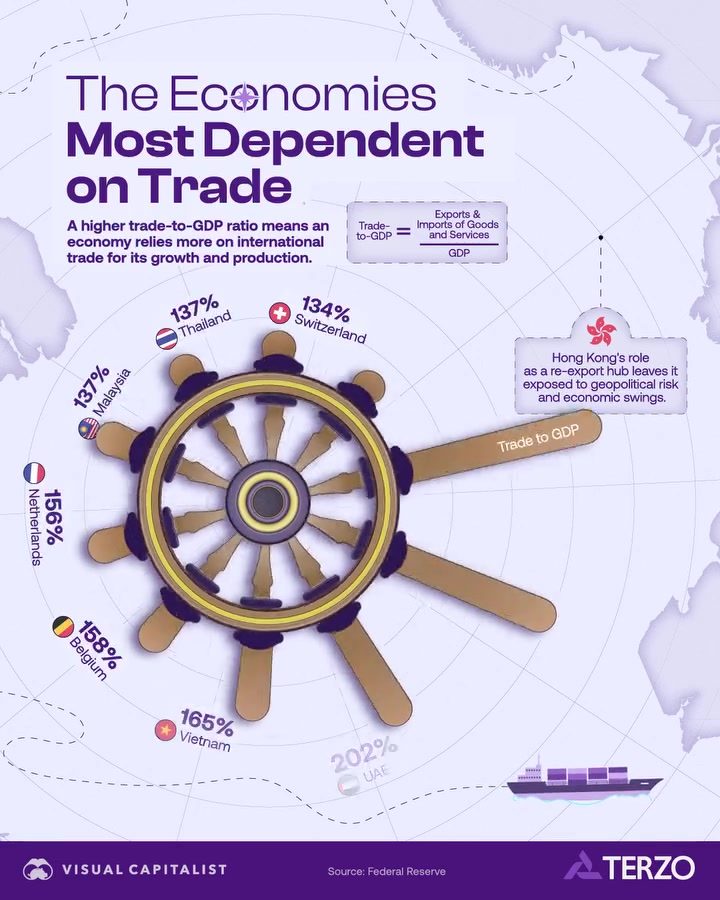
Economies Most Dependent on Trade
Trade is a lifeline for many economies, fueling growth and production. The recent escalation in trade tensions has raised critical questions about which countries and jurisdictions are most exposed to shifts in international trade. Understanding the trade-to-GDP ratio provides valuable insights into a country's reliance on trade. This ratio is calculated as the sum of a country's exports and imports of goods and services, divided by its Gross Domestic Product (GDP). A higher ratio indicates a greater dependence on international trade.
Context: Why this matters
In 2025, trade wars have heightened the importance of evaluating which economies are most vulnerable to these shifts. The impacts can ripple through global markets, affecting everything from supply chains to financial stability. Countries with high trade-to-GDP ratios are particularly at risk, as their economies are deeply intertwined with global trade dynamics.
Main discussion
Defining Trade-to-GDP Ratio
The trade-to-GDP ratio is a crucial metric for assessing a country's economic health and its exposure to international trade. It measures the total value of a country's exports and imports in relation to its GDP. Countries with high trade-to-GDP ratios often have economies that are highly integrated with global markets, making them more susceptible to fluctuations in international trade.
Highlighting the Most Affected Economies
Switzerland, a well-known hub for international trade, has a trade-to-GDP ratio of 134%. This indicates that the country's economy is heavily reliant on international trade for its growth and production. The high ratio suggests that any disruption in global trade could significantly impact Switzerland's economic stability.
Hong Kong: A Re-Export Hub
Hong Kong's role as a re-export hub makes it particularly vulnerable to geopolitical and economic shifts. As a re-export hub, Hong Kong facilitates the flow of goods between other countries, serving as a critical intermediary in global trade networks. However, this role exposes it to heightened risks from geopolitical tensions and economic fluctuations, which can disrupt supply chains and alter trade dynamics.
The Importance of Data Reliability
The data used in this analysis is sourced from the Federal Reserve, a reputable institution known for its economic insights. Reliable data sources are essential for accurate analysis and informed decision-making. As trade wars intensify, having access to credible data helps policymakers, investors, and businesses navigate the complexities of international trade.
Practical tips
Monitoring Trade-to-GDP Ratios
Regularly monitoring the trade-to-GDP ratios of key economies can provide early warnings about potential risks and opportunities. This information can help businesses and investors make informed decisions, such as diversifying their supply chains or adjusting their trade strategies.
Diversifying Trade Partners
For countries heavily reliant on international trade, diversifying trade partners can reduce the risks associated with geopolitical tensions and economic shifts. By spreading trade activities across multiple regions and countries, economies can mitigate the impact of disruptions in any single trade relationship.
Strengthening Domestic Production
Increasing domestic production can help insulate economies from the volatility of international trade. By enhancing local manufacturing capabilities, countries can reduce their dependence on foreign markets and improve their economic resilience.
Engaging in Global Trade Policies
Participating in global trade negotiations and policy discussions can provide a platform for countries to voice their concerns and collaborate on solutions that promote stable and predictable trade environments. Engaging in these dialogues can help mitigate the risks associated with trade wars and foster more cooperative international trade relationships.
Important takeaways
- The trade-to-GDP ratio is a key indicator of a country's reliance on international trade.
- High ratios, like Switzerland's 134%, suggest a significant dependence on trade for economic growth.
- Hong Kong's role as a re-export hub exposes it to geopolitical and economic risks.
- Reliable data from sources like the Federal Reserve is crucial for accurate analysis.
- Countries can mitigate risks by diversifying trade partners, strengthening domestic production, and engaging in global trade policies.
- Regular monitoring of trade-to-GDP ratios can provide valuable insights for informed decision-making.
Conclusion
In the face of escalating trade wars, understanding the economies most dependent on trade is crucial. Switzerland and Hong Kong, among others, demonstrate the vulnerabilities and complexities of relying heavily on international trade. By monitoring trade-to-GDP ratios, diversifying trade partners, strengthening domestic production, and engaging in global trade policies, countries can navigate these challenges more effectively. Staying informed and proactive will be essential as the global trade landscape continues to evolve.
Watch the Reel
Questions readers ask
What is the trade-to-GDP ratio and why is it important?
The trade-to-GDP ratio is a measure of a country's trade volume relative to its economic output. It is important because it indicates how reliant a country's economy is on international trade, making it a key indicator of vulnerability to trade tensions.
Which countries are most vulnerable to trade tensions based on their trade-to-GDP ratio?
Hong Kong and Switzerland are among the most vulnerable due to their high trade-to-GDP ratios, indicating a significant dependence on international trade.
How do trade tensions affect economies with a high trade-to-GDP ratio?
Economies with a high trade-to-GDP ratio are more susceptible to disruptions in global trade dynamics. Trade tensions can lead to decreased trade volumes, impacting economic growth and production.
What is the significance of the trade-to-GDP ratio in the context of trade wars?
The trade-to-GDP ratio helps identify which economies are most exposed to the impacts of trade wars. A higher ratio means a greater reliance on trade, making these economies more vulnerable to shifts in international trade policies.
How does the trade-to-GDP ratio help in understanding a country's economic vulnerabilities?
The trade-to-GDP ratio provides insights into a country's dependence on trade. A high ratio suggests that the country's economy is heavily reliant on international trade, making it more susceptible to global trade dynamics and potential disruptions.
Which economies are considered trade hubs and why are they at risk during trade tensions?
Economies like Hong Kong and Switzerland act as trade hubs due to their substantial trade volumes. During trade tensions, these economies are at risk because disruptions in global trade can significantly impact their economic activities and growth.
What are the potential impacts of trade tensions on global markets?
Trade tensions can ripple through global markets, causing fluctuations in trade volumes and affecting various sectors. This can lead to economic instability and uncertainty, particularly for countries with high trade-to-GDP ratios that rely heavily on international trade.
Recent articles
Fresh deep dives from the latest Reels we unpacked.




Comments
Be the first to comment.