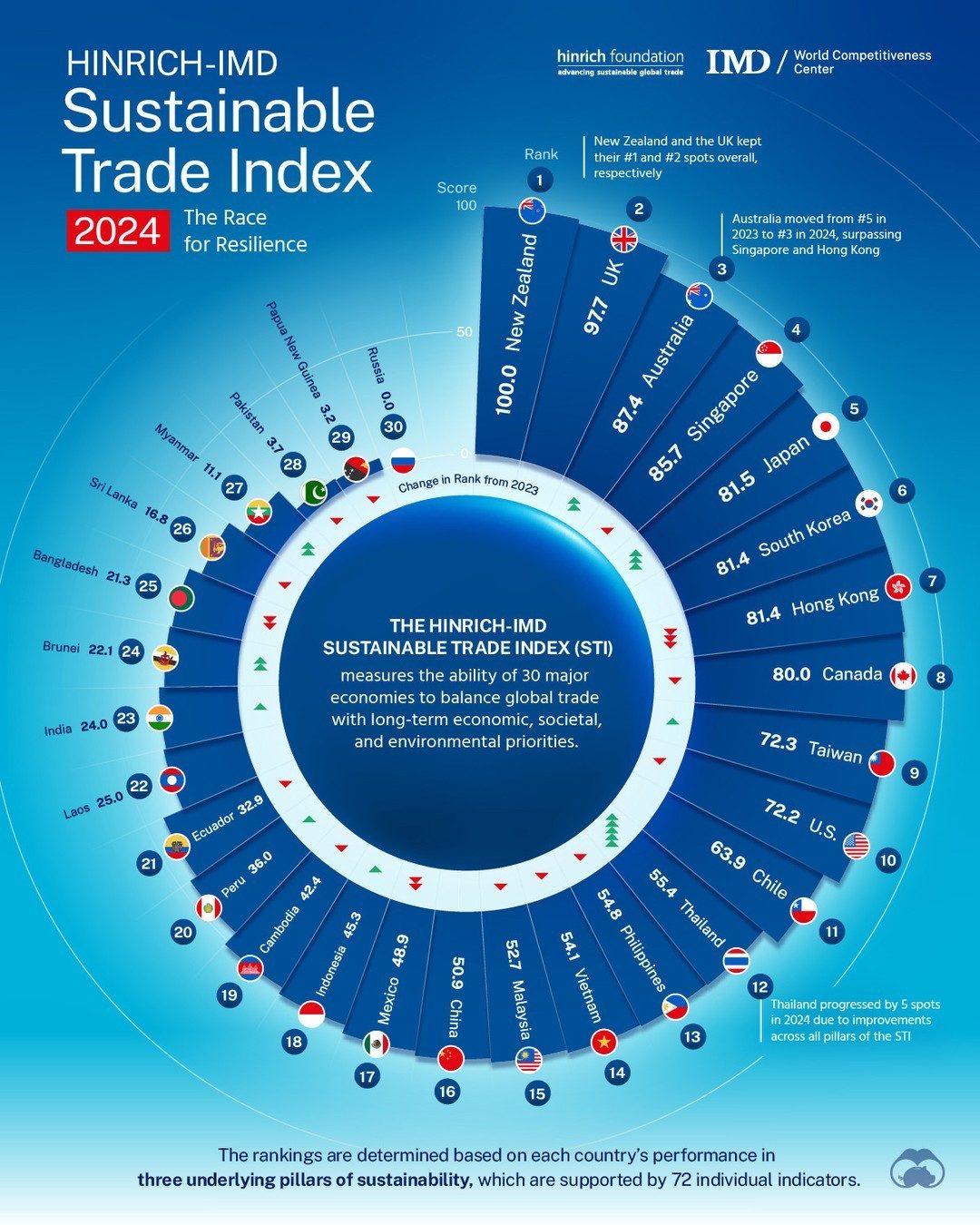
Sustainable Trade Index 2024
This year, the Sustainable Trade Index (STI) 2024, compiled by the Hirnich Foundation, highlights the global leaders in sustainable trade. New Zealand and the UK maintain their top spots, emphasizing their commitment to balancing economic growth with societal and environmental priorities. The index ranks 30 major economies across three key pillars: Economic, Societal, and Environmental.
Why this matters
Understanding the Sustainable Trade Index (STI) is crucial for recognizing which countries are leading the way in sustainable practices. As nations strive to achieve a balance between trade, economic stability, and environmental conservation, the STI helps identify the most resilient economies. This balance is vital for ensuring long-term economic stability, social progress, and environmental preservation in a world increasingly focused on sustainability and ethical trade.
Main discussion
Economic Pillar
The Economic Pillar evaluates an economy's ability to foster growth through international trade. Factors considered include government debt-to-GDP ratios, tariff barriers, and overall economic resilience. Countries excelling in this pillar demonstrate strong trade policies and financial stability. New Zealand and the UK's high rankings reflect their robust economic frameworks and strategic trade agreements.
Countries that perform well in the Economic Pillar are often those with stable financial systems, effective trade policies, and low levels of government debt. These factors contribute to an economy's ability to sustain growth and promote international trade. Australia's jump from #5 in 2023 to #3 in 2024 highlights its significant improvements in economic resilience and trade strategies, surpassing Singapore in the process.
Societal Pillar
The Societal Pillar focuses on the development of human capital. Metrics such as life expectancy, education levels, and universal health coverage are critical indicators. Countries that score high in this pillar invest heavily in their citizens' well-being, ensuring a healthy and educated workforce. This investment is crucial for long-term economic growth and social stability.
Top-performing countries in the Societal Pillar prioritize social welfare, education, and healthcare. For instance, New Zealand and the UK's high rankings in this pillar reflect their well-developed social systems, which contribute to a high standard of living and a more productive workforce.
Environmental Pillar
The Environmental Pillar assesses an economy's commitment to mitigating environmental impacts. Metrics include CO2 emissions, natural resource management, and renewable energy adoption. Countries excelling in this pillar demonstrate a strong commitment to environmental sustainability, which is essential for preserving natural resources and mitigating climate change.
Economies that rank highly in the Environmental Pillar are often leaders in adopting sustainable practices. They focus on reducing carbon emissions, promoting renewable energy, and implementing policies to protect natural resources. For example, New Zealand's top ranking underscores its efforts in environmental conservation and sustainable resource management. The UK follows closely, showcasing a strong commitment to environmental sustainability.
Practical tips
For businesses and economists looking to align with sustainable trade practices, it's crucial to understand the key metrics used in the STI. Here are some practical tips for improving performance in each pillar:
Economic Strategies
- Trade Agreements: Negotiate favorable trade agreements to reduce tariff barriers and enhance economic resilience.
- Debt Management: Implement policies to manage government debt effectively, ensuring long-term financial stability.
- Financial Regulations: Establish robust financial regulations to safeguard economic growth and stability.
Societal Investments
- Education and Healthcare: Invest in education and healthcare to develop a skilled and healthy workforce.
- Social Welfare: Implement social welfare programs to enhance the quality of life for citizens, promoting long-term growth and stability.
Environmental Practices
- Renewable Energy: Transition to renewable energy sources to reduce carbon emissions and environmental impact.
- Resource Management: Implement sustainable resource management practices to preserve natural resources for future generations.
- Regulatory Frameworks: Develop and enforce environmental regulations to mitigate environmental risks and promote sustainable practices.
Important takeaways
The Sustainable Trade Index 2024 underscores the importance of balancing trade with long-term economic, societal, and environmental priorities. New Zealand and the UK lead the way, demonstrating effective strategies in all three pillars. Countries like Australia, which have made significant improvements, show that progress is possible with the right policies and investments.
Economies that prioritize sustainable trade practices not only foster long-term growth but also contribute to global efforts in environmental conservation and social welfare. The STI serves as a valuable benchmark for countries and businesses aiming to align with sustainable practices, promoting a more resilient and equitable global economy.
Conclusion
The Sustainable Trade Index 2024 emphasizes the need for a holistic approach to trade, balancing economic growth with societal and environmental priorities. By examining the key pillars and understanding the metrics used, countries and businesses can work towards achieving sustainable trade practices. New Zealand, the UK, and other top-performing economies provide valuable lessons in effective trade strategies, social investments, and environmental conservation. For those aiming to align with sustainable practices, the STI offers a roadmap to building a resilient and equitable global future.
Watch the Reel
Questions readers ask
Which countries are at the top of the Sustainable Trade Index 2024?
New Zealand and the UK hold the top positions in the Sustainable Trade Index 2024, demonstrating their strong commitment to balancing economic growth with societal and environmental sustainability.
What are the key pillars measured in the Sustainable Trade Index 2024?
The Sustainable Trade Index 2024 evaluates 30 major economies based on three key pillars: Economic, Societal, and Environmental. These pillars help assess how countries integrate sustainability into their trade practices.
What is the significance of the Sustainable Trade Index 2024?
The Sustainable Trade Index 2024 is important for identifying nations that excel in balancing economic stability, environmental conservation, and societal responsibility, helping to guide global sustainable trade practices.
How does New Zealand rank in sustainable trade?
New Zealand is a top performer in the Sustainable Trade Index 2024, highlighting the country's comprehensive approach to sustainability in trade, encompassing economic growth, societal well-being, and environmental stewardship.
What does the UK's top ranking in the Sustainable Trade Index 2024 indicate?
The UK's top ranking in the 2024 Sustainable Trade Index signifies its strong policies and practices in sustainable trade, showing a commitment to integrating environmental and societal factors into its economic strategy.
What factors are considered in evaluating sustainable trade practices in 2024?
The Sustainability Trade Index 2024 considers a range of factors, including economic stability, environmental trade practices, and societal responsibility, to determine how resilient and sustainable a country's trade practices are.
How does the Sustainable Trade Index 2024 help in recognizing sustainable economies?
The Sustainable Trade Index 2024 helps in identifying resilient economies that effectively balance trade with environmental and societal goals, offering insights for global policy making and sustainability initiatives.
Related deep dives
Similar reads based on topic and creator.


Recent articles
Fresh deep dives from the latest Reels we unpacked.




Comments
Be the first to comment.