Oil Production in 2023: The Global Landscape
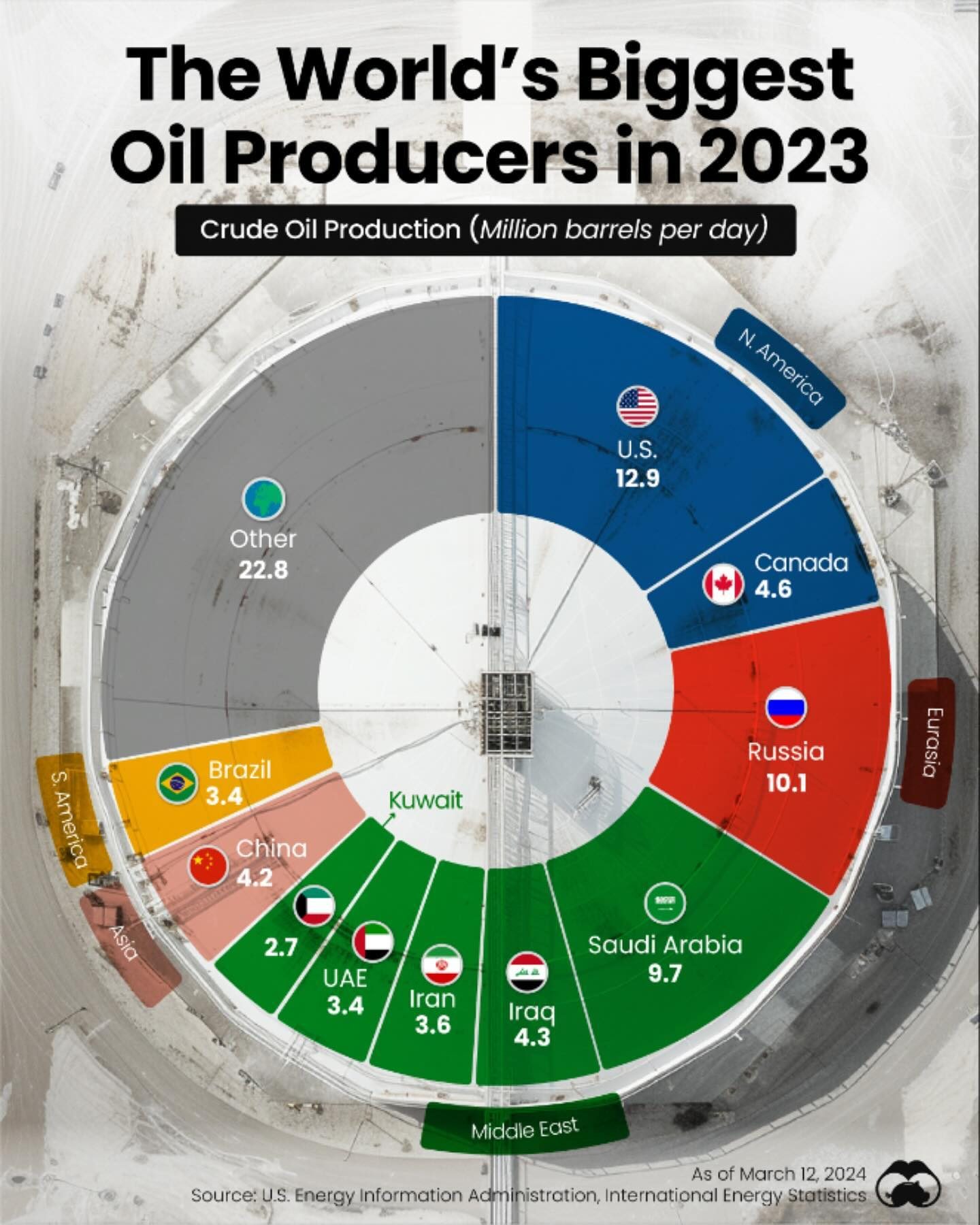
Crude oil remains a cornerstone of the global energy landscape. In 2023, the U.S., Russia, and Saudi Arabia were the top producers, collectively accounting for 40% of the world's total oil production. This dominance in oil production gives these countries significant economic and political influence, even as the world pushes towards a decarbonized future.
Why This Matters
Oil is still crucial for many industries, including transportation, manufacturing, and energy generation. The countries that produce the most oil hold substantial economic power due to the high demand and limited supply of this resource. Understanding the distribution of oil production is essential to grasping the broader geopolitical landscape and future energy trends.
The Top Oil Producers in 2023
Leading the Pack
The United States leads the global oil production, churning out an impressive 12.9 million barrels per day. This makes the U.S. the world's largest oil producer, surpassing both Russia and Saudi Arabia. The country's robust oil and gas industry, combined with technological advancements in extraction methods, has greatly contributed to this achievement. Russia follows closely with 10.1 million barrels per day. The country's vast reserves and state-controlled energy sector play a significant role in maintaining this high level of production. Saudi Arabia is a close third, producing 9.7 million barrels per day. As a founding member of OPEC (Organization of the Petroleum Exporting Countries), Saudi Arabia’s influence in the global oil market is substantial. The country's massive Ghawar Field, one of the world's largest oil fields, contributes significantly to its production capabilities.
The Middle East
The Middle East is a hotbed of oil production, with several key players contributing to global output.
Iraq, with 4.3 million barrels per day, is a major player in the region. Despite ongoing political instability, Iraq's oil production has remained robust. Iran, producing 3.6 million barrels per day, also holds a significant position. However, international sanctions have limited Iran’s oil exports, affecting its economic leverage. Kuwait and the United Arab Emirates (UAE) each produce 3.4 million barrels per day. Both countries are known for their strategic investments in diversifying their economies and have invested heavily in the technology and infrastructure to enhance their oil production.
Brazil, which produced 3.4 million barrels per day in 2023, is a significant contributor to global oil supplies. The country’s offshore fields, particularly those in the pre-salt layer, have been critical in boosting production. China, producing 2.7 million barrels per day, is a dominant force in the Asian region. As the world's largest oil importer, China's production efforts are driven by a need to reduce reliance on foreign oil and secure domestic energy needs.
Other Notable Producers
Canada, with 4.6 million barrels per day, is a significant oil producer, particularly in the realm of unconventional oil. Its oil sands are a critical source of heavy crude oil, which can be processed into lighter oil products. The "Other" category, which accounts for 22.8 million barrels per day, includes various countries and smaller producers that collectively contribute to global oil supplies.
Oil Production by Region
North America
North America, led by the U.S. and Canada, is a dominant region in global oil production. The U.S. has seen a surge in production due to advancements in hydraulic fracturing and horizontal drilling, which have unlocked vast reserves of shale oil and gas. Canada's oil sands, particularly in the province of Alberta, have also been a significant contributor. The region's strong regulatory environment and technological innovation have been key drivers of its success.
Middle East
The Middle East, home to some of the world's largest oil reserves, continues to be a powerhouse in global oil production. Countries like Saudi Arabia, Iraq, and Iran have vast reserves and the infrastructure to support high levels of production. Despite regional conflicts and political tensions, the Middle East remains a critical player in the global oil market.
South America
South America, with Brazil as its leading producer, is a growing force in the global oil industry. Brazil's pre-salt fields, discovered in the early 2000s, have significantly boosted its production capabilities. The country's strategic investments in technology and infrastructure have been instrumental in harnessing these resources.
Asia
China is the leading oil producer in Asia, with significant investments in both exploration and production. The country’s domestic production efforts are driven by a need to reduce its reliance on imported oil and secure energy sustainability.
Practical Tips for Understanding Global Oil Production
Stay Informed with Reliable Sources
To stay informed about global oil production, it's essential to rely on credible sources such as the U.S. Energy Information Administration (EIA). The EIA provides comprehensive and up-to-date data on global oil production, consumption, and reserves.
Monitor Geopolitical Developments
Geopolitical trends and events significantly impact the global oil market. Staying aware of political stability, international relations, and economic policies in key oil-producing countries can help in understanding shifts in production and supply.
Analyze Market Trends
Understanding market trends and forecasts can provide valuable insights into future oil production. Factors such as technological advancements, regulatory changes, and economic conditions play a crucial role in shaping the oil market. Analyzing these trends can help in predicting future supply and demand dynamics.
Important Takeaways
- The U.S., Russia, and Saudi Arabia are the top oil producers, accounting for 40% of global production in 2023. These countries hold significant economic and political influence due to their oil production capabilities.
- The Middle East, North America, and South America are the leading regions in global oil production, each with unique strengths and challenges.
- Staying informed with credible sources, monitoring geopolitical developments, and analyzing market trends are crucial for understanding the global oil landscape.
- The U.S. leads global oil production, followed by Russia and Saudi Arabia.
- The "Other" category, which includes various smaller producers, accounts for a substantial portion of global oil production.
Conclusion
Oil production remains a critical component of the global energy landscape, with the U.S., Russia, and Saudi Arabia leading the charge. Understanding the distribution of oil production and the factors influencing it is essential for navigating the complex geopolitical and economic dynamics of the world. By staying informed and analyzing market trends, one can gain valuable insights into the future of global oil production and its impact on the world.
Watch the Reel
Questions readers ask
Who are the top three crude oil producers in 2023?
The top three crude oil producers in 2023 are the United States, Russia, and Saudi Arabia. These countries lead global crude oil production, collectively responsible for 40% of the world's total output.
What is the significance of global crude oil production distribution in 2023?
The distribution of global crude oil production in 2023 shapes geopolitical dynamics and influences future energy trends. Countries with high oil production hold substantial economic and political power due to the high demand for this resource.
How much crude oil does the U.S. produce daily in 2023?
The U.S. is the world's largest crude oil producer in 2023. The country produces around 18.9 million barrels of oil per day, nearly 20% of the global total.
Which countries are among the world's largest oil producers besides the top three?
Besides the U.S., Russia, and Saudi Arabia, other major oil producers in 2023 include Canada, Iran, and Iraq. These countries play a significant role in the global oil market, contributing millions of barrels of oil per day.
How does Canada's oil production compare to other top producers in 2023?
Canada is the world's fourth-largest oil producer in 2023, with an average daily production of around 5.5 million barrels of oil. This places it behind the top three producers: the U.S., Russia, and Saudi Arabia.
What is the approximate daily oil production of Saudi Arabia in 2023?
Saudi Arabia, one of the top crude oil producers in 2023, produces around 11.6 million barrels of oil per day. This significant output contributes to the country's economic and political influence in the global energy landscape.
Why is understanding crude oil production by country important in 2023?
Understanding crude oil production by country in 2023 is important because it provides insights into geopolitical dynamics, global energy trends, and economic power shifts. The distribution of oil production among nations helps predict future energy trends and understand the balance of power in the international arena.
Related deep dives
Similar reads based on topic and creator.




Recent articles
Fresh deep dives from the latest Reels we unpacked.




Comments
Be the first to comment.