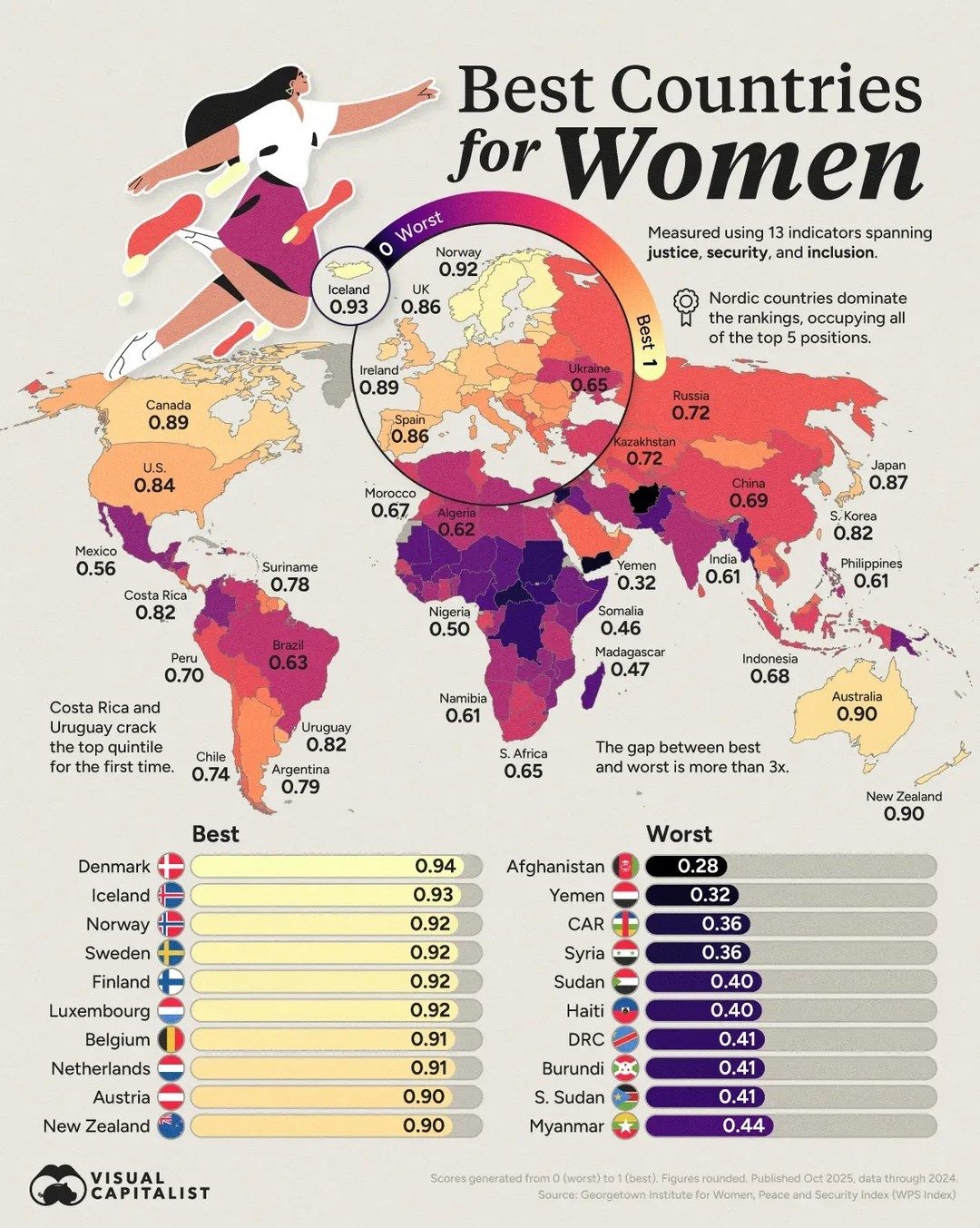
Best Countries for Women
Denmark is the best country for women, according to the 2025/26 Women, Peace, and Security (WPS) Index from the Georgetown Institute for Women, Peace, and Security. Nordic countries dominate the rankings, occupying all five of the top spots, while Afghanistan remains the lowest-ranked country. Costa Rica and Uruguay have made notable strides, entering the top global quintile for the first time. This ranking evaluates 179 countries and territories based on 13 indicators related to justice, security, and inclusion.
Why This Matters
The WPS Index provides a comprehensive assessment of the conditions women face worldwide. By evaluating factors such as poverty, health, education, and political participation, the index offers a holistic view of women's well-being and empowerment. Understanding these rankings can help identify areas where progress has been made and where further efforts are needed.
Nordic Dominance and Global Trends
Nordic Countries: Setting the Standard
Iceland, Norway, Sweden, Finland, and Denmark dominate the top five positions. These countries are recognized for their strong social welfare systems, gender equality policies, and robust institutions. They consistently score high in areas such as economic participation, education, and health.
Iceland, in particular, stands out for its leadership in gender equality. The country has implemented policies that promote equal pay, parental leave, and women's representation in politics. Norway and Sweden follow closely, with comprehensive systems supporting women's rights and inclusion.
Afghanistan and the Global Struggle
Afghanistan, Yemen, and Syria rank at the bottom of the index. These countries face significant challenges, including conflict, instability, and a lack of basic services. The low rankings reflect the severe impact of these issues on women's lives, particularly in areas of security, justice, and economic opportunities.
Latin American Progress
Costa Rica and Uruguay entering the top global quintile is a significant milestone. The progress in these countries highlights the potential for positive change in Latin America. Both nations have made strides in areas such as education, health, and women's political representation, demonstrating how targeted policies can drive meaningful improvements. Their success serves as a model for other countries in the region looking to enhance women's rights and overall well-being.
Key Indicators
Justice
Justice indicators assess the fairness and effectiveness of legal systems and institutions. Countries with strong legal frameworks and access to justice tend to score higher in this category. For example, women in Nordic countries have greater access to legal protections and support systems. Conversely, countries with weak legal systems and high levels of corruption struggle to ensure justice for women.
Security
Security indicators evaluate the presence of violence, conflict, and personal safety. Nordic countries excel in this area, with low crime rates and robust public safety measures. In contrast, countries like Afghanistan and Syria face significant security challenges, making it difficult for women to lead safe and secure lives.
Inclusion
Inclusion indicators measure women's participation in society, including political representation, economic opportunities, and social cohesion. Nordic countries lead in this area, with high levels of women's representation in politics and the workforce. This inclusion fosters a more equitable and inclusive society, benefiting both men and women.
Important Takeaways
This ranking underscores the importance of comprehensive policies and strong institutions in promoting women's rights and well-being. Nordic countries serve as a model for other nations, demonstrating how investments in social welfare, gender equality, and inclusion can drive progress. Meanwhile, the challenges faced by countries at the bottom of the ranking highlight the urgent need for targeted interventions and support.
Conclusion
The 2025/26 WPS Index provides a critical look at the status of women worldwide, identifying both success stories and areas for improvement. By focusing on key indicators such as justice, security, and inclusion, the index offers a roadmap for creating more equitable and inclusive societies. As we move forward, it is crucial to build on the progress made and address the persistent challenges that continue to affect women's lives.
Watch the Reel
Questions readers ask
Which countries are the top five in the 2025 ranking for women?
The top five countries in the 2025 ranking for women are all Nordic nations with Denmark at the top, followed by the other Nordic countries in the subsequent positions.
What makes the Nordic countries stand out in global rankings for women?
Nordic countries stand out due to their strong performance in indicators related to justice, security, and inclusion. These nations consistently rank high in measurements of women's well-being, equality, and safety.
How does the Women, Peace, and Security (WPS) Index evaluate countries?
The WPS Index evaluates 179 countries and territories based on 13 indicators. These indicators focus on justice, security, and inclusion, providing a comprehensive view of the conditions women face globally.
Which countries have shown significant improvement in the 2025 ranking?
Costa Rica and Uruguay have made notable strides, entering the top global quintile for the first time. This improvement reflects their progress in areas such as political participation, health, and economic opportunities for women.
Why is Afghanistan at the bottom of the 2025 ranking for women?
Afghanistan remains at the bottom due to challenges related to conflict, women's rights, and overall well-being. The country faces significant issues with poverty, health, and security, which impact women's lives negatively.
What factors are considered in the WPS Index for the ranking of countries?
The WPS Index considers factors such as poverty, health, and political participation. These factors provide a holistic view of women's well-being and equality in society, helping to determine the best countries for women globally.
How do the rankings reflect women’s rights and equality in different regions?
The rankings reflect the varying degrees of gender equality and women's rights across different regions. Nordic countries excel due to their strong policies and societal norms that support women's inclusion and security, while countries in conflict face significant challenges.
Recent articles
Fresh deep dives from the latest Reels we unpacked.




Comments
Be the first to comment.